


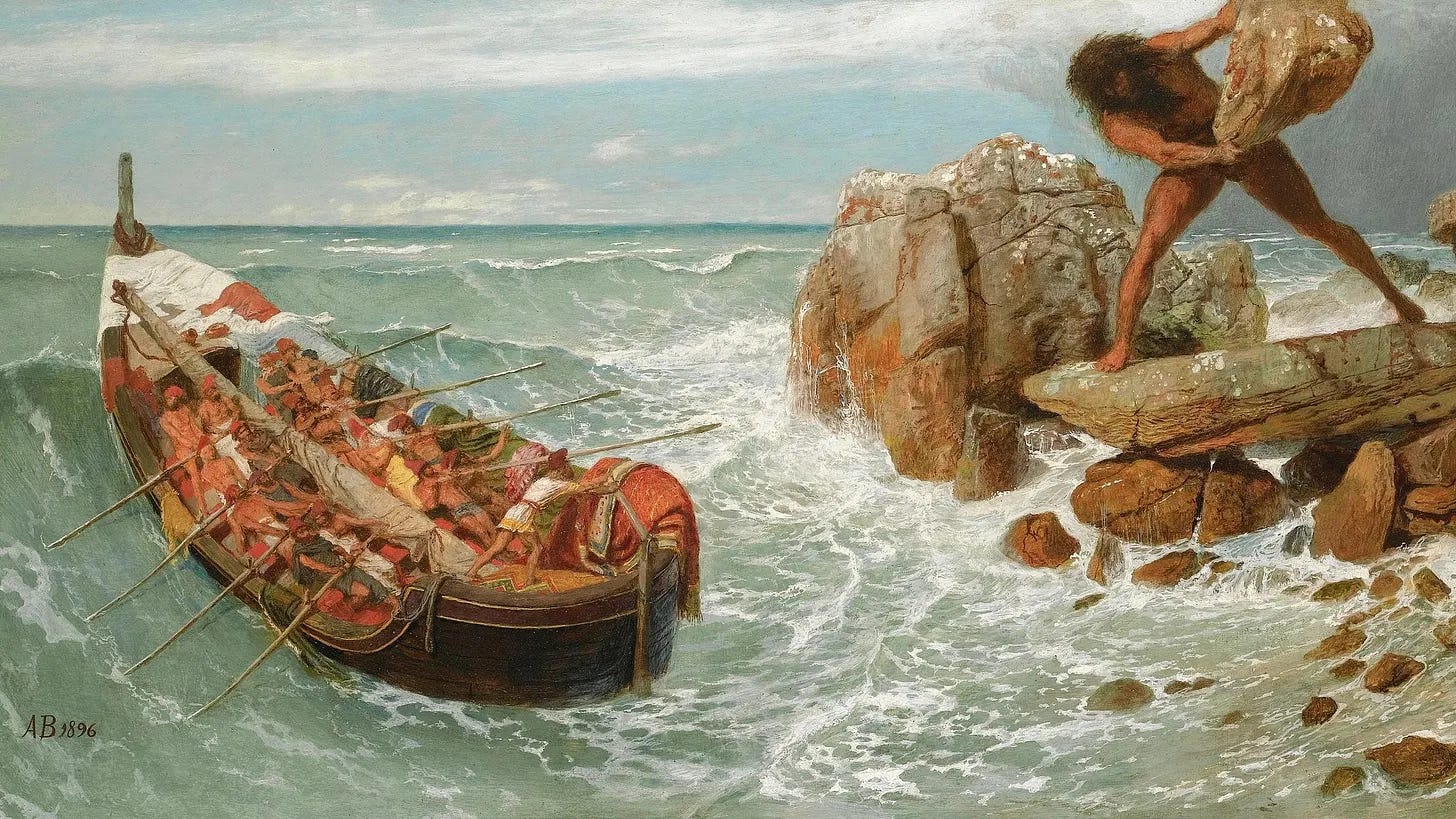
Why should you read the Odyssey in 2026?
Because it is not just an ancient poem—it is “our story.”
Homer’s epic opens with a single word: “man.” From that moment, Odysseus becomes every one of us—wrestling with fate and free will, clinging to the sacred idea of home, choosing his humanity over divine immortality, and learning what the gods will demand of him to rectify the injustice that consumes his house.
This isn’t dusty literature (nor something malleable to modern man’s ideologies).
It’s the fountainhead of Western civilization, the poetic training ground for Plato, and a surprising preparation for the coming of the Christ.
Here are 10 reasons to read the Odyssey.
Reminder: you can support our mission and get all our members-only content for just a few dollars per month:
New, full-length articles every Tuesday and Friday
The entire archive of members-only essays
Access to our paid subscriber chat room
The Odyssey is certainly worth your time. Here are ten general reasons why this epic by Homer merits your time and attentive. And see below for how you can read it with a group!
10. The Story of Humanity
You read the Odyssey to better understand the nature of man. You should take seriously that the very first word of the Odyssey in the Greek is “man.” Odysseus is in many ways a representative of man and his story is our story. In fact, when Homer invokes the Muses at the beginning of the text to help him sing the story of Odysseus, he asks the Muses to sing of “our story too”—the story of man. As such, the Odyssey is a deeply anthropological tale that weaves together perennial questions about the human condition, like free will, fate, justice, home, place, and the divine.
9. The Question of Fate & Free Will
You read the Odyssey to explore the tension of fate and free will. Though the Iliad is often read as a deeply fatalistic text, the Odyssey is often praised for exploring the agency of man. In fact, in the beginning of the text, Zeus defends the gods and blames the misery of man upon man’s own poor choices. But, to what degree are Zeus and fate separate? At times Zeus seems to be the caretaker of fate, shepherding all things according to a providential pattern; yet, at other times, fate seems to be the alter ego of Zeus, another persona of the king of gods and men. The Odyssey presents these in tension and, in the tension, has you explore perennial questions about free will, fate, and the divine.
8. In Praise of Arete (Virtue)
You read the Odyssey to understand the arete of men (and women). In the Iliad, arete, the excellence of men, is usually reserved for military prowess and skill in combat; yet, in the Odyssey, human excellence takes on a more robust, intellectual character. Odysseus is a man of military might, but he’s also a man of resilience, cleverness, and perseverance. Moreover, Homer uses the term arete to describe Odysseus’ wife, Penelope, who is certainly not a warrior but a clever, faithful woman. Homer is at the beginning of the virtue tradition, and the concept of arete in the Iliad and Odyssey deserves special consideration. What does it mean to be a good man?
7. Understanding Guest-Friendship (Xenia)
You read the Odyssey to explore guest-friendship. The concept of xenia or guest-friendship is a sacred ritual overseen by Zeus in which the stranger is welcomed, bathed, and feasted before he is even asked his name; and, in reciprocity, the guest usually tells his story. The host gives gifts and helps the guest on his way. The ritual is a sign of civilization, and violations of it are sacrilegious—and deserve swift punishment. Xenia permeates the stories of the Odyssey. It also makes for a wonderful parallel to the Bible, like with Abraham and the three strangers (Gen 18:1-15) or St. Paul’s comment that those who host strangers sometimes entertain angels unknowingly (Hebrews 13:2). Hospitality is central to Western thought, and Homer is an indispensable teacher on the subject.
6. Homer the Philosopher
You read the Odyssey to better understand Plato. Homer is not a dull echo of his age. Too often, Homer is seen as some passive collector of oral traditions who simply regurgitates them into a flat narrative. No, Homer is a teacher. He is a philosopher. He is very intentional in his writing and presents concepts and characters in tension—and this tension creates a “poetic dialectic.” In other words, the tension or layers of the text mimics the effect of dialogue—it gives contrasting views that, if contemplated, lead you to a perennial truth. Homer has a philosophy on the human person and his place in the cosmos—if you are willing to listen. It is arguably where Plato learned the art of dialectic.
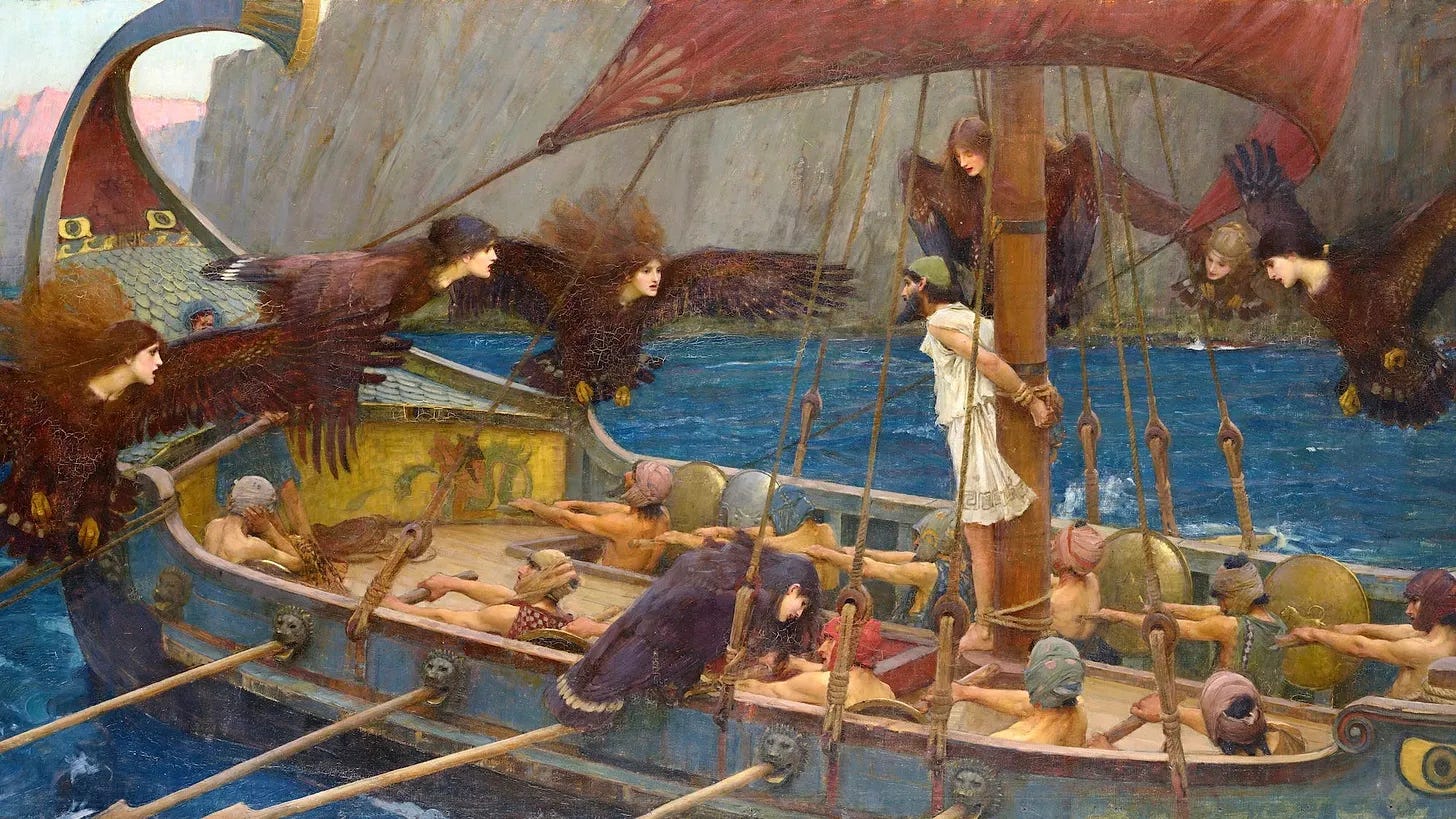
5. The Coming Home Story
You read the Odyssey for the coming home story of Odysseus. It is a tale of perseverance, glory, and place. One of the most important passages of the entire text is Odysseus refusing to become a god. He declines an immortal life of pleasure with a beautiful goddess. Why? In another passage, he declines to marry a princess and rule over a utopian island blessed by the gods and filled with wondrous technologies. Why? In Odysseus’ journey home, Homer offers you an insight into the nature of man and the importance of place—and he offers you a moral read, i.e., what decision would I make and why?
4. The Coming of Age Story
You read the Odyssey to understand how a boy becomes a man. Often overshadowed by the coming home story, the coming of age story of Telemachus, Odysseus’ son, is a powerful template of maturation. In King Odysseus’ absence, his house is filled with suitors wooing his wife and consuming his goods—Telemachus, the boy, is not a threat to them. Yet, Telemachus must become a threat to this injustice. He must overcome his fatherlessness and become a man who can regain his father’s house. Telemachus has his own odyssey in which he finds his spiritedness, his thumos.
3. Beginning of the Great Books
You read the Odyssey because Homer is the beginning of the great conversation. The so-called “great books” are the most influential texts in Western civilization—and they start with the Iliad and the Odyssey. The great books are great because they engage in the perennial questions of the human condition like free will, the soul, virtue, politics, and the divine. Homer, the teacher, is the beginning of these perennial discussions—save for the Bible. And you must understand that the authors of the great books are all in conversation with one another, as Plato is in dialogue with Homer, and Aristotle is in dialogue with both. As such, you read Homer to enter into this great conversation on the human drama.
2. Understanding Western Civilization
You read the Odyssey to understand the identity of the West. Western culture is downstream from Homer. He plays an unrepeatable role in Western identity, and he is ubiquitous throughout the ages of Western philosophy and literature. The rage of Achilles, the piety of Hector, and the wit of Odysseus serve as constant reference points for exploring the truth of the human condition in the Western mind. Though Homer may seem foreign at first, reading him is like coming home—you see the first conversations that led to the world you inherited. You read the Odyssey to understand yourself and your world better.
1. Homer as a Forerunner to Christ
You read the Odyssey to better understand the reality of Christ. Greek reason coupled with Hebrew faith under Roman order prepared the world for Jesus Christ. As St. Paul teaches, Christ came in the “fullness of time.” The Incarnation is not an accident but an intentional act for which Providence prepared the world—and Greek culture played a large part of that cultivation. The first Old Testament canon, the Septuagint (250 BC), is written in Greek. The New Testament is written in Greek. St. Paul quotes from Greek poets and philosophers (Acts 17:28; 1 Cor 15:33; Titus 1:12). St. John uses a multifaceted but rich Greek philosophical word, logos, to describe the Second Person of the Blessed Trinity (John 1:1). In other words, Hellenistic language—and with it Greek thought—is imprinted on Christianity (and on Judaism before it). To best understand that Greek imprint, you start with the fountainhead of Greek thought: Homer.
PS: Read the Odyssey Now!
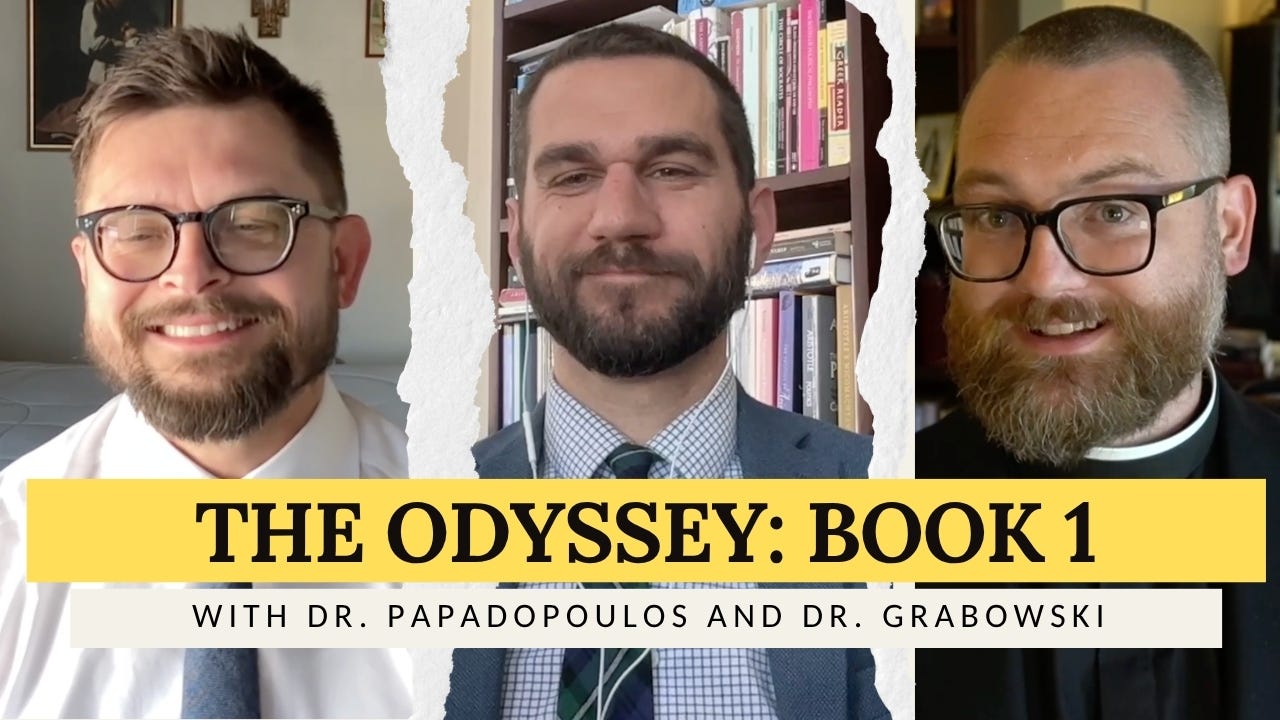
Our friends over at Ascend: The Great Books Podcast are hosting a FREE 12-week study of the Odyssey with professors from around the country. Check it out on Youtube, Apple Podcast, Spotify, and more. Not too late to join!
Dcn. Harrison Garlick is a deacon, husband, father, Chancellor, and attorney. He lives in rural Oklahoma with his wife and five children. He is also the host of Ascend: The Great Books Podcast. Follow him on X at Dcn. Garlick or Ascend.
Thank you for this piece! Excellent.
Is there a particular translation you prefer?