


Dear Ascend Book Club Members,
The Phaedo is a beautiful but complicated dialogue. It captures the final hours of Socrates where he discusses the immortality of the soul and faces death with unparalleled courage and philosophical clarity. I am indebted to Dr. Christopher Frey whose insights and commentary helped to illuminate the beauty of Plato’s thought in this dialogue. Our conversation, as with this guide, covers the prologue—which has a deep parallel to the myth of Theseus—and then the various arguments for the immortality of the soul.
Join our reading group and study the great books with us!
To support our mission and get all our resources, become a paid book club member. In addition to the weekly podcast, you’ll get:
Live book club discussions with Dcn. Garlick & guest scholars (monthly)
In-depth reading guides and essays to lead you through the great books
Access to our incredible community of readers
The full archive of members-only content (guides, essays, and podcasts)
The Phaedo explores several enduring themes. Central is the soul’s immortality, argued through four key arguments—cyclical, recollection, affinity, and final cause—which wrestle with the mystery of life and death. Moreover, the Phaedo raises many questions about the role of the body. Does Socrates hold the body to be an evil, a prison of the soul, or are his comments simply a realistic commentary on the challenges being embodied brings to the pursuit of truth? The Phaedo has many comments on the body, but also many lessons subtly woven into the drama.
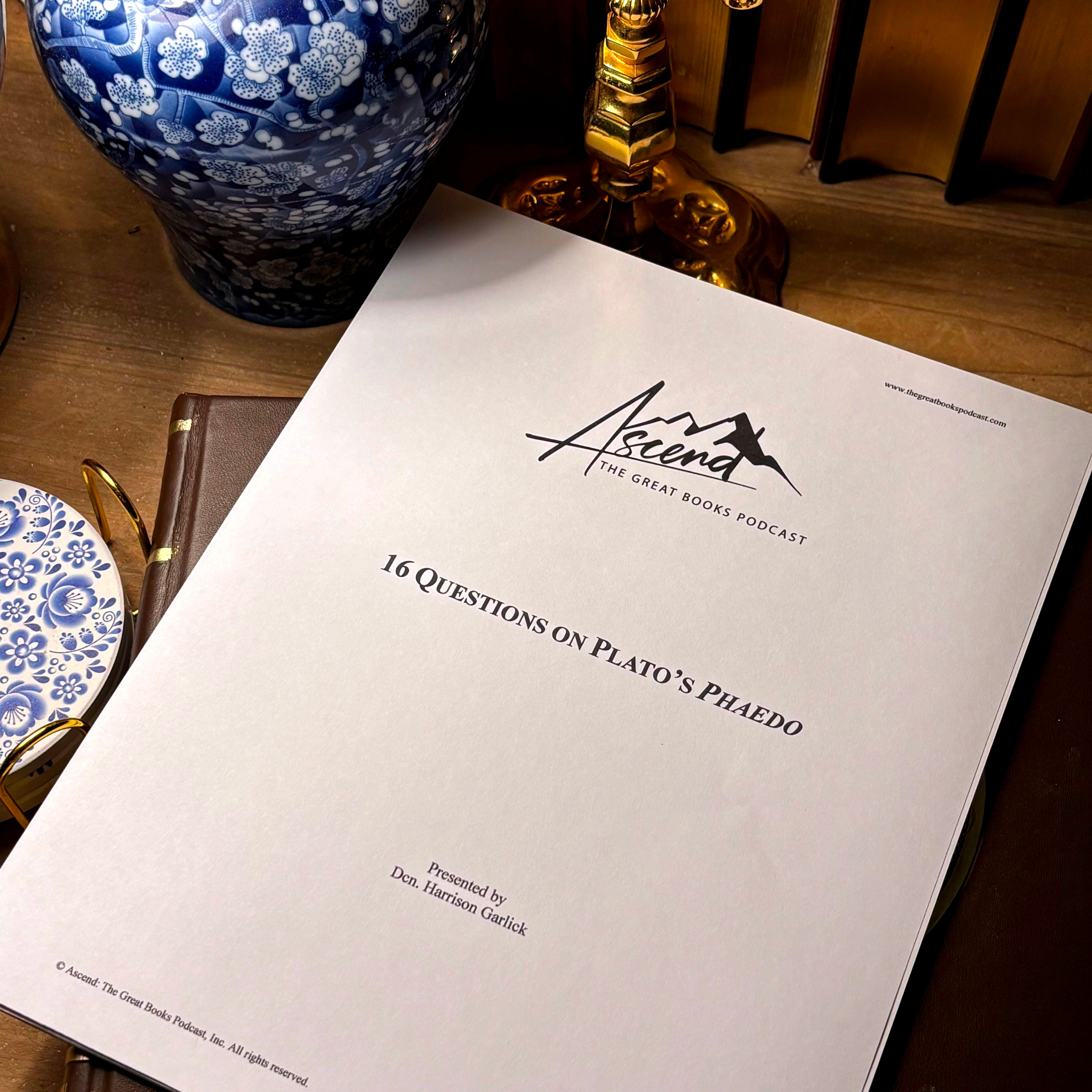
Here is everything you receive in the guide:
A 12-page guide (5200+ words)
An introductory letter from Dcn. Garlick
General outline of the text
Preliminary questions to consider before you read
16 thorough questions on Plato’s Phaedo
The Phaedo is also a writing of hope. Socrates has a serene acceptance of death, and he, as the one slotted to die, is comforting his friends. He is a model of philosophy in action, a life in conformity of the truths to which the mind has assented. He argues for the immortality of the soul but also lives (and dies) as someone who believes it.
Below is the full guide available to download.
Why is the Phaedo worth reading? It challenges us to confront life’s ultimate questions with courage and openness, as Socrates does in his final moments, facing death with the hope of death being a good. For Christians, how much less should Christians fear death than the pagan Socrates? Yet, Socrates’ tranquility and courage in the face of death is a high standard. The Phaedo’s blend of rigorous argument and delightful drama invites us to think and live philosophically—a life of wisdom and virtue.
In Christ,
Dcn. Harrison H. Garlick

Dcn. Harrison Garlick lives in rural Oklahoma with his wife and five children. He serves as a deacon at Holy Family Cathedral and as Chancellor & General Counsel for the Roman Catholic Diocese of Tulsa. Follow him on X at Dcn. Garlick or Ascend.