


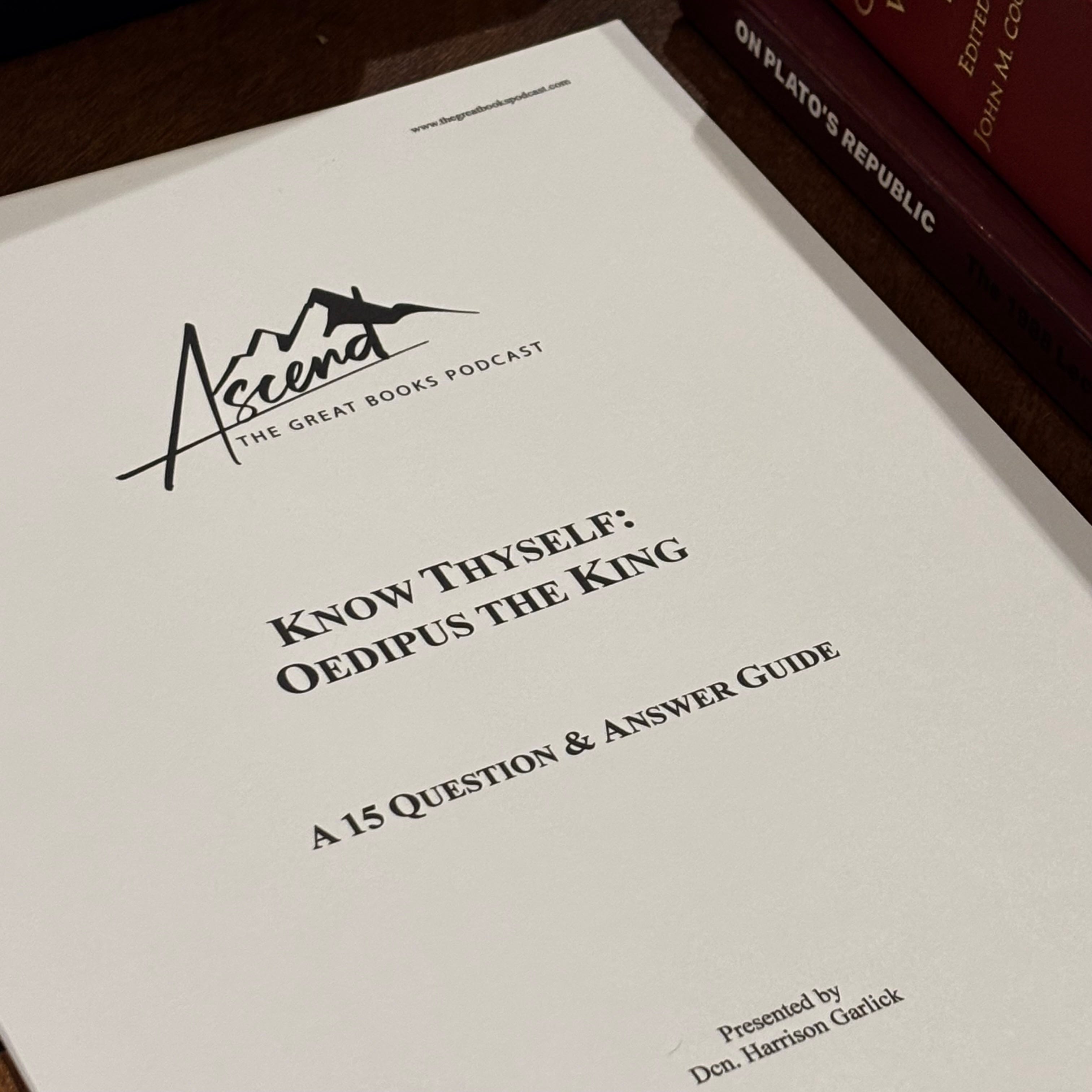
Oedipus the King is, according to Aristotle, the best of the Greek tragedies. Through Oedipus’ own investigation, he comes to understand the horrific truth of his identity—and this leads the reader into marvelous reflection on fate, freedom, self-knowledge, and the cosmic order.
Everything you get in the written guide:
9 pages, 4000+ words to help you understand the text
Introductory letter from Dcn. Garlick
Preliminary reading questions
15 comprehensive questions on the text
Be sure to check out our podcasts, videos, and more on Oedipus Rex.
Join our reading group and study the great books with us!
To support our mission and get all our resources, become a paid book club member. In addition to the weekly podcast, you’ll get:
Live book club discussions / Q&A with Dcn. Garlick & guest scholars
In-depth reading guides and essays to lead you through the great books
Access to our incredible community of readers
The full archive of members-only content (guides, essays, and podcasts)

Why Should You Read Oedipus Rex?
Oedipus the King is a play I had to come to appreciate. Unlike Antigone, it is not one I loved at first. In fact, my lackluster appreciation for the play is why I scheduled only one episode discussing it. Over time, however, I matured in my own understanding and see it as an antecedent to the philosophical principle of know thyself. I would suggest one could glean much from comparing Oedipus the King and First Alcibiades by Plato.
The drama does have layers for the attentive reader. It presents clearly a question on the interplay of freedom and fate, which is reminiscent of our discussions on the Iliad. Moreover, there is much to consider on the theme of suffering, and how that theme is presented in the Odyssey, the Oresteia, and Oedipus the King. Note that these two concepts are tethered—as the journey to self-knowledge is often an arduous one of suffering and great difficulty.
