


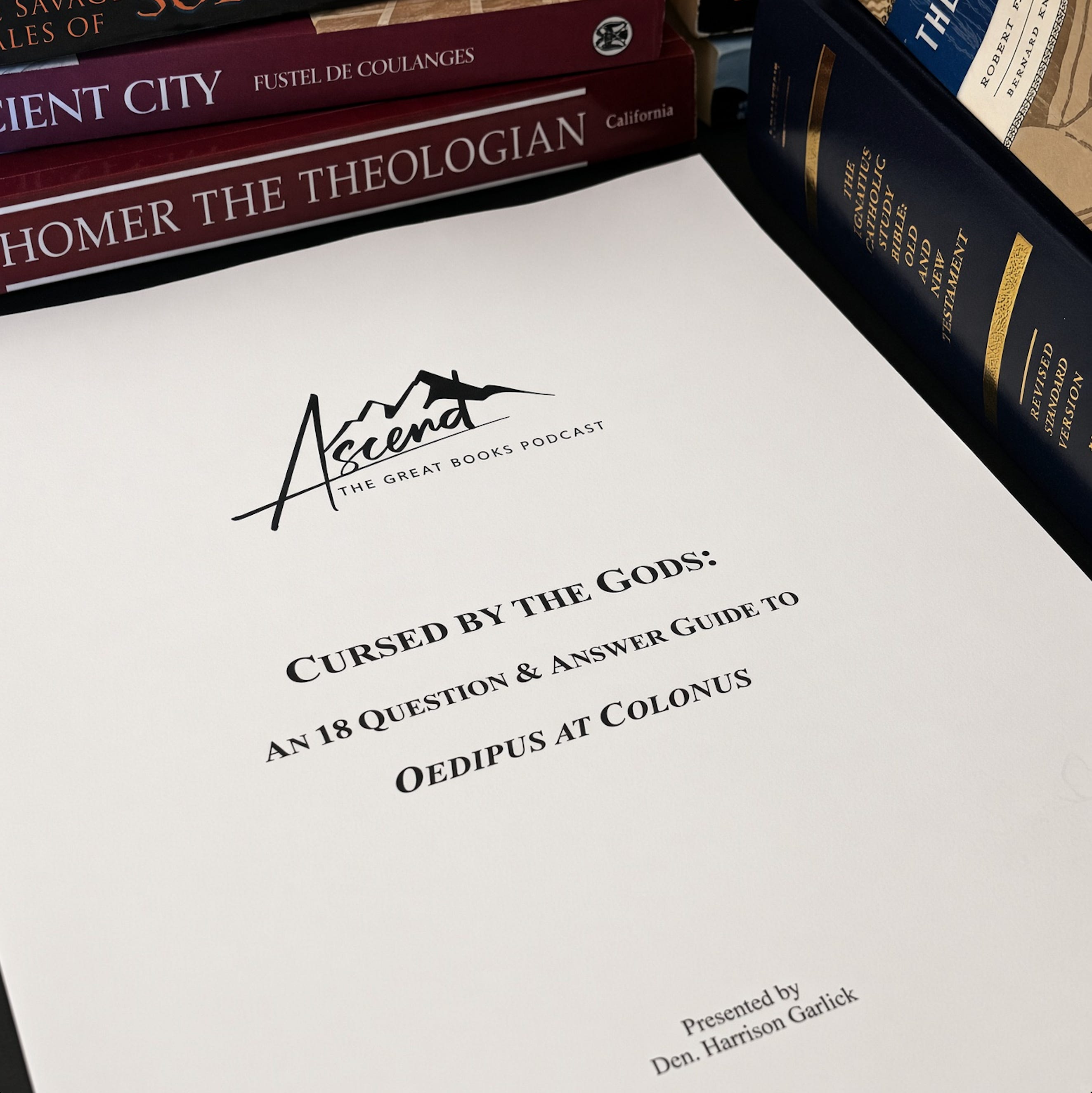
Oedipus at Colonus deserves your attention. It is the end of Sophocles’ Oedipus cycle and his best expression of the redemptive nature of suffering. The play focuses on the death of Oedipus and gives greater insights into familiar characters, like Antigone, Ismene, and Creon. To help you harvest what is best in this text, we’ve produced a written guide to help you or your small group.
Here is what you receive with Cursed by the Gods: An 18 Question and Answer Guide to Oedipus at Colonus:
13 pages, 6400+ words to help you understand the text
Introductory letter by Dcn. Garlick
List of Preliminary themes with explanations
18 rich Q&A on the text that allows you to reap the most from this famous work
You can read Oedipus at Colonus with the Ascend Book Club. We are here to help.
Join our reading group and study the great books with us!
To support our mission and get all our resources, become a paid book club member. In addition to the weekly podcast, you’ll get:
Live book club discussions / Q&A with Dcn. Garlick & guest scholars
In-depth reading guides and essays to lead you through the great books
Access to our incredible community of readers
The full archive of members-only content (guides, essays, and podcasts)

Introductory Letter from Dcn. Garlick
Dear Ascend Book Club Members,
Oedipus at Colonus is a beautiful tale. It brings a tremendous amount of meaning to the Oedipus Cycle. Sophocles offers us perennial truths on fate, the agency of man, and the cosmic whole. I greatly enjoyed, as a first time reader, the narrative of Oedipus at Colonus—especially the ending. It is a tremendous zenith to the Oedipus Cycle and one that parallels the Book of Job in its ability to address the question of suffering.
Oedipus at Colonus remains an important text within the Western canon of great books, as it is a beautiful antecedent to how later thinkers, like St. Augustine, will come to understand the world as subject to Divine Providence. Sophocles offers several preliminary considerations on whether the fate that rules the world does so according to justice; and whether man must adopt a certain docility in consideration of such a fate. The balance, however, of man’s agency and fate’s dominion is a perennial question.
