


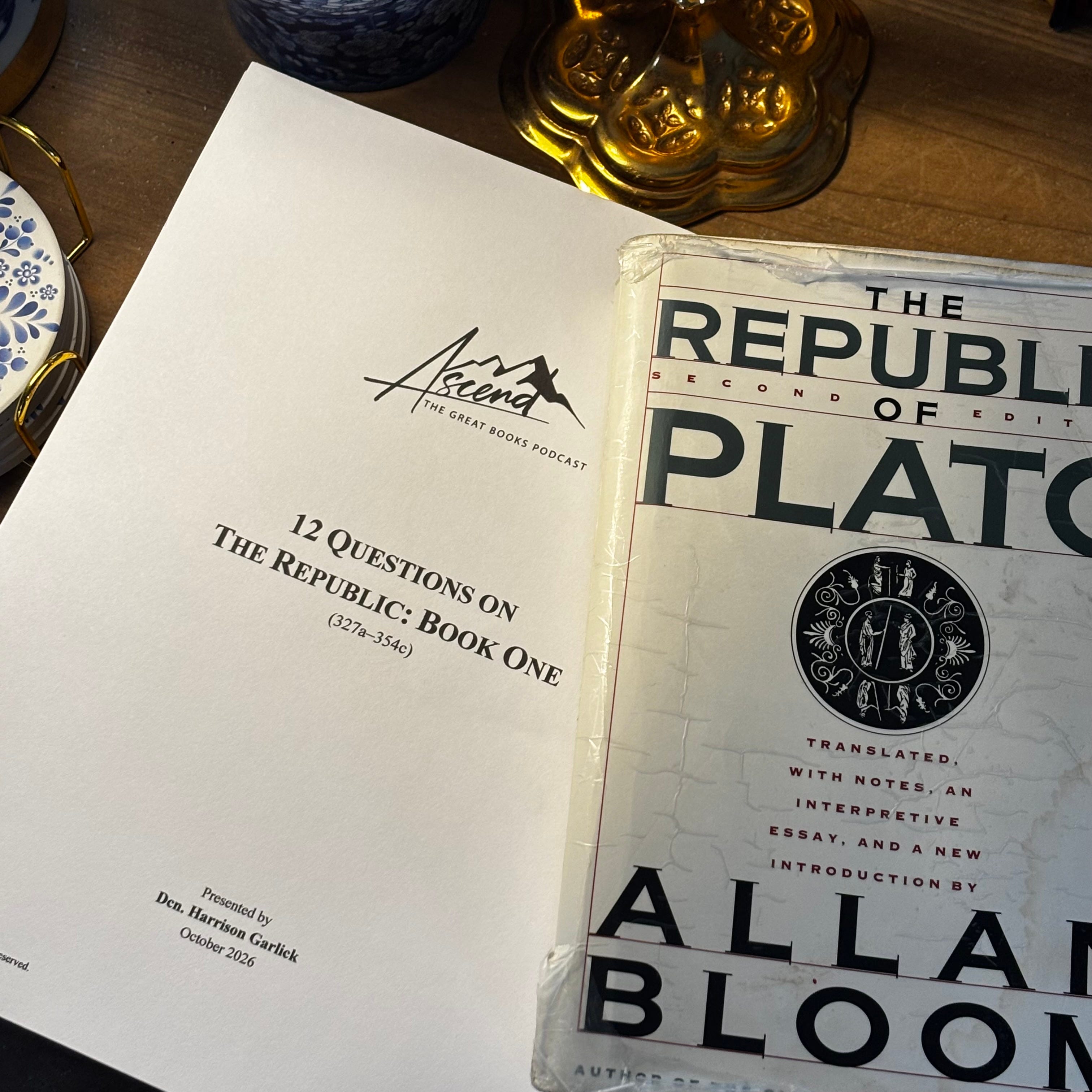
Dear Members of the Ascend Book Club,
Plato is philosophy. To summarize a famous quote: all Western philosophy is simply a series of footnotes to Plato. If this is true, then reading his masterwork, the Republic, will give you a guidepost, a reference point for the rest of the Western philosophic tradition. Reading this text in a slow, attentive manner is worth your time. In fact, it can be life changing.
Join our slow read-along of Plato’s Republic!
We begin reading this life-changing book on October 6. Check out the full reading schedule here.
To support our mission and get all our resources, become a paid book club member. In addition to the weekly podcast, you’ll get:
Live book club discussions with Dcn. Garlick & guest scholars (monthly)
In-depth reading guides and essays to lead you through the great books
Access to our incredible community of readers
The full archive of members-only content (guides, essays, and podcasts)
But this does not exhaust the reason to read Plato. It is not reducible to an intellectual pursuit; rather, we read Plato to help you have a beautiful soul. Philosophy, for Plato, is truly the love of wisdom and that love is transformative. Plato’s Socrates will invite you to live a virtuous life—a life with a well-ordered, healthy soul that has conformed to the reality of the cosmos and eternal truth. To wit, true philosophy, Platonic philosophy, makes a claim upon your soul. Reading Plato can never be a sterile, academic exercise. It is always fecund. It shows you what is beautiful and invites you to become beautiful.
Here is everything you receive in the guide:
A 13-page guide (6600+ words)
An introductory letter from Dcn. Garlick
A detailed outline of Book One
A list of questions to consider as you read
20 robust questions on the text
Below is the full guide available to download. A wonderful resource!
Reading the Republic can be very difficult but Ascend is here to help. Plato is the teacher, and we are all his students. An attentive, intentional read of Plato that has the patience to work through the layers of the text is deeply rewarding. In fact, reading Plato well will sharpen your capacity to read deeply any other complicated text—including the Bible.
Book One is the preamble to the Republic, and it reads like a dialogue of its own. Three accounts of justice are offered, and none of them are satisfactory. Socrates outdoes Thrasymachus at his own game and “wins” the argument—but he does not win as a philosopher, he does not give a satisfactory definition of justice. The ending is aporetic and leaves the reader ready to receive the opening of Book Two in which Glaucon will restate the argument and give structure to the rest of the text. Overall, Book One is a wonderful work that introduces you to the modes and movements of Socrates—take it seriously. Plato offers you good practice on discerning his subtle lessons in this passage.
