


To Members of the Ascend Book Club,
Dante is a master of the soul. The Divine Comedy is no less than St. Thomas Aquinas’ Summa Theologiae in poetic form. It is the zenith of the medieval mind, and a testament to an ordered cosmos under Divine Providence. Dante the Poet weaves together Holy Scripture, Aristotle, Greco-Roman mythology, St. Thomas Aquinas, and more to invite you, his reader, to one thing: salvation. Dante the Poet asks us to see ourselves in Dante the Pilgrim and join him in his journey through hell, purgatory, and heaven.
Join our reading group and study the great books with us!
To support our mission and get all our resources, become a paid book club member. In addition to the weekly podcast, you’ll get:
Live book club discussions with Dcn. Garlick & guest scholars (monthly)
In-depth reading guides and essays to lead you through the great books
Access to our incredible community of readers
The full archive of members-only content (guides, essays, and podcasts)

In the Inferno, Dante the Poet rips away the glamorous veneer of human desire and reveals the ugliness of sin. The damned loved a lesser good than God, and in hell, God gives the damned that which they loved—and they become imploded and grotesque. The architecture of hell is love. And everything that is presented in the Inferno is part of a pedagogy of love. Dante the Poet wants you to go to heaven, and he offers the punishments of hell, the identities of the damned, and the structure of hell itself as lessons for your sanctification in Jesus Christ. We see ourselves in Dante the Pilgrim and follow the call to ascend toward God.
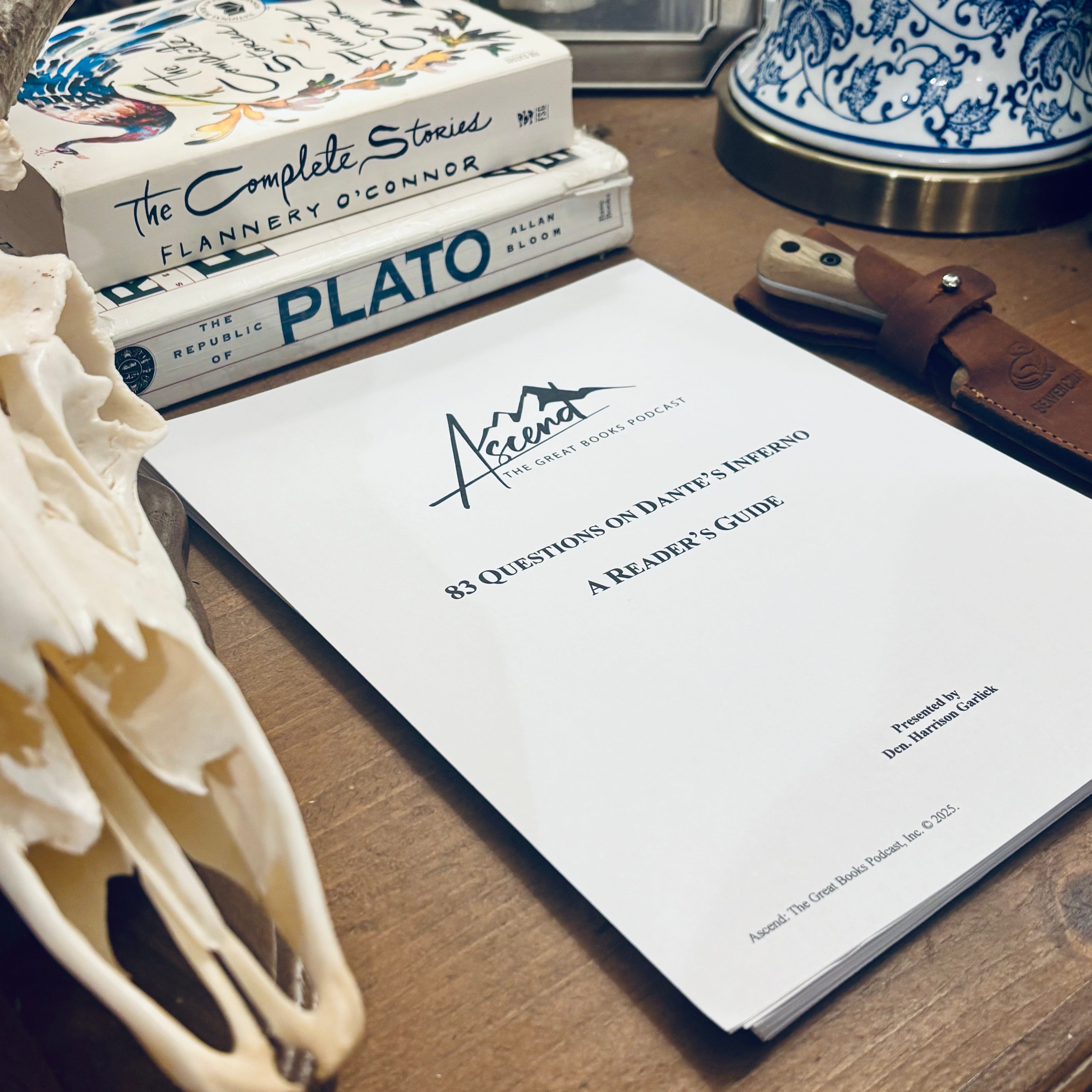
Here is everything you receive in the guide:
A 36-page guide (19,000+ words)
An introductory letter from Dcn. Garlick
Preliminary reading questions
83 thorough questions on Dante’s Inferno
I am indebted to those with whom I have read the Inferno before and to those who joined me in discussing Dante’s Inferno for Lent 2025. Thank you to Dr. Jeremy Holmes of Wyoming Catholic, Dr. Jennifer Frey of the University of Tulsa, Dr. Jessica Hooten Wilson of Pepperdine, Dr. Jason Baxter of Benedictine College, Fr. Thomas Esposito, O. Cist., of the University of Dallas, Noah Tyler and Gabriel Blanchard of the Classic Learning Test, Dr. Donald Prudlo of the University of Tulsa, and Mr. Evan Amato. I was blessed by their wisdom and insights, and I hope you all will be as well.
Below is the full guide available to download.
Dante presents us with a tremendous challenge. Not simply because he is a master teacher of the soul and its loves, but because he is not a modern man. He is free from many of the ideologies that warp our religious and political imaginations today. He has lessons for us if we are bold enough to embrace them. Like Dante the Pilgrim journeying through hell, we too must grow in our courage and push onward toward God. We must discipline our desires, order our loves, and be beautiful as God is beautiful.