


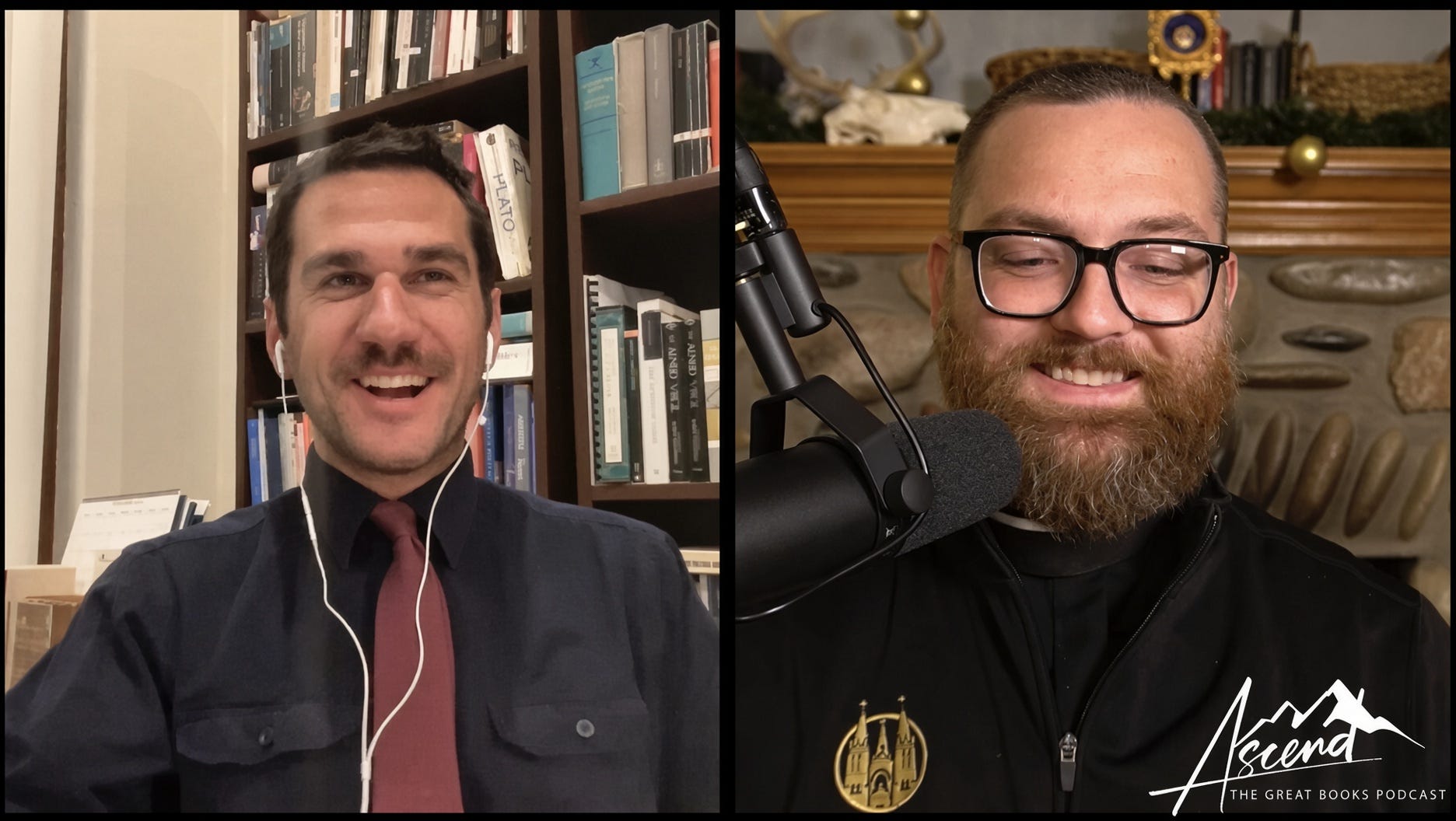
In this episode, Dcn. Harrison Garlick and Dr. Pavlos Papadopoulos, a professor at Wyoming Catholic College, dive into Plato’s Crito, a dialogue set in Socrates’ prison cell as he awaits execution. They explore Socrates’ refusal to escape, his debt of gratitude to Athens, and the tension between philosophy and the poetic traditions of the polis. They unpack the dialogue’s themes of justice, piety, and civic obligation, offering insights for first-time readers and drawing parallels to modern liberal democracy.
Here are the Ascend Book Club materials to help you read:
Detailed written guide to help you dig into the Crito
An excellent video discussion on the Crito (below)
The video is also available as a podcast
Check out “How Gratitude Can Save the West,” an article on piety.
The Crito is often read alongside other dialogues as the “last days of Socrates,” which includes the Euthyphro (before his trial), the Apology (during his trial), the Crito (in prison), and the Phaedo (his death).
Join our reading group and study the great books with us!
To support our mission and get all our resources, become a paid book club member. In addition to the weekly podcast, you’ll get:
Live book club discussions with Dcn. Garlick & guest scholars (monthly)
In-depth reading guides and essays to lead you through the great books
Access to our incredible community of readers
The full archive of members-only content (guides, essays, and podcasts)

Video Discussions on the Crito
The questions explored about Plato’s Crito reveal key themes of justice, piety, gratitude, and the tension between philosophy and the polis. Socrates’ imprisonment, set against Athens’ cultural life governed by the poetic myth of Theseus, underscores the conflict between philosophical inquiry and the city’s traditional piety, highlighting philosophy’s precarious role in a society shaped by poetry.
Good work! You’re almost done with the dialogues depicting the last days of Socrates (the first tetralogy). The next is the Phaedo, a labyrinth of a dialogue, that tells of the death of Socrates and discusses the immortality of the soul.
And be sure to check out our entire, growing library on Plato.
Dcn. Harrison Garlick lives in rural Oklahoma with his wife and five children. He serves as a deacon at Holy Family Cathedral and as Chancellor & General Counsel for the Roman Catholic Diocese of Tulsa. Follow him on X at Dcn. Garlick or Ascend.