


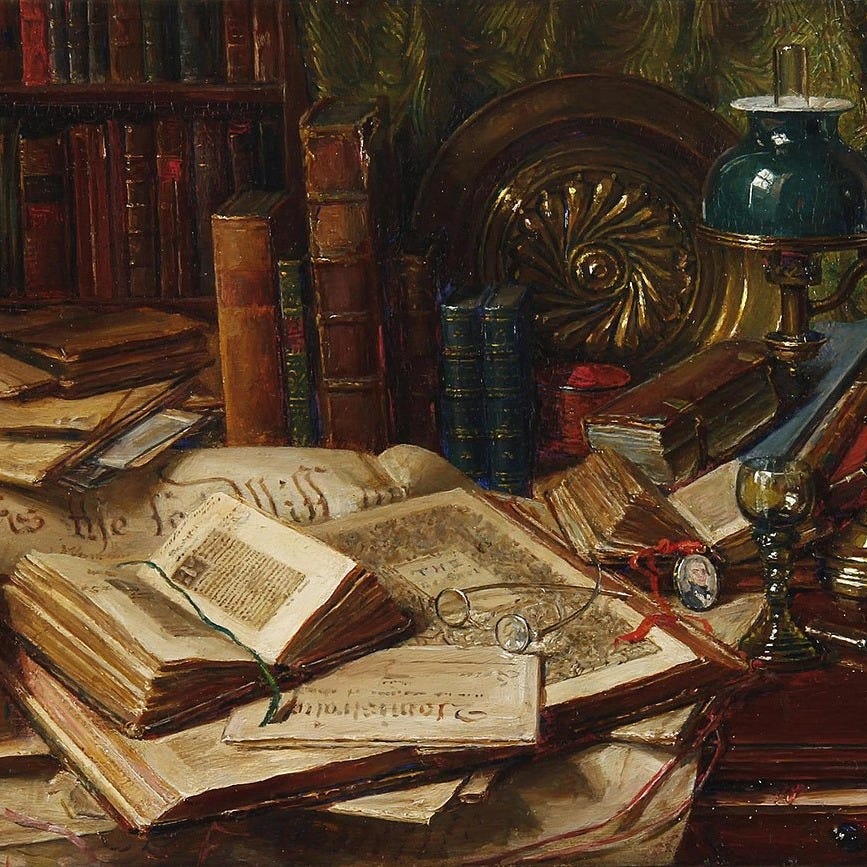
Christians should read the great books.
Homer, Plato, and others invite you to explore the drama of the human condition and ponder the perennial questions of mankind.
Yet many Christians neglect these texts. Why?
Far from threatening faith, the great books—whether Plato’s pursuit of truth or Nietzsche’s hammer—become invitations to know your faith in Jesus Christ more deeply.
This is especially true for Christian leaders.
Reminder: you can support our mission and get all our members-only content for just a few dollars per month:
New, full-length articles every Tuesday and Friday
The entire archive of members-only essays
Access to our paid subscriber chat room
Introduction to the Great Books
The great books will change your life. The great books are a collection of the foundational primary texts of Western civilization (e.g., philosophy, theology, literature, politics, ethics, and more) across many different genres (e.g., poetry, plays, dialogues, treatises, novels, etc.). Popularized by Mortimer Adler in the 1950s through his influential 54-volume set, these works—from Homer to Freud—address the perennial questions of the human condition, e.g., the nature of the soul, free will, virtue, political order, the cosmos, the divine, and the transcendentals of truth, goodness, and beauty. The reader is invited to join the “great conversation,” in which these authors are in dialogue with one another.
In the Christian approach to the great books, it is the historic incarnation of Jesus Christ—the Logos made flesh—that serves as the standard. Hebrew faith, Greek reason, and Roman order came together to prepare the world for the coming of Jesus Christ. As St. Paul tells us, Christ came in the “fullness of time” (Gal 4:4). It is the Incarnation that helps determine which books should be read, and it is the Incarnation—the reality of Christ—that serves as the ultimate standard of truth. Some authors of the great books, like Plato and Aristotle, helped prepare the world for the Incarnation. Other great authors, like St. Augustine, St. Thomas Aquinas, and Dante, helped reflect upon Christ and the Western tradition as a whole, a tradition in pursuit of wisdom, a sapiential tradition. Other authors, like Machiavelli, Marx, and Nietzsche, rejected the Christian tradition of the West. The great books are not necessarily chosen for the truth but for their impact on Western civilization, and Western civilization is rooted in the Incarnation.
Overall, the great books tradition helps you to reclaim your intellect—to understand the origin of ideas, to test them, and to own them. It gives you a better understanding of your present world and how your current theological and philosophical beliefs accord with the narrative of the West. Truth is the conformity of the mind to reality, and the great books are one of the best ways to explore reality. While the authors must first be known in and of themselves, to know Plato qua Plato, the ultimate guide—both in historical priority and truth—is the Incarnate God, Jesus Christ. The great books help you understand how Providence prepared the world for the Incarnation, how the West reflected upon it, and how the West rejected it.
The Formation of Christian Leaders
The great books are a wonderful aid to the Christian imagination. The great books list below is taken—with some adaptation—from the diaconate formation program of the Roman Catholic Diocese of Tulsa, the courses that help train men to become deacons. In Tulsa, the great books sequence runs parallel with courses in systematic theology, which should alert you that this great books list is not designed for theological formation—but rather is a complement to it. Moreover, the list presupposes you have a solid mastery of Holy Scriptures. If not, you can always read the Bible or key parts of it (Genesis, Exodus, I & II Samuel, Psalms, Isaiah, Book of Wisdom, and the New Testament) prior to reading this list. There is a lot of fecundity in reading Scripture alongside the great books, especially Homer and Plato; as St. Basil taught, your soul is like a branch and reading the Bible helps the branch bear fruit, but reading the classical pagans helps it bear leaves. In other words, the classical Greek texts help prepare the soul for a better understanding of God’s word.
But how do these great books help the formation of a Christian minister?
Christian formation is more than theology. It is a holistic formation in the reality of the human condition. The great books can assist by helping Christian leaders cultivate self-understanding (know thyself), wisdom, spiritedness (thumos), and a bridling of the insatiable human desire for more (pleonexia). Through direct engagement with primary sources, like St. Augustine or Dante, rather than secondary summaries, readers encounter spiritual masters who map the soul’s desires, virtues, and path to God.
For Christian leaders, the great books also enhance pastoral effectiveness by building well-ordered empathy through immersion in diverse human dramas, enabling them to step outside themselves and better understand others’ perspectives—crucial for accompanying souls in ministry (always toward the Truth). Spiritually, these works, often discussed in Socratic-style groups where the author serves as the true teacher, deepen interior life and discernment. Humanly, they promote maturity, integrity, and a well-rounded character grounded in perennial truths. Intellectually, the challenge of wrestling with great minds sharpens clear, deep thinking about the faith. Ultimately, the conversational pedagogy mirrors everyday ministry—attentive listening, questioning, and guiding toward truth—equipping leaders to teach and share the faith personally and robustly, as one cannot give what one does not have.
A Great Books Reading List for Christian Leaders
Greek Poetics
Letter #70 by St. Jerome & Address to Young Christian Men on the Right Use of Greek Literature by St. Basil - These two letters, both from early church fathers, give an excellent, short introduction to why Christians should read the classical Greek authors. For a conversation on these texts, check out Why Christians Should Read the Pagans.
The Iliad (750 BC) - Except for Holy Scripture, this is the “first great book” and the beginning of the story of Western civilization. Homer is a master teacher, and he shows you many of the perennial questions of man in a nascent, subtle manner. Check out this playlist hosting discussions on each book of the Iliad along with this free 115 Q&A Guide on the Iliad.
The Odyssey (725 BC) - The sequel to the Iliad, Homer weaves together the coming of age story of Odysseus’ son, Telemachus, with the coming home story of Odysseus to Ithaca into a profound narrative of perseverance and restoration. Odysseus is the man of “twists and turns,” and this describes both his journey and his character. Check out this introduction to the Odyssey with Dr. Patrick Deneen with follow conversations on each book. Also, this 115 Q&A Guide on the Odyssey is helpful for first time readers.
The Oresteia by Aeschylus (458 BC) - Shifting to the Greek plays, the Oresteia (a collection of three plays) tells of Agamemnon’s tragic homecoming after the Iliad and raises perennial questions on justice, piety, and man’s political order within the cosmos. As an aside, the Greek plays are an intellectual bridge between Homer and Plato, and very much worth your time and attention. Check out these discussions on the Oresteia for a good small-group-like conversation along with this written guide.
Prometheus Bound by Aeschylus (450 BC) - The first play of a lost triad telling the story of Prometheus, the drama explores liberty and tyranny. It is particularly interesting for the Christian imagination given its clear thematic parallels to Satan and Jesus Christ. Check out this discussion on the text with Dr. Jared Zimmerer and this written guide.
Antigone by Sophocles (441 BC) - Arguably the best of the Greek plays, it tells the story of Antigone clashing against King Creon on whether to bury her brother who died a traitor to the state. The drama raises questions about the threefold aspect of piety: family, polis, and the divine—and what happens if these are in friction. Check out these discussions on the text and this written guide. If you want to start with someone short (not Homer), then read Antigone first to get your feet wet. The two subsequent plays, Oedipus Rex and Oedipus at Colonus, are also excellent.
Bacchae by Euripides (405 BC) - One of the most unsettling of the Greek plays, the Bacchae tells the story of the god Dionysus returning to Thebes to punish those who doubt his godhood. It is a disturbing story of piety and eros that challenges the norm in other Greek writings and sets up the reader for a richer understanding of Plato’s Symposium. Check out this discussion with Dr. Frank Grabowksi alongside a written guide: Madness and Piety.
Greek Philosophy
First Alcibiades by Plato - Plato is philosophy, and the start of your journey with Plato should begin with First Alcibiades. It was historically the first dialogue students of Platonic thought would read, as it focuses on the student’s turn toward philosophy and the ever-important principle of know thyself as the beginning of wisdom. For a wonderfully deep conversation on this text, check out these videos and this accompanying guide.
Euthyphro by Plato - What is piety? The Euthyphro is one of the most important Platonic texts for Christian theologians, as it takes up the question of piety and its relation to the divine. It contains the famous “Euthyphro dilemma,” which can also be reworded in a monotheistic context and present challenging questions to Christian theology. Check out this group discussion on the text and this accompanying guide for help. Also, listen to this conversation on Aquinas and the Euthyphro dilemma with Dr. Prudlo to under this Platonic question within a Christian context.
Apology by Plato - Easily one of the most famous speeches in Western civilization, Socrates’ speech at his trial explores the reality of the soul and what it means to live a good life. Check out this discussion on the Apology with Fr. Just Brophy, OP, and the accompanying guide: 30 Questions on the Apology.
Meno by Plato - A dialogue on virtue, it also serves as an excellent introduction to education and is often the first dialogue many students of philosophy read. It can be a complicated text to unravel, so check out this discussion with Dr. Daniel Wagner.
Republic by Plato - Arguably the most important work in the Western philosophical tradition, the Republic seeks to understand justice and whether it is more beneficial for a man to be just than to be unjust. In this pursuit, Socrates raises perennial questions on the nature of the soul, virtue, education, politics, and much more. It contains some of the most famous passages in all of Western thought, like the allegory of the cave.
Symposium by Plato - One of the most important spiritual texts in the great books canon, the Symposium set a spiritual template of ascent that became fundamental to both pagan (middle and late Platonists) and Christian (St. Gregory of Nyssa, Dionysius, St. John Climacus, etc.) thought. Often misunderstood, the work tells of the so-called ladder of love in which the soul ascends to God through love (eros) and its desire for beauty.
Nicomachean Ethics by Aristotle - A foundational work in ethics, Aristotle works in a technical, systematized way to map the virtues and the corresponding vices. The text became a considerable source of natural wisdom in the Christian middle ages, especially through St. Thomas Aquinas.
Politics by Aristotle - The natural successor to the conversation in the Nicomachean Ethics, Aristotle shifts from the good of the soul to the good of the polis. It is often considered the first systematized work of politics in West - and Aristotle roots political life in virtue, natural justice, and the common good.
The Romans & the Early Church
Eclogue 4 by Virgil (40 BC) - One of the most fascinating pieces of pagan literature from a Christian perspective, Eclogue 4 is a short poetic work by the Roman poet Virgil in which he prophesies the coming of a golden child, born of a virgin, who will usher in a golden age. Virgil did not intend his poem to refer to the coming of the Christian Messiah, but many early church fathers read him as an unintentional pagan prophet. Similarly to how the psalmist in Psalm 22 did not intend to write what Christ was thinking about the Cross.
The Aeneid by Virgil (19 BC) - Often neglected on many great books reading lists, the Romans were much more than simply copies of the Greeks. The Roman understood how to build an empire and how apply wisdom. One core text is Virgil’s Aeneid, which tells the story of the founding of Rome—an epic and spiritual successor to Homer’s Iliad. The text was arguably one of the most popular texts at the time of Christ, and several early church fathers, like St. Augustine, make allusions to it. It is also foundational to understanding Dante’s Divine Comedy.
First Apology by St. Justin Martyr (c. AD 150) - Addressed to Emperor Antoninus Pius and the Roman Senate, the work is a powerful defense of Christianity against pagan accusations of atheism, immorality, and sedition. In it, St. Justin Martyr explains core Christian beliefs and practices—including the Eucharist, baptism, and Sunday worship—while arguing that Christianity is the true fulfillment of reason and philosophy through the incarnate Logos (Christ), deserving justice and toleration rather than persecution. It is an incredible testimony to early Christian thought and how Christians saw Christ as the fulfillment of the Greek philosophical tradition.
On the Unity of the Church by St. Cyprian (AD 250) - Written amid schisms and persecutions in the mid-3rd century, this treatise passionately defends the indivisible unity of the Church. You can benefit from it as a timeless reminder of ecclesial communion, the dangers of division, and the necessity of clinging to the one true Church founded by Christ, especially relevant in eras of fragmentation or doctrinal controversy.
Catechetical Teachings by St. Cyril of Jerusalem (c. AD 348–350) - Delivered to catechumens preparing for baptism in Jerusalem, these lectures systematically explain the Creed, sacraments, and Christian mysteries with clarity and scriptural depth. They are worth your time for their enduring catechetical model, as they equip believers—especially those teaching or preparing others for initiation—with profound insights into faith fundamentals, liturgical life, and the transformative power of the sacraments.
The Life of Moses by St. Gregory of Nyssa (c. AD 380) - One of the first works of Christian mysticism, St. Gregory uses the life of Moses as an allegorical image of the soul’s journey toward God. It is often presented that St. Gregory wanted to present Moses to the Greeks as a life worthy of imitation, like a Christian Plutarch’s Lives. He borrows from the eros-motif of ascent, which has its roots in the Symposium, to describe Moses’ ascent up Mount Sinai as an act of love (eros) until it satiates in “the bright darkness of God.” It is an invaluable text that brings together both Hebrew and Greek wisdom to present a distinctly Christian mysticism.
Confessions by St. Augustine (AD 397–400) - A complete masterpiece, the Confessions tells of St. Augustine’s descent into sin and his ascent into conversion and divine contemplation. Written in a beautiful, autobiographical style, he brings together biblical and platonic themes to give you one of the best spiritual texts ever written. It provides you with a map to understand the attractiveness of sin, the stubbornness of the will, and the beauty of God’s grace. St. Augustine pulls from the Platonic tradition and will be foundational for the later writings of St. Thomas Aquinas.
The Divine Names by Dionysius the Areopagite (c. AD 500) - Part of the Dionysian corpus, this work explores how human language and concepts can (and cannot) name God, using affirmative (kataphatic) and negative (apophatic) theology to approach the transcendent Divine. It profoundly shapes Christian mysticism by teaching humility before God’s ineffability while affirming His attributes, helping readers balance intellectual pursuit of truth with reverent silence and adoration. The text draws from the Platonism of the West and will later serve as a foundational work for St. Thomas Aquinas.
On Pastoral Care by St. Gregory the Great (590 AD) - Written shortly after his election as pope, the work is a seminal four-part treatise on the responsibilities, qualifications, and conduct of clergy, especially bishops, as shepherds of souls. It emphasizes humility, the balance between contemplation and active ministry, the need for self-examination, and the art of adapting preaching and guidance to diverse people and circumstances while maintaining moral integrity and inner virtue. It was the standard instructional text for Christian clergy for arguably over a thousand years.
The Medieval Age
Sermons on the Song of Songs by St. Bernard of Clairvaux (c. 1135–1153) - A collection of sermons, this mystical commentary interprets the biblical Song of Songs as an allegory of the soul’s intimate love affair with Christ the Bridegroom, progressing through stages of longing, purification, and ecstatic union. Christians find it invaluable for its passionate yet disciplined exploration of contemplative prayer, the dynamics of divine love, and the transformative power of affection for God, offering timeless spiritual nourishment for deepening interior life and devotion. In many ways, it starts the medieval spiritual motif of bridal mysticism, which should be read alongside the spiritual motif of eros and ascent.
Summa Theologiae by St. Thomas Aquinas (c. 1265–1274) - It would be difficult to exaggerate the influence the Summa has had on Christian theology. Originally written for beginners to provide them a philosophical and theological framework for biblical studies, Aquinas organizes Christian doctrine using all the sources available to him (e.g., the Bible, St. Augustine, Aristotle, Dionysius, Averroes, etc.) to address questions of God, creation, human nature, grace, virtues, sacraments, and eschatology in a clear, question-and-answer format. Christians benefit profoundly from reading it (or key selections) as it offers the most comprehensive and intellectually rigorous synthesis of faith and reason in the Catholic tradition, equipping believers to understand the harmony between Scripture, Tradition, and philosophy while deepening trust in the intelligibility of divine revelation through the incarnate Logos.
The Divine Comedy by Dante Alighieri (c. 1308–1321) - Sometimes called the Summa in poetic form, Dante the Poet presents a narrative in which Dante the Pilgrim travels through hell, purgatory, and heaven as an allegorical journey of the soul’s pilgrimage to God. Like the Summa, Dante the Poet draws from the entire Western tradition and the reader is exposed to a whole library of sources. In the Inferno, Dante the Poet rips away the polite veneer on human desire and reveals the ugliness of sin. In the Purgatorio, he gives one of the absolute best maps of how the soul can overcome sin and ascend to God. And in the Paradiso, Dante the Poet presents a heavenly world we struggle to understand—as we are so accustomed to sin and disorder. Dante the Poet is not giving you a literal map of the afterlife—but rather an allegorical tale that invites you to purify your soul and pursue God, the Love that Moves All Things. Check out these videos discussing the Inferno and this 80+ question guide.
The Interior Castle by St. Teresa of Ávila (1577) - Written under obedience near the end of her life, this mystical treatise describes the soul as a crystal castle with seven mansions, each representing progressive stages of prayer and union with God, from initial conversion through trials to spiritual marriage. Essential for Christians, it provides a practical and profound map of the interior life, emphasizing humility, detachment, love, and perseverance amid dryness or suffering, while guiding readers toward authentic mystical encounter with Christ and greater conformity to His will. It is important to include spiritual texts on your great book studies, and The Interior Castle is a wonderful selection.
The Moderns
The Three Waves of Modernity by Leo Strauss (1975) - This short essay is one of the best maps to the modern age, allowing you to see the subtle difference between the modern movements. Like most maps, it is beneficial to consult first and then again when you’re moving through the authors described. Overall, Strauss sees modernity as a rejection of the ancients and medievals—and this insight, especially from a non-Christians, merits further attention.
The Regensburg Address by Pope Benedict XVI (2006) - Another good introductory essay to modernity, Pope Benedict XVI takes a similar but distinct path from Strauss by describing modernity in three stages of dehellenization—or rather three successive movements of moving away from the logos of Greek thought, including the Logos of St. John’s Gospel. Like Strauss, Pope Benedict XVI contextualizes modernity as a rejection, one that has lost faith in human reason.
Letter to German Nobility by Martin Luther (1520) - This fiery tract attacks the “three walls” of the Roman Church’s authority, calls for reform by the German nobility, and asserts the priesthood of all believers while challenging the idea of Holy Orders and the papacy. It is an important letter to read, for both Protestants and Catholics, as it shows how politics and faith were held together in the Church and how the Protestant response is inseparable from politics as well. The letter should be read alongside Pope Gelasius’ letter to the Byzantine Emperor in AD 494 that articulated the Catholic political doctrine of “duo sunt” or “there are two”—a temporal power and spiritual power. It is the same political doctrine that undergirds Dante’s Divine Comedy. Another good writing to show Luther’s thought is The Babylonian Captivity of the Church (1520)
The Prince by Niccolò Machiavelli (written 1513; published 1532) - What at first glance appears to be a pragmatic treatise on politics, Machiavelli offers a significant rupture in the Western tradition by effectively separating politics from Christian morality—and even subtle calling into question Christianity as a whole. You should read it as a foundational text of modern secular politics that inaugurates the “ancients vs. moderns” divide by rejecting virtue ethics and divine law in favor of amoral pragmatism. It is clear contrast to the writings of Aristotle and Aquinas.
Council of Trent (1563) & Catechism of Trent (1566) - The Council of Trent’s decrees and the subsequent Roman Catechism systematically reaffirmed Catholic doctrine on Scripture and Tradition, justification, sacraments, and Church authority in response to Protestant challenges. The writings provide a helpful contrast to Luther and other Reformers, as it provides the reform the Catholic Church underwent versus the reform the Protestants led. It is a helpful contrast for any Christian leader exploring their own faith tradition.
Leviathan by Thomas Hobbes (1651) - This foundational political treatise argues for absolute sovereignty to escape the brutal “state of nature,” redefining human life, law, and religion under new, modern terms. What Machiavelli did for the prince, Hobbes does for the citizen. It is a complete rejection of the political tradition of the West predicated on a new anthropology and state of nature.
Second Treatise of Government by John Locke (1689) - Though Hobbes has a few similar characteristics, it is John Locke that will usher in the new predominate political ideology of West: liberalism. Locke, re-defining key terms in Western civilization, explores the natural rights to life, liberty, and property, limited government by consent, and the right of revolution against tyranny. It is important for you or any Christian leader to read, because Locke starts a new identity for the West—one that dominates our ethical and political discourse today with “rights language.” He is worth a slow, careful read—especially in contrast to those who came before him.
What is Enlightenment? (1784) and To Perpetual Peace (1795) by Immanuel Kant - Kant is a quintessential Enlightenment figure, but his works can be very difficult to approach. These two essays, however, can serve as a good introduction for those working through the great books for the first time. The essays focus on key Enlightenment themes, like autonomy and reason. These essays are very much worth your time, as the language of Kant is much more kneaded into your everyday culture than say Plato or St. Thomas Aquinas. With Kant, as with all modern writers, you are seeing the origin of ideas that you take to be normative and the philosophical default.
The Communist Manifesto by Karl Marx and Friedrich Engels (1848) - Another guidepost to modernity as a rejection, Marx sets forth a revolution by proclaiming class struggle as history’s engine and calls for the proletariat to overthrow the bourgeoisie—capitalism will fall to a classless society. Marx’s critiques of capitalism should be taken seriously as should the reasons people were eager to listen to him. Marx presents a contrary understanding of history and economics that seems to continually be a temptation to modern man—a temptation that Christian leaders should understand well.
Immortale Dei (1885) & Libertas (1888) by Pope Leo XIII - In Catholic circles, Pope Leo XIII (the namesake of Pope Leo XIV) represents a Church responding to the new problems of a rapidly post-Christian West. In Immortale Dei, Pope Leo XIII, drawing from Aquinas and the tradition of duo sunt, critiques the rise of liberalism and secular politics. In Libertas, Pope Leo XIII cuts at the heart of modernity by critiquing a false understanding of freedom. Is freedom the desire to do what is good? Or is freedom the plurality of options to satiate desire? The West has replaced Christian freedom for a Luciferian one—a must read for any Christian leader who wants to know where the radical autonomy of today arises. Other good writings include Aeterni Patris (1879) calling for the restoration of the teaching of St. Thomas Aquinas, and Rerum Novarum (1891) promulgating Catholic social teaching to a new industrialized world.
Twilight of the Idols by Friedrich Nietzsche (1889) - In certain ways, Nietzsche is the first modern to understand the modern project. Whereas many modern writers attempt to dethrone Christianity but somehow maintain a semblance Christian ethics, Nietzsche brings hammer to the “idols” of morality, religion, and truth. He understands that “God is dead” and that the West, even with a Christian veneer, has killed him. Nietzsche goes back to Greeks to understand the origin of the West, and the Twilight of the Idols represents a short, powerful introduction to Nietzsche’s thought.
The Abolition of Man by C.S. Lewis (1943) - One of the best summaries of what is wrong with the modern world, Lewis breaks down the problem of modern man in a short, powerful work. He critiques modern education’s rejection of objectivity (which he represents as the “Tao”), warning that it leads to the dehumanization and conquest of man by unchecked power. Essential for Christians, it defends an ordered cosmos and realism against relativism. Lewis’ rhetorical approach should be studied by Christian leaders, as he sidesteps the anti-Christian bias of his audience by brilliantly using the Tao.
Start today!
The Great Books tradition offers Christian leaders an unparalleled opportunity to reclaim the intellectual and spiritual depths of Western civilization while anchoring every inquiry in the reality of the Incarnate Christ. By joining the “great conversation” through primary texts—from Homer’s heroic epics and Plato’s pursuit of truth to St. Augustine’s restless heart, Dante’s vision of divine love, and even the modern contrasts of Machiavelli, Marx, and Nietzsche—readers gain profound insight into the human condition.
Ultimately, engaging these works holistically forms every part of the soul and invites it to satiate in Beauty-itself, God. It is a path of ascent.
PS - What would you add? All great books lists have to make some cuts. What do you think is a must-read for a great books list for Christian leaders?
Dcn. Harrison Garlick is a deacon, husband, father, Chancellor, and attorney. He lives in rural Oklahoma with his wife and five children. He is also the host of Ascend: The Great Books Podcast. Follow him on X at Dcn. Garlick or Ascend.
Many thanks to those who put this list together. I wish i had the time left to read them all. (I’m almost 90 years old.).
Excellent list. For those interested, take a look at The Catherine Project which organizes reading groups on line. Core program includes many of the early Greek works. I would add one Shakespeare play, Measure For Measure, which deals with government, sacrifice, justice, and hypocrisy.