


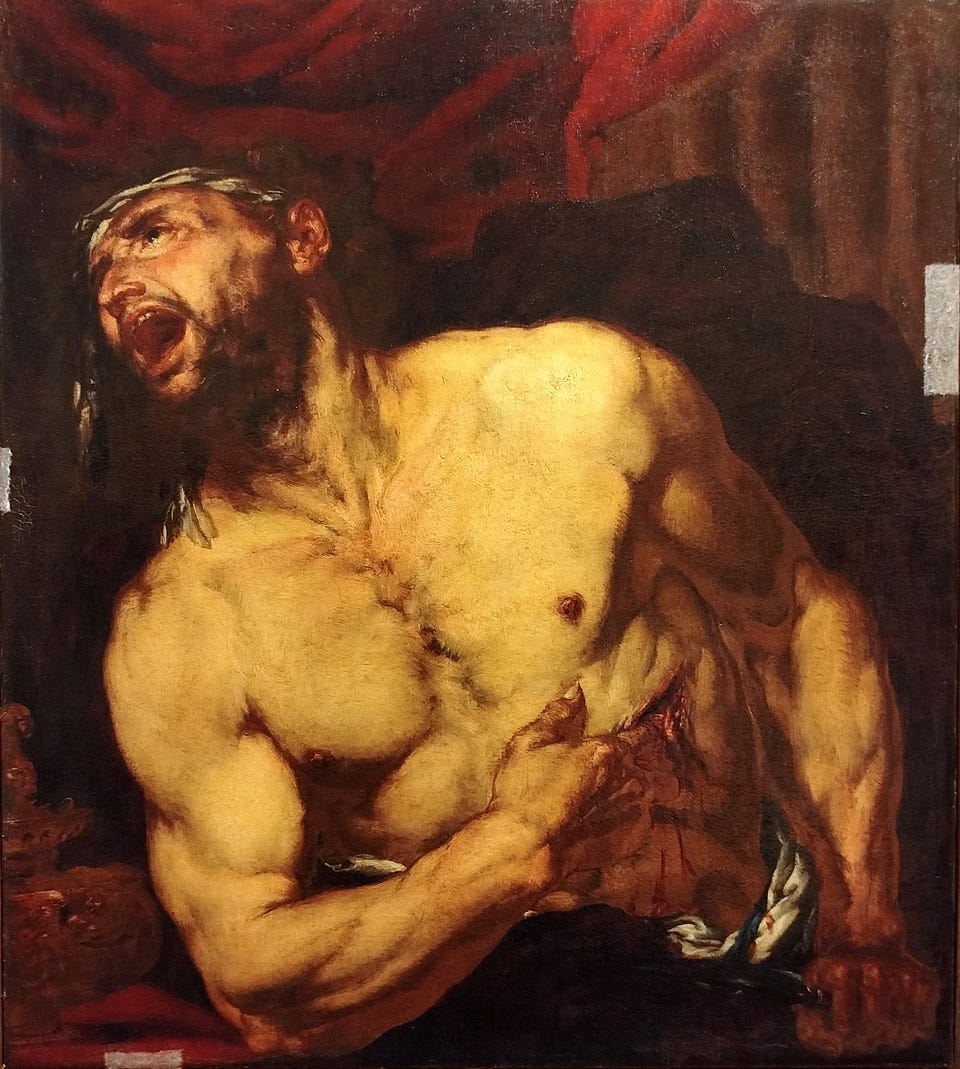
The last soul to enter into heaven will be a pagan suicide.
As they crawl out of hell onto the shores of Mount Purgatory, Dante and Virgil run into a mysterious old man, illuminated by the stars whose face shines like the sun.
He is the guardian of purgatory.
But his identity is shocking—this paragon of natural virtue is not Socrates or Aristotle, it is Cato the Younger, a pagan suicide.
Why would Dante the Poet make this scandalous decision?
A clue comes from an ancient Roman poem, the Pharsalia, and this clue leads to a shocking comparison between this pagan suicide and Jesus Christ.
It is an incredible lesson in Providence and the self-mastery of the soul.
This is a teaser of our members-only deep dives.
We are a 100% reader-supported publication. To support our mission and get our premium content every single week, please consider subscribing for a few dollars per month.
New, full-length articles every Tuesday and Friday
The entire archive of members-only articles essays
Access to our paid subscriber chat room and community
The Mysterious Guardian of Purgatory
Dante and Virgil crawl out of hell and find themselves on the island of Mount Purgatory on Easter Sunday, AD 1300. In Dante’s imagination, Satan’s fall to the earth pushed out Mount Purgatory on the other side of the world—a poetic picture of Satan’s pride leading to the salvation of mankind. The atmosphere of the Comedy changes immediately, as the grim darkness and despair of the Inferno gives way to the fresh, bright hope of the Purgatorio—and this is especially symbolized in the return of the stars (unable to be seen in hell, signs of hope and ascent).
Dante then sees something odd. The four stars representing the four cardinal virtues—prudence, justice, temperance, and fortitude—shine upon an old man. He was an “elder, alone, whose bearing demanded reverence,” as Dr. Baxter’s translation reads (1.31). The elder is bearded and he is so illumined by the stars, Dante the Pilgrim declares: “I looked on him as if he were the sun before me.” Dr. Donald Prudlo, the Warren Chair of Catholic Studies at the University of Tulsa, comments that Dante the Poet presents this elder as the “incarnation of the virtues.” The elder questions how Virgil and Dante have escaped the “eternal prison,” and later the elder will ensure the souls new to purgatory start their ascent up the mountain—in other words, Dante the Poet presents this mysterious man as the guardian of purgatory, an initial gatekeeper and shepherd.
But who is this elder who shines like the sun but sits alone in purgatory?
He is Cato the Younger, a Roman statesmen, who lived at the end of the Roman Republic.
And he is a pagan.
And he is a suicide.
And since all souls in purgatory will eventually reach heaven, and since he is the farthest away from the summit of the mountain—Cato the Younger, a pagan suicide, will be the last soul to enter heaven.
The scene is bizarre.
What is Dante the Poet trying to teach you?
The Problems of the Pagan Suicide
Dante the Poet’s choice of Cato for the guardian of purgatory—the epitome of natural virtue—is not only odd but scandalous. As Dr. Prudlo emphasizes, “Cato the pagan, the suicide is going to heaven—and we have got to confront that or we’re going to miss so much of what Dante has to tell us here.”
You may have a couple questions immediately come to mind.
First, Dante the Poet places suicides in hell. The seventh circle of hell in the Inferno punishes the violent—those who perverted the spirited (thumotic) part of the soul—and this includes the self-violent, the suicides. The punishment of the suicides is one of the most unsettling in the Inferno, as they are denied the bodies they mistreated and spend eternity as trees and bushes—ones that black dogs crash through and harpies tear at causing immense pain. How can Dante the Poet, who is so harsh toward suicides, place a suicide in Purgatorio—meaning that at some point he will be amongst the blessed in heaven?
Second, if Dante the Poet was going to select a paragon of natural virtue, why did he not select Socrates, Plato, or Aristotle? These are classical pagans that the Church already admired for their natural virtue and observations on nature. Moreover, St. Augustine had great recourse to late platonic thought, and St. Thomas Aquinas drew heavily from St. Augustine and Aristotle. All of this flows into Dante the Poet who, in turn, uses this rich tradition to inform his Comedy. His debt to these pagans is notable, yet they remain in limbo amongst the damned while Cato shines like the sun in purgatory—why?
Lastly, to this second point, what of Virgil? Virgil is the analogue or sign of natural human reason in the Comedy and is often presented with great fondness by Dante the Poet—and not even Virgil is granted salvation and remains amongst the virtuous damned in limbo.
Why does Dante the Poet honor Cato the Younger in this manner?
Well, let’s take a closer look at Cato’s life.
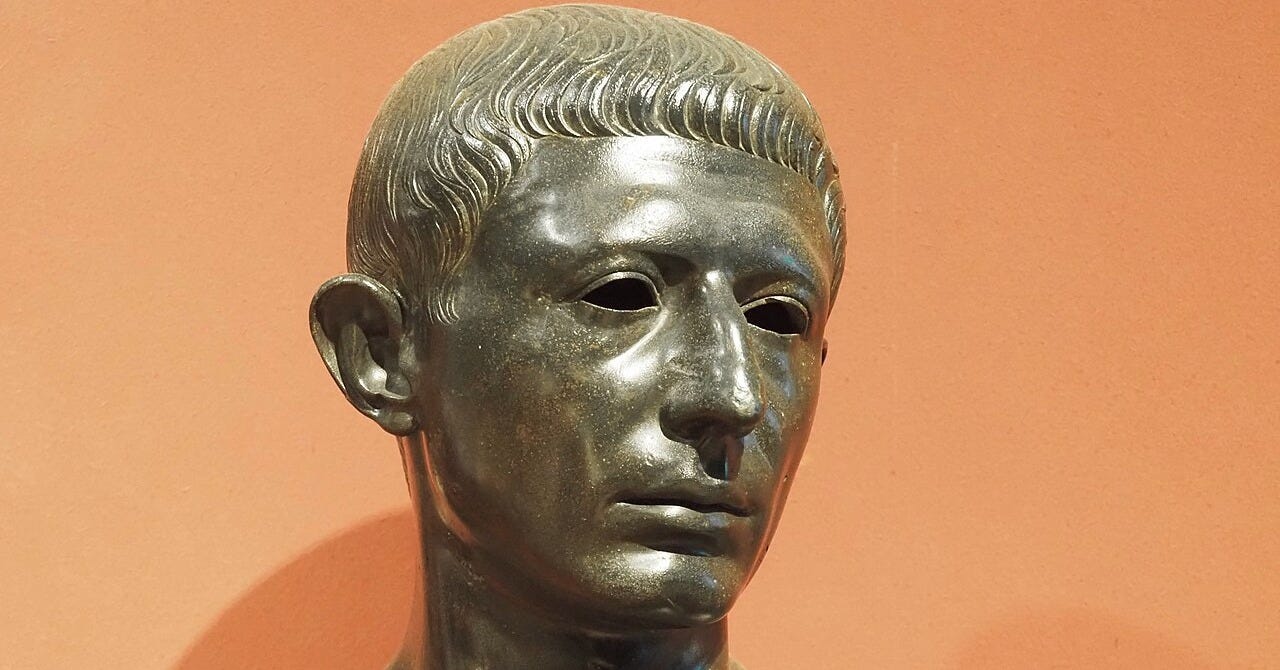
The Story of Cato’s Suicide
Historically, Cato the Younger (95–46 BCE) was a Roman senator and Stoic philosopher known for his uncompromising moral integrity. He lived in the Roman Republic as it was on the verge of becoming an Empire. As Dr. Prudlo recounts, “Cato is the standard bearer of Republican virtue. He is the great defender, one of the last defenders along with Cicero of the goodness of the Roman Republic.” During the Roman Civil War, Cato opposed Julius Caesar’s seizure of power, aligning with Pompey and the senatorial faction to preserve the Republic.
When it became clear Julius Caesar would win the war and become the first emperor, Cato elected to read Plato’s Phaedo, a dialogue on the soul’s immortality, and eviscerate himself. In other words, he would rather commit suicide than live under the tyranny of Caesar—but he places his hope in the immortality of the soul. Cato believes that his suicide will not be his end. In attempt to see what Dante the Poet sees, you can read Cato’s suicide not as an act of despair but as a defiant assertion of liberty: “He dies for freedom. He will not live a slave to a tyrant,” as Dr. Prudlo states.
Cato’s life and death exemplified Stoic ideals: fair, upright, rigid morality, and incorruptible—yet, he was also compassionate, as demonstrated in his fondness toward his wife, Marcia. It is said he granted her whatever she wished, because he knew her wishes were virtuous—he knew her heart.
Posthumously, he became a symbol of republican liberty. In Virgil’s own Aeneid, Cato is presented as the lawgiver of Rome, and in the Roman poet Lucan’s Pharsalia, an unfinished poem about the Roman Civil War written around 61–65 AD, Cato is portrayed as a Republican hero. As Dr. Prudlo explains, Cato’s influence extended even into the early American republic, as George Washington’s favorite play was Cato by Joseph Addison.
Yet, Cato as an emblem of republican virtue only makes Dante the Poet’s use of him more mysterious given Dante’s own political vision.
Dante the Poet desires for the return of a Christian caesar, an emperor to bring peace to the temporal power of the West and push the papacy, the spiritual power, out of temporal affairs and into its original, evangelical mission. Moreover, recall that Dante the Poet places Julius Caesar not amongst the violent tyrants of the seventh circle of hell but amongst the virtuous pagans of limbo. Also, those who murdered Caesar, with whom Cato was aligned, are punished the worst in all of hell except for Judas. For Brutus and Cassius are eternally crunched in the mouths of satan as the chief betrayers of the temporal authority, Caesar, while Judas, the betrayer of Jesus Christ, is in the other mouth of Satan head first. Dr. Prudlo highlights this tension: “Two defenders of the Republic are being chewed in the mouth of Satan. The other defender of the Republic is the gatekeeper to heaven.”
One may try to reconcile these political visions by stating that Dante the Poet envisions a political cosmos in which a republic, like Florence, can have liberty under a Christian emperor—a vision of unity and subsidiarity, a theory Dr. Prudlo suggests.
Yet, this does not seem to reconcile Cato’s incredible place of prominence over other virtuous pagan souls, like Socrates and Virgil, nor explain how a suicide is not only granted salvation but given the role of guardian of purgatory (and arguably of heaven).
Dr. Prudlo suggests an incredible theory.
Dante the Poet holds Cato’s suicide as a precursor to the sacrifice of Jesus Christ.
How could this be possible?
A clue is written in an ancient Roman poem—a poem that Dante the Poet knew well.
And it invites you to contemplate what it truly means to be sovereign of yourself.