


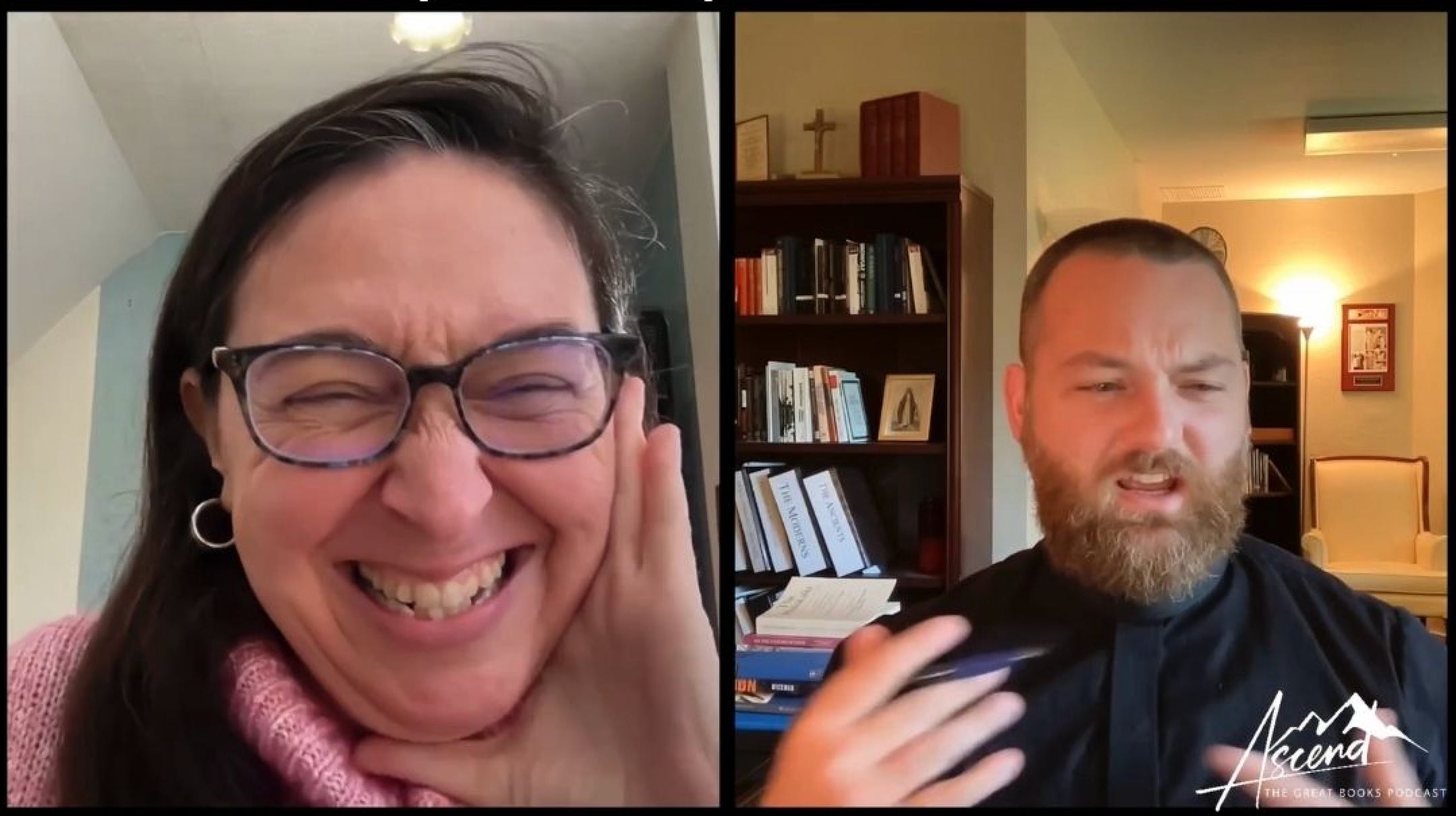
In this episode, Dcn. Harrison Garlick, Chancellor and General Counsel of the Roman Catholic Diocese of Tulsa, welcomes Dr. Zena Hitz, a tutor at St. John’s College and founder of the Catherine Project, to discuss Aristophanes’ comedic masterpiece, The Clouds—vulgar, crude, yet somehow profound.
Here is everything you need to read The Clouds well:
Check out this detailed, Q&A guide to The Clouds
Video discussion with Dr. Zena Hitz (below)
You can read The Clouds with the Ascend Book Club. We are here to help.
Join our reading group and study the great books with us!
To support our mission and get all our resources, become a paid book club member. In addition to the weekly podcast, you’ll get:
Live book club discussions with Dcn. Garlick & guest scholars (monthly)
In-depth reading guides and essays to lead you through the great books
Access to our incredible community of readers
The full archive of members-only content (guides, essays, and podcasts)

Introduction on The Clouds from Dcn. Garlick
Dear Members of the Ascend Book Club,
The Clouds is hilarious, vulgar, and profound. I had the great privilege of discussing this text with Dr. Zena Hitz, a tutor at St. John’s College and the founder of the Catherine Project. Dr. Hitz is wonderful, and I am certainly in her debt for her insights into this famous comedy. Our conversation is the basis of this guide, and it is my hope these introductory themes and substantive questions will help illuminate a text that is very much worth your time.
For Aristophanes, comedy is a teacher—and the play certainly presents us with lessons on morality and education—and how the two are intertwined with familial and societal flourishing. As we have seen in other great works, such as the Iliad and the Oresteia, piety is a virtue of cohesion—it binds the family, the polis, and gods together within an ordered cosmos. In The Clouds, the naturalistic, atheistic education of Socrates and his Thinkery bring about immediate familial and political instability. Aristophanes, even in the midst of ribald humor, is inviting us to understand the role of piety in political flourishing.
Another important theme is Aristophanes’ comparison of the old morality (just speech) and the new morality (unjust speech). The Athens that defeated the Persians at the Battle of Marathon and saved a nascent West is now losing a war to the Spartans. What has changed? Moreover, one of the most famous aspects of The Clouds is that Socrates is a character—but who is he in this play? Is there a distinction between Aristophanes’ Socrates and the one we have seen presented by Plato? Finally, Aristophanes’ portrayal of Socrates—a buffoon who corrupts the young—shaped public opinion and is cited in Plato’s Apology.
The Clouds is certainly a great text. I am very grateful to Dr. Zena Hitz for her wonderful guidance, and I hope you all enjoy this hilarious but insightful work on education, morality, and political flourishing.
In Christ,
Dcn. Harrison Garlick
Podcast Discussion on The Clouds with Dr. Hitz
Good work! The Clouds is a bit crude but an important piece of literature in the saga that is Socrates. Next up on the podcast we are discussing The Frogs with an excellent, wonderful guest. The Frogs tells the hilarious story of Dionysus traveling to Hades to bring back a tragic poet to Athens, which ends in a poetry battle between Euripides and Aeschylus. Lots of fun!
Keep up the good work.
Dcn. Harrison Garlick lives in rural Oklahoma with his wife and five children. He serves as a deacon at Holy Family Cathedral and as Chancellor & General Counsel for the Roman Catholic Diocese of Tulsa. Follow him on X at Dcn. Garlick or Ascend.