


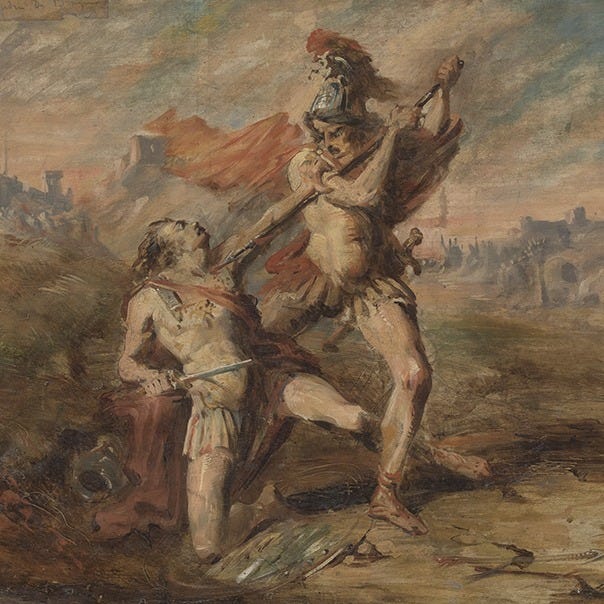
Does Achilles regret dying in Troy for immortal glory?
Many say “yes,” because he tells Odysseus he would rather be alive as a poor farmer than dwell in the house of death.
Others say “no,” as you must recall who is telling the story, Odysseus the liar, who frames himself as the hero, the new Heracles.
Yet, others call for a careful reading of how Achilles speaks of his son and father and the subtle lessons there.
The question of Achilles’ regret, under the careful hand of Homer the philosopher, becomes a question of yours—will you regret how you satisfy your soul?
Reminder: this is a teaser of our members-only deep dives.
To support our mission and get our premium content every week, upgrade for a few dollars per month. You’ll get:
New, full-length articles every Tuesday and Friday (or Saturday!)
The entire archive of members-only essays
Access to our paid subscriber chat room
What is the rage of Achilles?
The Iliad opens with the word “rage,” and it refers to the rage of Achilles—but this is no ordinary rage. It is a Greek word normally reserved for a divine rage, the anger of the gods, but here it applies to a man, Achilles. Why?
Achilles is the son of King Peleus, a mortal, and the immortal sea goddess Thetis. Before their marriage, Poseidon and Zeus were pursuing Thetis, but Prometheus, the titan with the gift of foresight, told them that Thetis’ son would be greater than his father. Zeus was always wary of having a son that could usurp him, as he had done to his father, Cronos, and as Cronos had done to his father, Uranus. It is one reason Zeus delighted in sleeping with mortals, as their demigod sons would never be strong enough to dethrone him.
To preserve his sovereignty, Zeus married Thetis to a mortal, Peleus, to ensure that the offspring would only be part god and thus not a threat. In other words, Achilles has a spirit that was destined to be the new Zeus, the new king of all the gods and men, trapped in a mortal body—an existential angst. Moreover, he has a natural superiority, an unmatched spiritedness that chafes at obeying lesser men. He was supposed to be the king of the gods, and now he is not even the king of men.
The Iliad opens with rage, because this is the central conflict: Achilles, the best of men, is dishonored by the leader of the Achaean army, King Agamemnon.
Yet, Achilles has a choice.
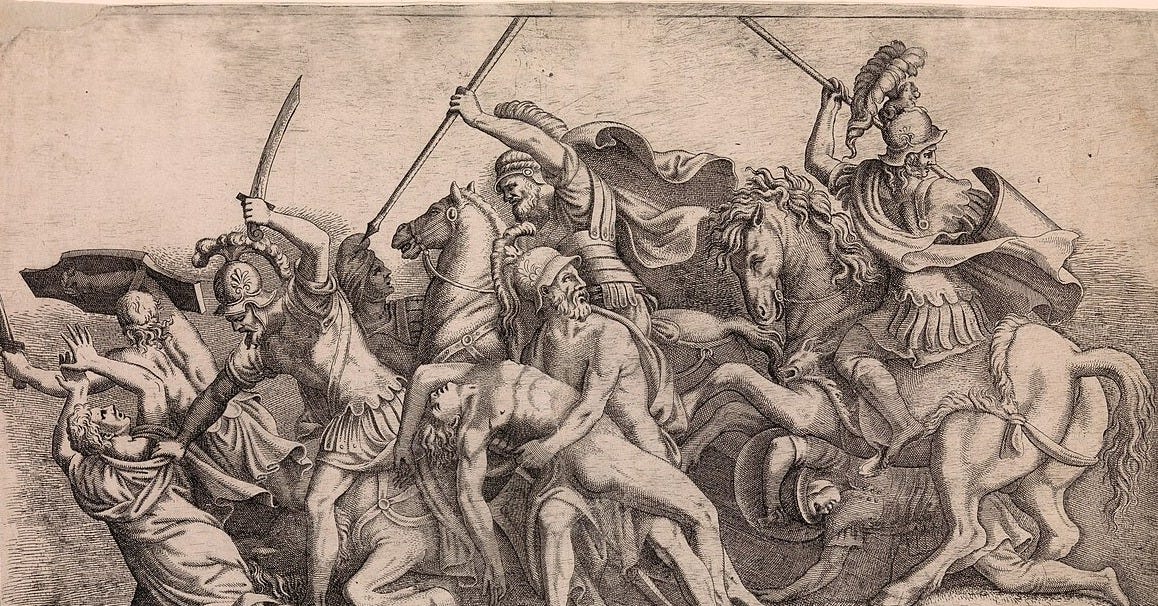
What are the fates of Achilles?
Unlike most men, Achilles was given a choice as to what fate he would endure. In the Iliad, Achilles tells an emissary of Achaeans, including Odysseus, that his mother, Thetis, presented him with two fates. He could either live a long, peaceful life at home, or he could fight and die in the Trojan war. But here is the catch. If he elects to live a peaceful life at home, his name will die out soon afterward; but, if he elects to fight and die in Troy, he will win everlasting glory (kleos)—his name will never be forgotten.
After King Agamemnon dishonored him, Achilles is tempted to return home and live out the fate of a peaceful life. Yet, after Hector, Prince of Troy, killed Achilles’ friend Patroclus, the rage of Achilles is redirected, and he decides to remain at Troy and kill Hector—and win his everlasting glory.
Achilles kills Hector, and his god-like rage returns to a simmer, especially through the acts of Hector’s father, King Priam of Troy. The Iliad ends with burial of Hector, but we know from tradition that Achilles died prior to the fall of Troy—he was shot in the heel by Prince Paris of Troy; hence, the famous idiom of an “Achilles’ heel.”
And many hold that Achilles is the hero of the Iliad.
But does his heroic reputation survive the Odyssey?
How is Achilles a hero?
It would be difficult to exaggerate the mimetic power of Achilles, especially for young men.
He is naturally superior and can best anyone in sheer power, yet he suffers the idiocy of lesser men. He has the spirit to be the king of the gods, but he is not even the king of men—and this rage of his aligns well with the existential angst of many young men who find themselves better than their so-called superiors.
Achilles is a sign of natural right, of a natural superiority and right to rule that outshines the so-often pusillanimous, bureaucratic leadership of lesser men. He is the most thumotic man who has ever lived, a soul with an unquenchable thirst for glory coupled with the capacity to accomplish the great deeds that earn it.
Yet, does Achilles regret his decision?
In the Odyssey, Odysseus travels to the house of death and speaks to the shade of Achilles—and many interpret his words to express regret for his life of glory.
And this would be devastating to the mimetic power of Achilles, to his life of natural superiority and natural right.
Did Achilles regret his decision?
Or is the truth something more subtle, something Homer wants you to notice about what it means to be a hero?