


Did Jesus appear in the Old Testament?
Many would say no. But the Bible stories are not that simple.
Who stood in the burning bush? Who visited Abraham? Who wrestled with Jacob?
Many Old Testament passages lend themselves to mystery. God seems to reveal Himself, but then we are told “no one has ever seen God.”
Who did these people see when God appeared to them?
Let’s examine the mystery.
Join our slow read-along of Plato’s Republic!
We begin reading this life-changing book on October 6. Check out the full reading schedule here.

To support our mission and get all our resources, become a paid book club member. In addition to the weekly podcast, you’ll get:
Live book club discussions with Dcn. Garlick & guest scholars (monthly)
In-depth reading guides and essays to lead you through the great books
Access to our incredible community of readers
The full archive of members-only content (guides, essays, and podcasts)

The Mystery of the Embodied God
Did Jesus Christ come to earth prior to His birth? In other words, did Jesus Christ, prior to the Incarnation, appear in the Old Testament? This may sound like an odd claim, but it may be the answer to an ongoing mystery in the Old Testament.
What is the mystery?
In the Old Testament, there is an angel who seems different from other angels. It is “the angel of the LORD” who speaks as God and is even called God. Then, to make it even more perplexing, there is the mysterious “commander of the Lord’s armies” who seems like the angel of the LORD—and allows Joshua to worship him. Even further, there is a time where God seemingly appears bodily and sits, eats, and walks with Abraham.
Who is the angel of the LORD?
Who are these seemingly bodily appearances of God?
The Angel who Speaks as God
We should recall that the word “angel,” as used in the Bible, simply means “messenger.” And while this term is normally reserved for a spiritual or heavenly messenger, the simple use of the term “angel” does not immediately mandate that it means the beings we now call “angels.” It simply means a heavenly messenger—and that broad definition leaves some room to question who or what is giving the message.
It is often clear that the angels are not God, because the angels speak of God in the third-person. For example, angels come and announce the judgment of God, like in Sodom (Genesis 19:13); angels will at times even pray to God (Zechariah 1:12); and at times the angels are even named, like Gabriel (Daniel 9:21–23; Luke 1:19), Michael (Daniel 10:13; Revelation 12:7), and Raphael (Tobit 12:15).
In all these cases, the angel matches the common perception—he is a heavenly being with a message from God but he is not God.
Yet, one angel seems to break this mold.
In Genesis, when Abraham is about to sacrifice Isaac, “the angel of the Lord” says:
“Do not lay your hand on the lad or do anything to him; for now I know that you fear God, seeing you have not withheld your son, your only son, from me” (Gen 22:12)
The angel, by saying “from me,” seems to refer to himself as God. Later in the narrative, the angel of the LORD speaks again:
“By myself I have sworn, says the Lord, because you have done this, and have not withheld your son, your only son, I will indeed bless you, and I will multiply your descendants as the stars of heaven and as the sand which is on the seashore. And your descendants shall possess the gate of their enemies, and by your descendants shall all the nations of the earth bless themselves, because you have obeyed my voice” (Gen 22:16-18).
Here, the angel of the Lord seems to speak in God’s name directly, which is notable, but he is still distinguishable from God—as he proclaims “says the Lord.” In other words, he still seems unique amongst the angels but clearly not God.
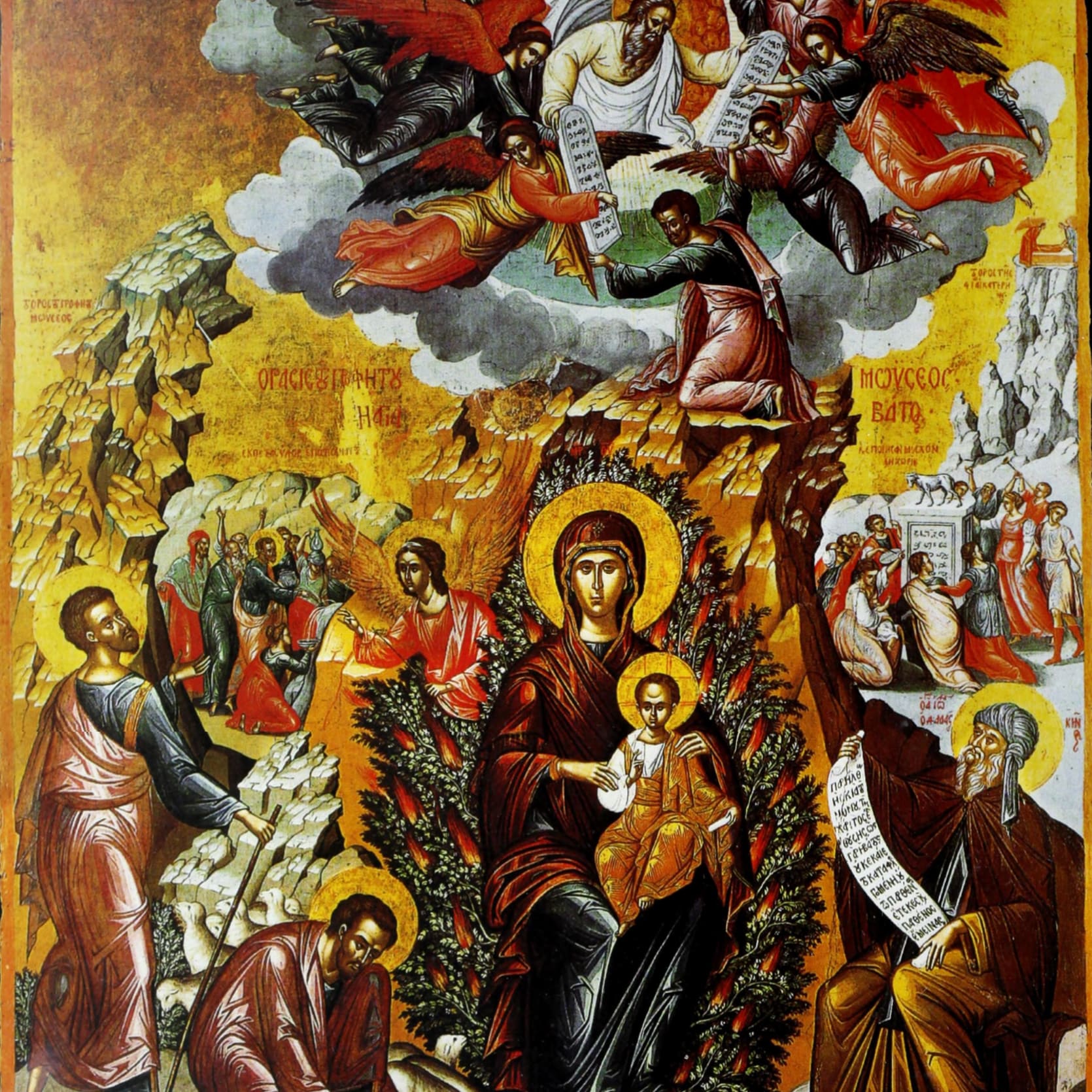
But in other passages, “the angel of the Lord” seems to speak directly as God. The most famous example may be the burning bush—which is so clearly God that most cultural depictions of the burning bush remove the angel from the story. Did you know there was an angel in the burning bush when God spoke to Moses? Let’s look.
In this passage, there is seemingly no distinction between “the angel of the Lord” and God.
And the angel of the Lord appeared to him in a flame of fire out of the midst of a bush; and he looked, and lo, the bush was burning, yet it was not consumed. And Moses said, “I will turn aside and see this great sight, why the bush is not burnt.” When the Lord saw that he turned aside to see, God called to him out of the bush, “Moses, Moses!” And he said, “Here am I.”
In fact, the angel of the Lord is referred to as “God” or the “LORD” for the rest of the passage, including identifying Himself as the God of Abraham, Isaac, and Jacob (Ex 3:6) and the famous “I AM, THAT I AM” (Ex 3:14). Very similar scenes happen with Hagar (Genesis 16:10–13); with Jacob where the angel of the Lord states, “I am the God of Bethel” (Gen 31:11-13); and in Judges when the angel of the Lord states, “I brought you up from Egypt” (Judges 2:1).
Who is “the angel of the Lord”?
Maybe it is simply a unique angel who can speak directly as God.
But there is another problem.
“The angel of the Lord,” or at least something similar to him, allows people to worship him as God.
