


Would you be good even if no one was watching?
What if you could do whatever you wanted and never suffer the consequences?
In Plato’s Republic, the young, spirited Glaucon presents this challenge to Socrates: tell us why the just life is better than the unjust life. Most people, he says, only agree to practice justice because they are afraid of someone being unjust to them—but the best life would be to appear just while being unjust. You receive the benefits of both.
To further push his claim, Glaucon describes the perfectly just man who has a perfect reputation for injustice. And what happens to this good man who is perceived as unjust?
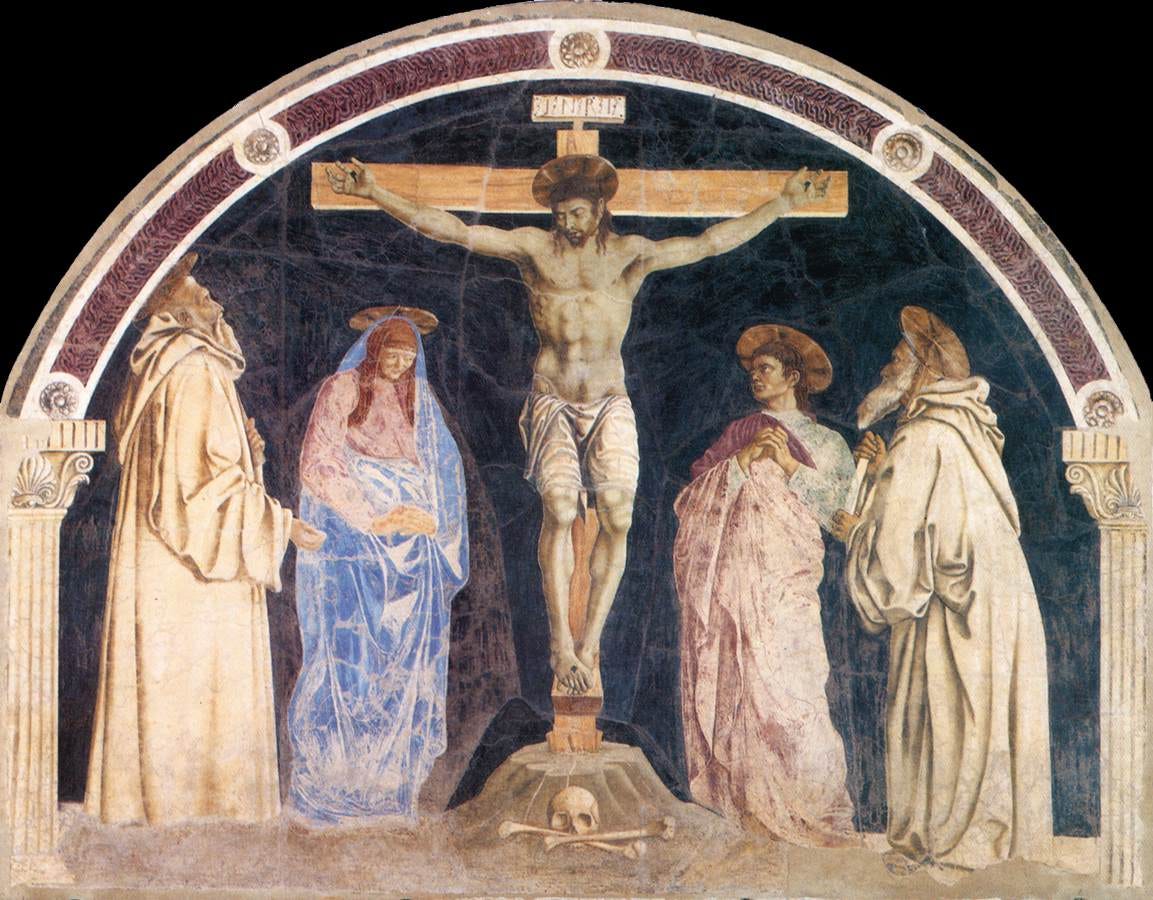
He is crucified.
Come wrestle with one of the most challenging and haunting passages in the Western Tradition.
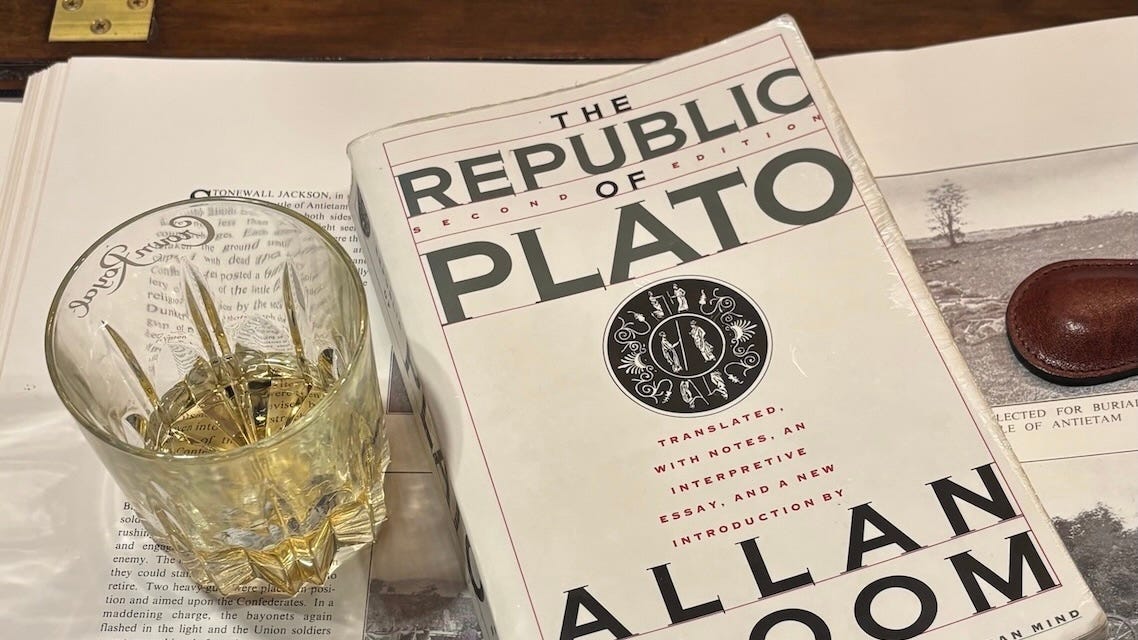
Join our slow read-along of Plato’s Republic!
Plato’s Republic is the masterwork of masterworks. Check out the full reading schedule here.
To support our mission and get all our resources, become a paid book club member. In addition to the weekly podcast, you’ll get:
Live book club discussions with Dcn. Garlick & guest scholars (monthly)
In-depth reading guides and essays to lead you through the great books
Access to our incredible community of readers
The full archive of members-only content (guides, essays, and podcasts)

The Unjust Life is Happier
Is it actually good to be just?
In the beginning of Book 2 of the Republic, the young, spirited Glaucon proposes that what is naturally good for man is to be unjust, and that what we call “justice” is simply a social compact, an agreement, to not be unjust toward one another. You see, even though everyone wants to be unjust (to maximize their own gains), everyone hates suffering injustice. In fact, Glaucon proposes that suffering an injustice far outweighs whatever benefits you would gain from being unjust. As such, the benefit of being unjust is not worth the risk of suffering an injustice; thus, we all enter into a social contract to not be unjust toward one another—and we call this “justice.”1 Notice that justice, in Glaucon’s argument, is a convention, something not only artificial to man but even contrary to his natural inclination.
But, what if you could get the benefit of the social contract and the benefit of being unjust?
Glaucon says this would be best: to appear to be just but be unjust. In this manner, you receive the benefits of having a reputation of justice but also receive the gains of being unjust.
But oddly, this is not what Glaucon believes.
So, why is he making such a strong argument for being unjust?
An Empire in Decline
Athens is an empire in decline. The excellence and the piety of Athens are in decay, and young, spirited men, like Glaucon and his brother Adeimantus, see everything around them modeling this theory of justice: it is best to appear to be just but be unjust. It is the life of a clever tyrant. The argument is that what is natural to man is being unjust. In other words, man’s natural condition is pleonexia—the unjust and insatiable desire for more. Humans love gain. You want more and more, whether it be power, pleasure, wealth, honor, etc.—and the best way to achieve this is to appear to be just but be unjust.
Glaucon does not believe this—or at least he does not want to believe. For Glaucon and his brother Adeimantus (both brothers of Plato), everything around them is telling them that this is the best life—to be unjust with a reputation for justice. The unjust man has a happier life. And, moreover, the old myths, the Homeric tales, do not adequately answer this question.
To wit, neither Athenian civilization nor the poets’ tales can show why the unjust life is not the happier life.
And Glaucon is at a crossroads. Does he live the life of the tyrant—the unjust life that promises gain and happiness? Or does he live a just life?2 Glaucon wants to understand. He wants Socrates to persuade him that the just life is the best life. So, he makes a series of arguments to Socrates on behalf of injustice, and asks Socrates to defend justice. Glaucon’s proposal at the beginning of Book Two of the Republic frames the main questions of the text: what is justice and is justice more profitable to the soul than injustice?
To answer this question, Socrates will take Glaucon, Adeimantus, and through a wild dialogue that explores theology, the soul, education, politics, ontology, the good, and much more. The Republic contains within it almost everything, which is why it remains a reference point to the entire Western philosophical tradition—and a text worth a slow, attentive read.
But, Glaucon’s argument has a shocking statement.
One that you cannot ignore.
One that makes you wonder not only about justice but whether there is a subtle and gentle work of God moving underneath this text…
A Pagan Prophecy for Jesus Christ
Glaucon wants to show that justice is a good that is only desired for its effects—like exercise or medicine. The good itself is not good nor delightful, it is simply desired for its outcome; as such, if you can achieve the outcome without the arduous good, that is better. Therefore, Glaucon argues that all one needs to delight in the benefits of justice is the reputation for justice—not justice itself. Again, he argues to be unjust but with the appearance of justice is the happier life.
To prove his point, he contrasts two men:
A perfectly unjust man who has a perfect reputation for justice; and
A perfectly just man who has a perfect reputation for injustice.
What is he doing here? He’s removing all the beneficial effects of being just (reputation, honor, respect, etc.) to see if the soul being just is good in and of itself—and if that good is more desirable than the unjust life.
The unjust man with the reputation for justice receives everything he wants. He lives a life of power, pleasure, and wealth and seemingly dies a happy man.
What happens to just man who has a reputation for injustice?
He’s crucified.
Glaucon states:
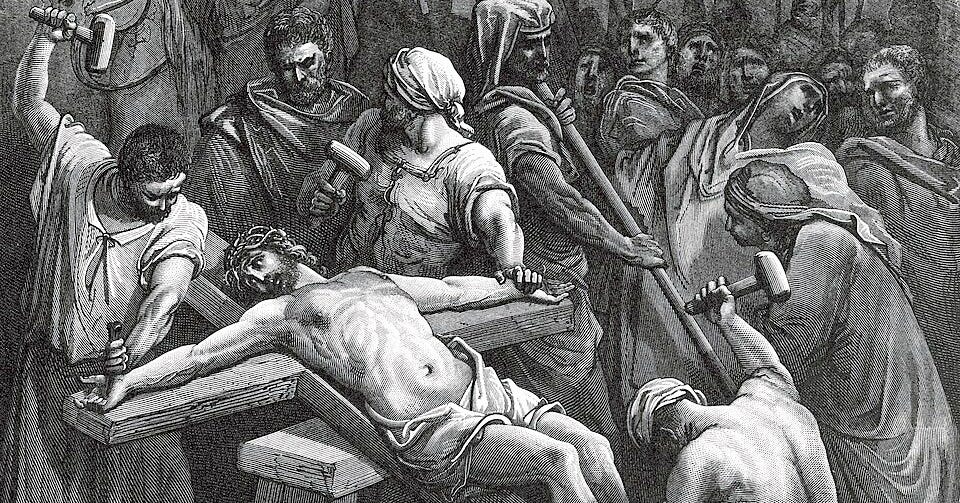
They’ll say that the just man who has such a disposition will be whipped, racked, bound, have both his eyes burned out, and at the end, when he has undergone every sort of evil, he’ll be crucified and will recognize that one shouldn’t want to be, but to seem to be, just (361e–362a).
The Christian imagination cannot read this passage without immediately thinking of Jesus Christ. Glaucon’s intent in this passage is to show the perfectly just man with a reputation for injustice does not live a happy life. Amidst losing every worldly good, the justice of his soul does not seem to benefit him any—in other words, being just is not worth such a sacrifice.3
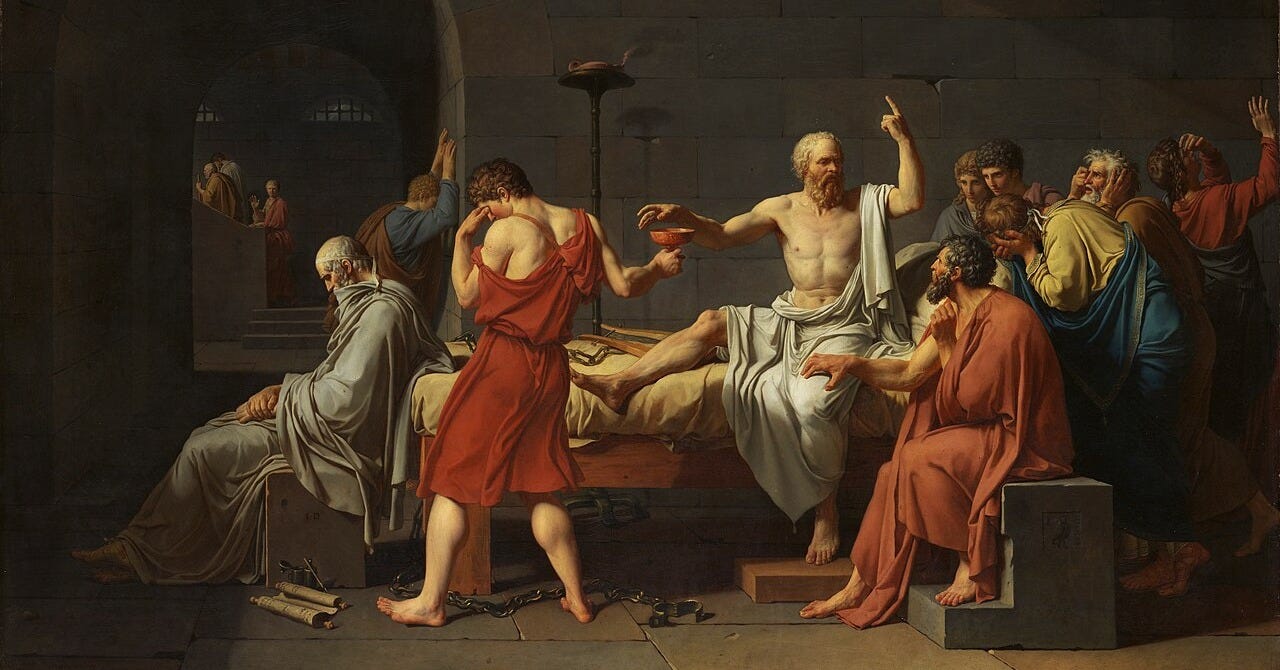
Plato, as the author, most likely has in mind here an allusion to his teacher, Socrates, who though a just man was executed for his false reputation for injustice (i.e., impiety and corrupting the youth). Notably, however, this death is far worse that Socrates’, as Socrates was not tortured and was made to drink Hemlock—a slow acting poison.
The death, however, is much more akin to Jesus Christ, who, being perfectly just but suffering a reputation for injustice, was tortured (e.g., scourged, crown of thorns, etc.) and then crucified.4
But could this really be a prophetic but unintentional prophecy about Jesus?
