


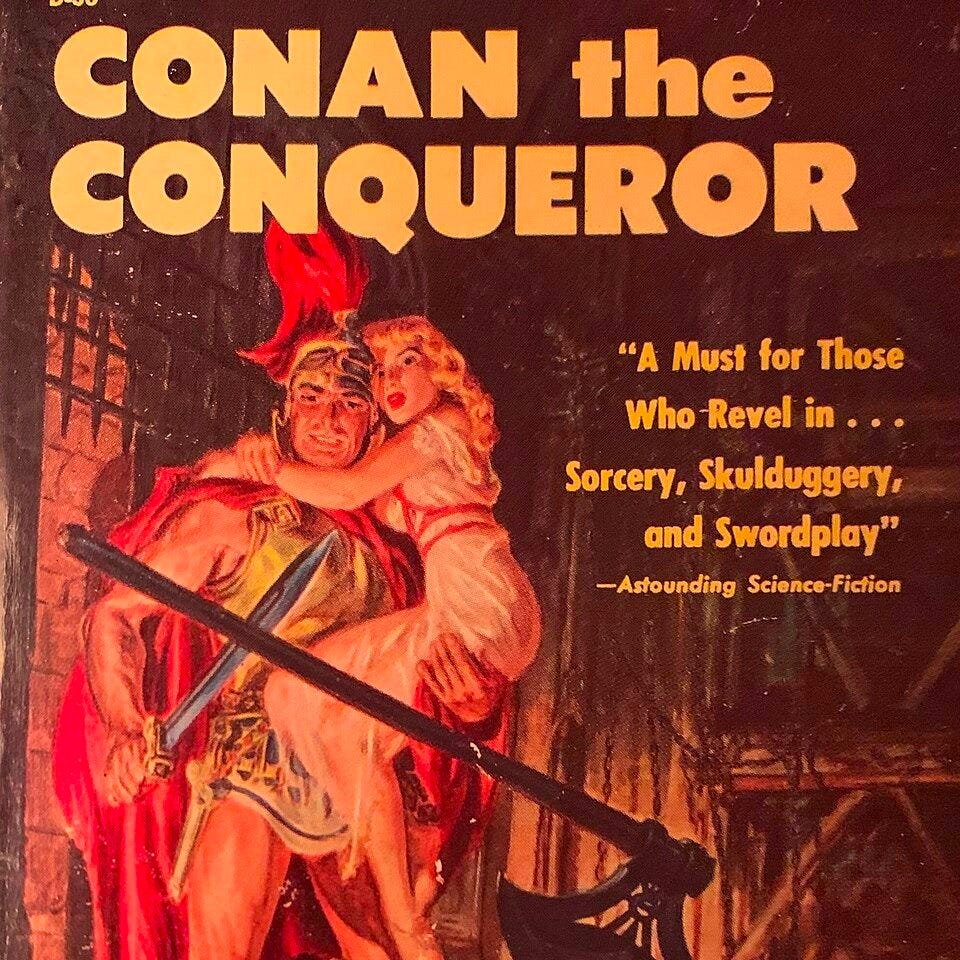
Does civilization make men weak?
“Civilized men,” wrote Robert E. Howard, “are more discourteous than savages because they know they can be impolite without having their skulls split.”
Many people miss the political critique of Howard’s most famous pulp character, Conan the Barbarian, because all they know is the 1980s movie. Civilization makes men soft, limp-wristed, and unaccountable.
Howard, however, wrote another character: Solomon Kane—a civilized, austere Puritan who will traverse the world to pour out God’s wrath upon the wicked.
So, Howard offers young men a question.
Has civilization tamed you, made you safe and timid?
Or is your strength in service to making civilization right and just?
Reminder: you can support our mission and get all our members-only content for just a few dollars per month:
New, full-length articles every Tuesday and Friday (or Saturday!)
The entire archive of members-only essays
Access to our paid subscriber chat room
The Weakness of Civilized Men
Few lines from Robert E. Howard’s stories could summarize his philosophy better than this observation from his famous Conan the Barbarian short story, “The Tower of the Elephant”:
“Civilized men are more discourteous than savages because they know they can be impolite without having their skulls split, as a general thing.”
Howard loves this juxtaposition—but what exactly does he mean? Conan is a barbarian. He’s an uncivilized force of primal strength and unwavering will. He’s intelligent, swift, and very vitalistic—but he’s also straightforward, a man of commitment, someone who is true to himself.
Yet, when he comes in from the wild lands to the city, as he does in “The Tower of the Elephant,” he is perplexed by the city dwellers. It is the civilized man who is a liar, manipulator, and cheat. The man of the city is one who speaks out of both sides of his mouth. He is soft, weak, and untrustworthy. Conan seems innocent and gullible, because a man who says one thing and does another is almost unbelievable to him, a repugnant creature of contradiction.
But it is the man of the city, the so-called civilized man, who mocks Conan for being a barbarian.
Howard makes you ask: what does it mean to be civilized?
And why this type of civilization would produce weak-willed, milquetoast liars?
These men can speak, as noted above, without any immediate accountability for their words.
What is Howard attempting to teach us?
The Philosophy of Conan the Barbarian
Howard was born in 1906 in Texas. He wrote hundreds of stories for pulp magazines, chiefly Weird Tales, from the age of nineteen. He was a high school graduate, a voracious reader, steeped in Protestant culture but not necessarily religious, and a lover of Jack London and Rider Haggard.
Yet, Howard saw that the modern civilized man was lacking a certain vitality, a primal integrity between his heart and his actions. Civilization had made man mild and tame and wrapped him in a veneer of courtesy. The raw strength and primordial energy to overcome seen in Conan the Barbarian was alien to the timid, polite happenings of the civilized man. Moreover, the vicious man could navigate this timidity, this civilized courtesy to mask his own evil actions without fear of any immediate repercussions. In the barbarian wilds, a man who lies or speaks ill of another may be forced to defend himself from an attack—but the civilized man is one free of immediate accountability, a man free of immediate consequence.
Howard presents Conan as a primitive who is somehow more human than his lackluster, mealy-mouthed urban counterpart.
And like all good writers, Howard shows you this juxtaposition in his Conan stories and allows you to work out the philosophy that animates it.
And a recurring theme is the fact that civilized man is afraid.
Yes, the civilized man is unafraid that his words and actions will have any immediate consequence, that he will not be forced to defend his own speech—in this way, he is free from immediate consequence. But, overall, he is a coward—one habituated to the softness of urban life.
He cannot radiate life like Conan can.
He cannot overcome life challenges like Conan can.
Howard presents Conan as someone who is not only able to overcome the challenges of life, but he seeks them out. He enjoys the test and the victory. In the “Tower of the Elephant,” Conan knows of a treasure that everyone says cannot be stolen—so, of course, he decides to steal it. Most of the “civilized” men would never attempt to steal the treasure of an evil sorcerer, but Conan is not afraid. He does not let fear limit him. He meets the challenges of life with a “panther” like strength and agility alongside an adamantine will. His instincts are toned. He is accustomed to doing difficult things. The civilized man, the urban man, is not.
And Howard’s Conan is not a saint.
He is, however, true to a moral code, but it is the code of the god of Crom—a harsh, silent god that gives you the strength you need to overcome your enemies and the challenges of life. Don’t bother praying to Crom for help, as you have all you already need—and he despises the weak. Howard’s brilliance is setting the primal, primitive hero of Conan the Barbarian alongside the weakness of civilized man. Somewhere along the way, what is called “civilization” tamed man, bridling him to a certain fearfulness and smallness of soul.
Howard is presenting a critique on modern man amongst the genuine fun of sword and sorcery.
But Conan is not Howard’s only character.
The Savage Tales of Solomon Kane
In contrast to Conan the Barbarian, Howard also wrote stories about Solomon Kane, a Puritan hero who was an avenger for God. Solomon Kane echoes a similar philosophy of Conan except within the austere, Christian demeanor of a Puritan hero. He is Howard’s only series character who is explicitly a Christian—part Puritan, part Cavalier, with, as Howard later wrote of him, a touch of the philosopher and more than a touch of the pagan. Another fantasy writer called Kane “God’s angry swordsman.” Whereas Conan is vitalistic, having both mirth and melancholy, Kane has none of the mirth. He is cold, ascetic Puritanism.
A great introduction to Kane is “Red Shadows,” the first Solomon Kane story. It tells of Kane hunting down a band of bandits across the world to avenge the death of a young French girl. Notably, the girl was a stranger to Kane, yet the injustice of the heinous act kneads within him an inexhaustible desire for justice. Unlike Conan, Kane has a much more clear moral code and mission in life—being God’s vengeance. Howard, not necessarily a religious man, does not always present Kane as a true Christian hero, but the aesthetics are there—and he is certainly different than the code of Crom in Conan.
“Red Shadows” shows Kane as a vessel of God’s wrath. Whereas Conan shows us a critique of civilized man, Kane seems to show us the need for a just man within society. Kane is civilized. He is Christian. And he is needed—as society is filled with injustices that cry out for a reckoning. Howard, however, presents Kane as also coming to know his mission—as being driven by the desire for justice without being able to fully articulate what drives him.
Kane, as a civilized man, does not seem to fall into the critique seen in Conan. Kane’s strength and will are tempered by Christianity, but he remains a violent force bringing justice to the unjust. And Howard even shows Kane channeling his primitive, primal powers, as his “blood memory,” like Buck in Call of the Wild, flashes impressions and instincts of a primordial world.
Kane is arguably Howard’s presentation of a character who is both strong and civilized—but then must work to free that civilization from evil.
Conan and Kane as Societal Commentaries
Setting Conan and Kane side by side invites much consideration. Conan shows how civilization can make men weak and unaccountable for their speech. Kane seems to show that man can be civilized and strong—and even a protector of the weak. Conan is a creature of vitalism and mirth, but Kane is a creature of austerity and asceticism. Neither will suffer milquetoast men, but Kane’s moral code is more refined, acting according to justice.
Amongst the dumb fun of pulp stories, Howard offers you several critiques on civilization and the masculine soul.
They are lessons worth considering.
Want to Read Robert E. Howard?
This week on the podcast, we are discussing “Red Shadows,” a savage tale of Solomon Kane with the always wonderful Alberto Fernandez who joined us previously to discuss “The Tower of the Elephant,” a classic Conan the Barbarian story.
Join us!
Dcn. Harrison Garlick is a deacon, husband, father, Chancellor, and attorney. He lives in rural Oklahoma with his wife and five children. He is also the host of Ascend: The Great Books Podcast. Follow him on X at Dcn. Garlick or Ascend.
Off to read about Kane! Thank you and the late Howard for this article.