


You’ve spent your whole life following Jesus.
The murderer repents before his execution.
Both of you enter heaven.
Both of you receive eternal happiness with God.
In Jesus’ parable of the laborers in the vineyard, the workers who toil all day receive the same wage as those who labored just one hour.
Jesus presents eternal life as an equal, generous gift to all who respond to His call.
Yet the question lingers: Does that mean the lifelong saint and the deathbed convert experience heaven in the same way?
Or is there more to the story?
Reminder: this is a teaser of our members-only deep dives.
To support our mission and get our premium content every week, upgrade for a few dollars per month. You’ll get:
New, full-length articles every Tuesday and Friday
The entire archive of members-only essays
Access to our paid subscriber chat room
The Laborers in the Vineyard
In the Gospel of Matthew, Jesus gives the famous parable of the laborers and the vineyard (20:1-16).
“For the kingdom of heaven is like a householder who went out early in the morning to hire laborers for his vineyard. 2 After agreeing with the laborers for a denarius a day, he sent them into his vineyard. 3 And going out about the third hour he saw others standing idle in the market place; 4 and to them he said, ‘You go into the vineyard too, and whatever is right I will give you.’ So they went. 5 Going out again about the sixth hour and the ninth hour, he did the same. 6 And about the eleventh hour he went out and found others standing; and he said to them, ‘Why do you stand here idle all day?’ 7 They said to him, ‘Because no one has hired us.’ He said to them, ‘You go into the vineyard too.’
8 And when evening came, the owner of the vineyard said to his steward, ‘Call the laborers and pay them their wages, beginning with the last, up to the first.’ 9 And when those hired about the eleventh hour came, each of them received a denarius. 10 Now when the first came, they thought they would receive more; but each of them also received a denarius.
11 And on receiving it they grumbled at the householder, 12 saying, ‘These last worked only one hour, and you have made them equal to us who have borne the burden of the day and the scorching heat.’ 13 But he replied to one of them, ‘Friend, I am doing you no wrong; did you not agree with me for a denarius? 14 Take what belongs to you, and go; I choose to give to this last as I give to you. 15 Am I not allowed to do what I choose with what belongs to me? Or do you begrudge my generosity?’ 16 So the last will be first, and the first last.”
The response of the workers who worked the longest is the response of many readers: this seems unfair!
The Master answers the laborers by stating that he is allowed to be generous with what belongs to him.
But the Master’s answer does not seem to resolve the tension in the story.
Is there really no difference between those who labor all day and those who labor only one hour?
All parables are actually spiritual lessons. So how should this be read?
Pushing into this question leads to a profound understanding of eternal life (and how you should start preparing today).
How to Read the Parable
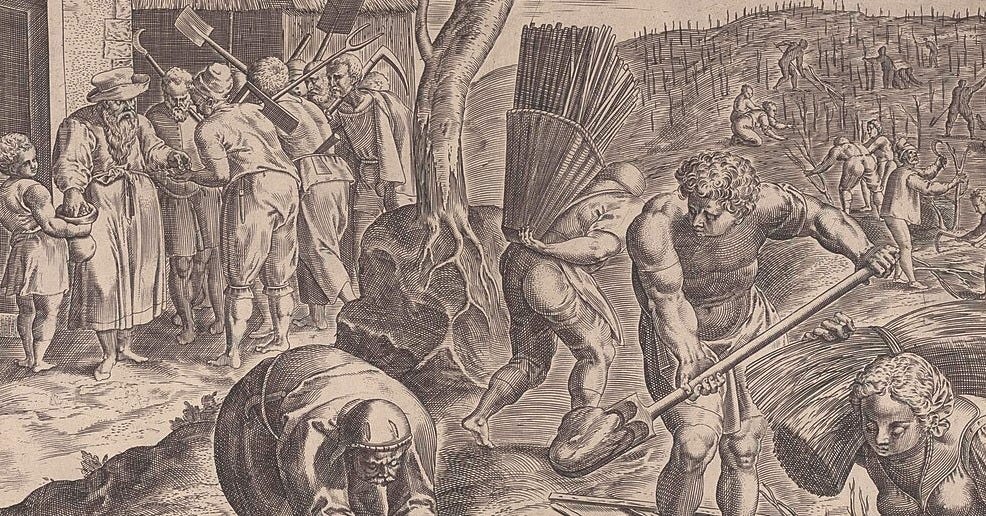
The first step in understanding the question of the parable is understanding the nature of Jesus’ speech. A parable is a simple story, usually rooted in agrarian life, that is allegorical—this means that each thing in the story is a sign or type of something else. Each parable has a “hidden sense” that reveals a truth about the Kingdom of God—and how that truth applies to your life.
What is the allegorical meaning of this parable?
The Master is Jesus Christ, and the laborers are the people he calls to be his disciples.
The vineyard is the Church at work in the world.
The day of work represents your life.
Some spend their whole life laboring for Jesus Christ, some start their work for Him halfway through their life, and others only labor a short time before their death. At the end of the work day, the darkness comes and the labor of this life is over. Each worker is then judged by the Master, as each soul will be judged by Jesus Christ.
Christians see the payment (the denarius) as salvation. The laborers are judged and given the denarius, eternal life. No matter if they labored for many hours or almost none at all, they are given the same payment—each laborer receives eternal life with Jesus Christ.
But again, the allegorical reading of the poem imports the same tension as the literal read. If you agree that Jesus, the Master, can be generous with what is His to give, then He can give the same eternal life to those who labored less as to those who labored more.
But is this true? Does everyone receive the same eternal life from Jesus?
Does the amount you labor in this earth not affect your heavenly reward?
Does the saint who works amongst the poor and configures her soul to Christ her whole life receive the same eternal life as the murderer who repents on his deathbed?
The lesson of this parable is profound.
But it must be seen as part of a larger teaching in the New Testament.
