



“Christmas trees are pagan!”
You’ve probably heard it a dozen times this season already.
Critics love to point the finger: Christians stole evergreen trees from ancient winter rituals, decked them out, and slapped a biblical bow on top, proving the whole holiday is inauthentic, hypocritical, even unbiblical.
But what if that’s not the full story?
What if accusing Christianity of “pagan plagiarism” actually reveals a narrower, more limited way of seeing the world—one that misses the deeper Christian vision altogether?
To truly understand Christmas—and why your twinkling tree isn’t a secret pagan idol—you need to stop thinking like a pagan... and start thinking like a Christian.
Reminder: you can support our mission and get all our members-only content for just a few dollars per month:
New, full-length articles every Tuesday and Friday
The entire archive of members-only essays
Access to our paid subscriber chat room
Think like a Christian about Christmas
Christians want you to think like a Christian about Christmas—and that might be much broader than you think. One of the basic distinctions within Christianity is between nature and grace. It is a distinction about the origin of things. Nature comes from God the Creator. Christians believe that the world is an ordered whole, an intelligible cosmos (Romans 1:18-32). Creation is ordered, so much so that this order in things can be studied and is the basis for our modern sciences. Humans too have a shared nature, whether Christian or not. Man is a rational animal. He has the gift of reason.
But how is this distinct from grace?
Grace is a word often used but rarely defined. In Christian terms, grace is the divine life of God. He offers you His grace through Jesus Christ, and you can accept it to participate in the divine life. This is not something mankind has by nature but rather a gift that must be chosen. What is means to be a Christian, a “little Christ,” is to be someone who has chosen to participate in the divine life through the saving work of Jesus Christ and His Church.
What is the relationship between nature and grace?
Christians believe that the God who gave you the gift of reason and an intelligible world is the same God who died on the cross for you. In other words, both nature and grace have the same source: God. As such, there should be a harmony between reason and faith, science and religion, philosophy and theology, et al. Christians see reality as an ordered whole.
More than just harmony, nature and grace exist in hierarchy. St. Thomas Aquinas and those who follow him would say that grace perfects nature. In other words, grace both heals the wounds of your nature and elevates, while nature serves as a foundation upon which grace is built. You could also see nature as a tilling of the soil, and grace as the reception of the seed.
What are some examples of grace perfecting nature?
A good example of this dynamic is virtue. The virtues are a certain health and beauty of the soul, and there are four natural virtues: prudence, justice, temperance, and fortitude. Christians hold that these four are available to all mankind, Christian or not, as they are part of the perfection of your shared human nature—what it simply means to be a rational animal and to live according to reason. In fact, these four virtues are listed first in Plato’s Republic (375–380 BC) and also in the Hellenized Hebrew text the Book of Wisdom (50–30 BC).
Then there are theological virtues of faith, hope, and charity, and Christians believe these are only given to the soul by participating in the life of God, His grace. These three virtues must be given to a soul, as they are not natural to it. Yet, once given, these three supernatural virtues help perfect and elevate the natural virtues. For example, having faith (the assent of the intellect to revealed truth) or hope (the desire for the eternal kingdom of God and His eternal happiness) helps you to be more prudent, just, temperate, or brave. They work together to make the soul beautiful as Christ is beautiful. Nature and grace are not antagonistic but rather congruous—two distinct realities from the same Divine Author.
To understand Christmas, you must first think like a Christian—and this means understanding the distinction between nature and grace.
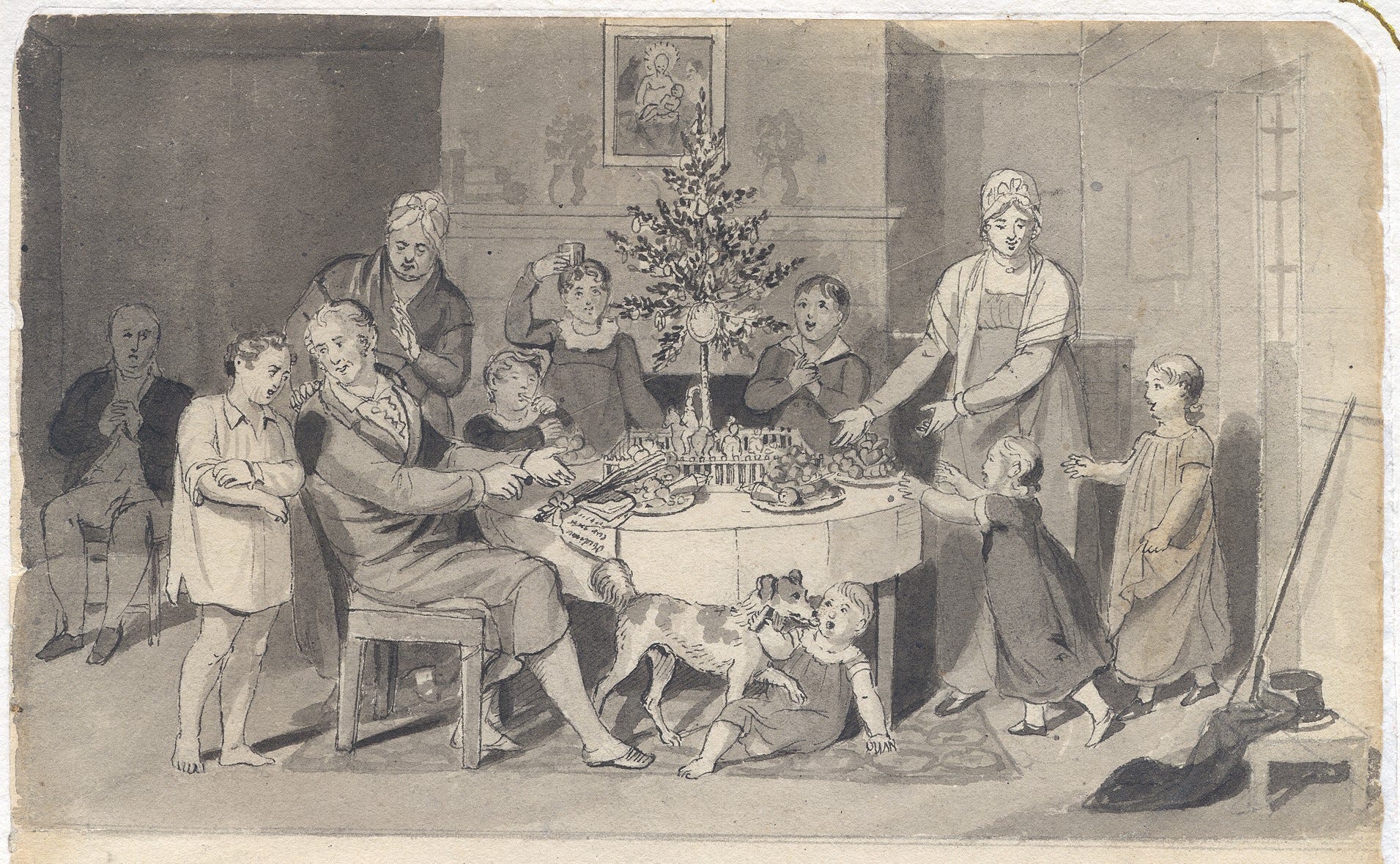
Everything good in paganism is Christian
Everything good in paganism is Christian. And this claim makes sense if you understand the grace and nature distinction. For unlike most paganism, Christianity is not an enclosed religion but holds that God is the Creator of all things, He is Being-itself, the source of all that is true, good, and beautiful. He is not the god of lightning or of the woods or some people group. He is the God of all. Therefore, anything that is good that is within nature is good for the Christian—for, again, they have the same author: God.
This means that everything that is good within paganism, whether it be from Plato’s Republic or ancient festivals, has its ultimate author in God and is available for adoption into Christianity according to the standard which is Jesus.
Sometimes people try to show Christianity’s adoption of pagan practices as hypocritical or inauthentic, but this is a pagan mindset and not a Christian one. All good things have the same Good Author, and all good things lead to the Good, God.
In other words, pagan is not a synonym for bad or unChristian. Christians hold that Jesus, in the Bible and His Church, is the standard, the Truth, by which all other things are judged. The question is less is this pagan and more is this good? If it is the latter, then Christians may adopt it into spiritual practice, like Christians adopted pagan teachings on virtue (Plato) and natural law (Cicero)—because they were true observation about the world and human nature. Moreover, even St. Paul quotes from pagan texts in his writings (Acts 17:28; 1 Cor 15:33; Titus 1:12).
Embrace the paganism of Christianity
So, does Christianity adopting pagan practices to celebrate Christmas or anything else show that Christianity is hypocritical or inauthentic? No. That is a pagan mindset. A Christian mindset sees that all that is true, good, and beautiful comes from God, and that Jesus Christ is the standard. All that is good within paganism is Christian.
All that is good leads to the Good, God!
So, enjoy your Christmas tree!
Post Script: A Christmas Reading!
We are reading Sir Gawain and the Green Knight (trans. by Tolkien) for Christmas! Join Dcn. Garlick and others over at Ascend: The Great Books Podcast to read this excellent Christmas tale together! It is a wonderful poem that tells one of the most famous stories from the Arthurian legends. We’ll be discussing an intro and Fitt 1 (12.16), then Fitts 2-3 (12.23), and end the discussion with Fitt 4 (12.30). Just follow the podcast or YouTube channel and join us!
Dcn. Harrison Garlick is a deacon, husband, father, Chancellor, and attorney. He lives in rural Oklahoma with his wife and five children. He is also the host of Ascend: The Great Books Podcast. Follow him on X at Dcn. Garlick or Ascend.
If all things good are created by God, where do all bad things come from?
Thanks for this!! I whole heartedly agree and am so so so tired of people saying Christmas is bad because it's not strictly "biblical"!