


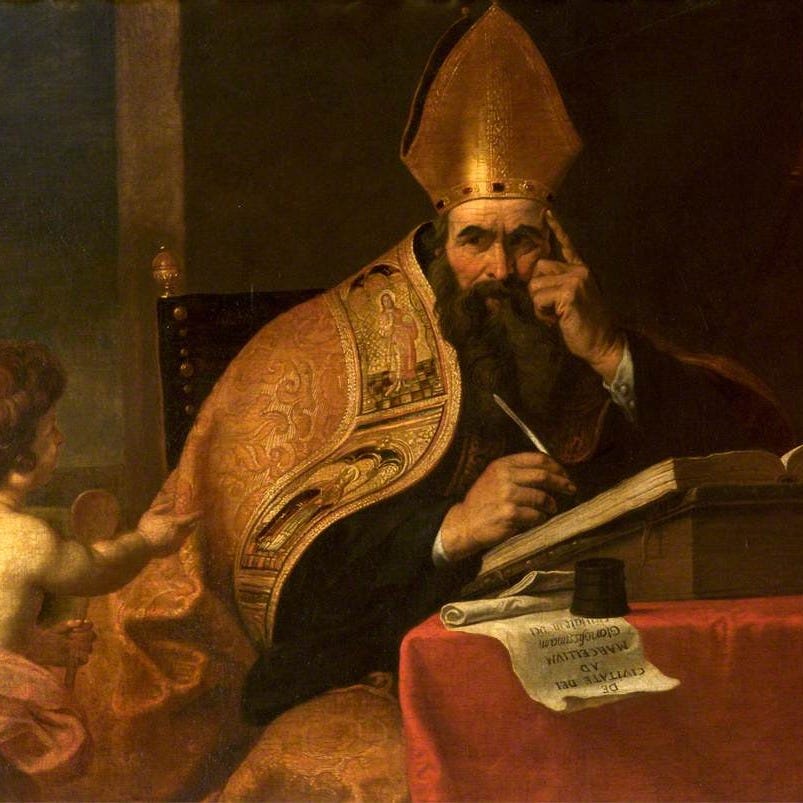
What if the greatest pagan philosopher of all time unknowingly paved the way for one of Christianity’s most brilliant saints?
Through the writings of the Platonists, St. Augustine overcame his deepest misconceptions about God and the soul, ascending in contemplation until he could smell the divine—“catch the fragrance” of transcendent Beauty and Being itself.
Yet he could not feast.
The Platonists were missing something essential.
That missing Truth is what finally let the young Augustine feast on the divine—and transformed his restless heart into one on fire for God.
Reminder: you can support our mission and get all our members-only content for just a few dollars per month:
New, full-length articles every Tuesday and Friday
The entire archive of members-only essays
Access to our paid subscriber chat room
Who was Saint Augustine?
St. Augustine is one of the greatest intellects in Christianity. He was born in 354 AD in Roman North Africa to a Berber mother (Monica, a Christian) and a Roman pagan father (Patricius or Patrick), who wanted him to rise into the Roman imperial class. He pursued an education in rhetoric, becoming a renowned Roman orator who advanced to the prestigious position of Imperial Rhetor in Milan, a coveted role that positioned him for a high career in the empire.
However, the young Augustine was a Manichaean, a dualist sect that placed a good spiritual world against an evil material world—and one ascended to the former through gnostic, esoteric knowledge. His became increasingly dissatisfied with their teachings, and it was the writings of Plato that helped move him from the Manichaean errors and into Christianity. He converted in AD 386 under the mentorship of St. Ambrose, Bishop of Milan, and went on to become the Bishop of Hippo and one of the greatest minds in Christianity.
But to the young Augustine, Christianity did not make sense.
It was not until he read the Platonists that his mind was properly tilled to receive the Gospel.
Who was Plato?
Plato’s philosophy is about becoming God-like. Plato, born around 428 BC in Athens, was a student of Socrates and presented his master’s philosophy in writings called dialogues—narratives of usually 2-3 people in conversation. The line between Socrates’ teaching and Plato’s is not always clear, as Plato never speaks directly but only through Socrates and his other characters. Plato built on Socrates’ philosophy by moving beyond material explanations of the cosmos (like the pre-Socratics’ focus on elements such as fire or water) to immaterial causes. His core teachings emphasize the existence of the soul, and the soul’s ascent from the visible, material world to the invisible realm of eternal, transcendent Forms or Ideas—the perfect, immutable universals that serve as the true causes and essences of all things you perceive in life.
In all things, Plato is seeking the logos. The logos is a rich, multifaceted word, but in brief it means “the rationale” or the “ordering principle” of things. In the Republic, Socrates is seeking the logos of justice—he wants to understand an account of it, its rational order, its essence. Plato shows you that the order of reality is intelligible, and that the logos of things is available to those who pursue it.
The ascent of the soul, however, requires purification and a life of virtue, as impure living clouds the mind’s ability to contemplate the logos of higher realities. In his Republic, Plato will list the same four cardinal virtues—prudence, justice, temperance, and fortitude—that will later be adopted by the Book of Wisdom and Christianity.
The ultimate goal of Platonic philosophy was to become like God, the homoiosis theo, through the contemplation of the true, good, and beautiful and virtuous living.
Platonism has many deep parallels to Christianity, but it also has one substantial core difference—a lack that St. Augustine noted well.
How did Platonism Develop from Plato to St. Augustine’s time?
Platonism originated with Socrates breaking from the pre-Socratics’ material explanations (such as fire, air, or water as origins) by emphasizing virtue, purification of life, logical dialogue, and the mind’s ascent from visible material things to invisible, immaterial causes—ultimately discovering that existence itself (being) is what everything shares in common, founding proper metaphysics and the first Academy in Athens under Plato.
Platonism then evolved through the skeptical second and third Academies, then spread into the Roman Empire as Middle Platonism (around the 1st century BC onward, with figures like Antiochus of Ascalon, Plutarch, and Apuleius), where it became highly religious, developing hierarchies of intermediaries beings called daemons (as Socrates mentions in his Apology), systematizing Plato’s teachings into mystical, liturgical, and syncretic frameworks that focus on the soul’s ascent to God.
By St. Augustine’s time in the late 4th century AD, Platonism, now Late Platonism or Neoplatonism as influenced by Plotinus in the 3rd century, had fully flowered as a religious philosophy emphasizing emanation from the transcendent One, the soul’s mystical return to union with Beauty, and detailed hierarchies of intermediaries, making it oddly both a direct competitor to and a close approximation of Christianity.
St. Augustine encountered these “Libri Platonici,” the books of the Platonists (likely Late Platonic writers like Plotinus and Porphyry) in Milan through Bishop Ambrose and Simplicianus, a Catholic priest.
In them he found something that helped him convert—and found that something was lacking.
How did the Platonic teachings help St. Augustine convert to Christianity?
Platonic philosophy profoundly influenced St. Augustine’s conversion by providing the intellectual framework that helped him overcome his Manichaean materialism and dualism, enabling him to conceive of God as transcendent, immaterial Being-itself and to grasp the soul’s capacity for a contemplative ascent to the divine.
In his Confessions, St. Augustine makes the remarkable claim that he learned in the Platonic writers what St. John also teaches at the beginning of his Gospel:
“In the beginning was the Word, and the Word was with God, and the Word was God” (John 1:1).
The Platonists helped St. Augustine see that there is an eternal Word (Logos) with God, that all things are made through this Word, that the Word is the true light enlightening every man, and that the soul, though testifying to the light, is not the light itself. The logos that the Platonists sought was God, for St. John taught that the Second Person of the Blessed Trinity was the Logos, the account for all reality in Whom and through Whom all things had been made (and are still held in being). The intelligible reality of created existence was an imprint of Reason-itself, the Logos.
The Platonists allowed him to intellectually affirm Christianity’s truth, seeing God as the supreme, transcendent cause of existence and as existence itself, with everything flowing from divine goodness. Thus, unlike Manichaeanism, material existence was not evil but good—as it was created by a good God. Moreover, the Late Platonists also helped St. Augustine understand that evil was not an equal opposite of the good. The world was dualistic, as the Manichaeans taught; rather, evil was something uncreated, a lack of the good. In other words, evil is real like a hole in the ground is real. It is a privation of the good.
In sum, Platonic teaching on the logos helped St. Augustine better understand reality, and he noted that these teachings had close parallels in Christianity—especially with St. John’s adoption of the term Logos to describe the Second Person of the Blessed Trinity.
Yet why did he become a Christian? Why not simply be a Platonist?
What was it that the Platonists did not have?
What was missing in the Platonists?
What St. Augustine did not find in the Platonists—and what only Christianity provided—was the Word made flesh, the incarnation of the Logos in Jesus Christ, which alone enables true, lasting union with God.
The Platonists allowed him to intellectually ascend to a vision of God as transcendent Being-itself, the eternal Logos who is the light and source of all things, giving him a glimpse of divine reality so profound that he “caught the fragrance” of God (as he describes in Book 7 of the Confessions).
However, this ascent remained incomplete: he could perceive and desire God, but he could not “feast” or adhere to Him in enduring communion because the Platonists lacked the incarnate Christ—the Logos who became flesh, took on human nature, and offered Himself in sacrifice to bridge the infinite gap between Creator and creature. Only through the Incarnation could the soul not merely contemplate God from afar but be truly united to Him by the mediator who is both fully divine and fully human, something Platonism promised in its longing for divine likeness but could never deliver.
What the Platonists did not have was the God-man as mediator, the Logos made flesh.
PS: Plato and St. Augustine Podcast
Want a deeper dive? This article is pulled from Plato’s Influence St. Augustine with Dcn. Harrison Garlick and Dr. Chad Pecknold over at Ascend: The Great Books Podcast on Apple Podcast, etc., and YouTube. Dr. Pecknold is a fantastic Augustinian scholar, check him out!
Dcn. Harrison Garlick is a deacon, husband, father, Chancellor, and attorney. He lives in rural Oklahoma with his wife and five children. He is also the host of Ascend: The Great Books Podcast. Follow him on X at Dcn. Garlick or Ascend.
I've heard it said that in the providence of God, Platonism laid the foundation for the Roman Empire to convert to Christianity.
Regardless of whether that was true or not for the collective consciousness, it's interesting to read how this was the case for St. Augustine. I had no idea.
Muy buen planteamiento. Agustín lo resume en De doctrina christiana con la imagen del oro de los egipcios, donde los platónicos tenían metales preciosos que la Iglesia debía recuperar para ponerlos a servir a la verdad. Y ese "oler sin poder comer" de Confesiones VII es de lo mejor que escribió.