


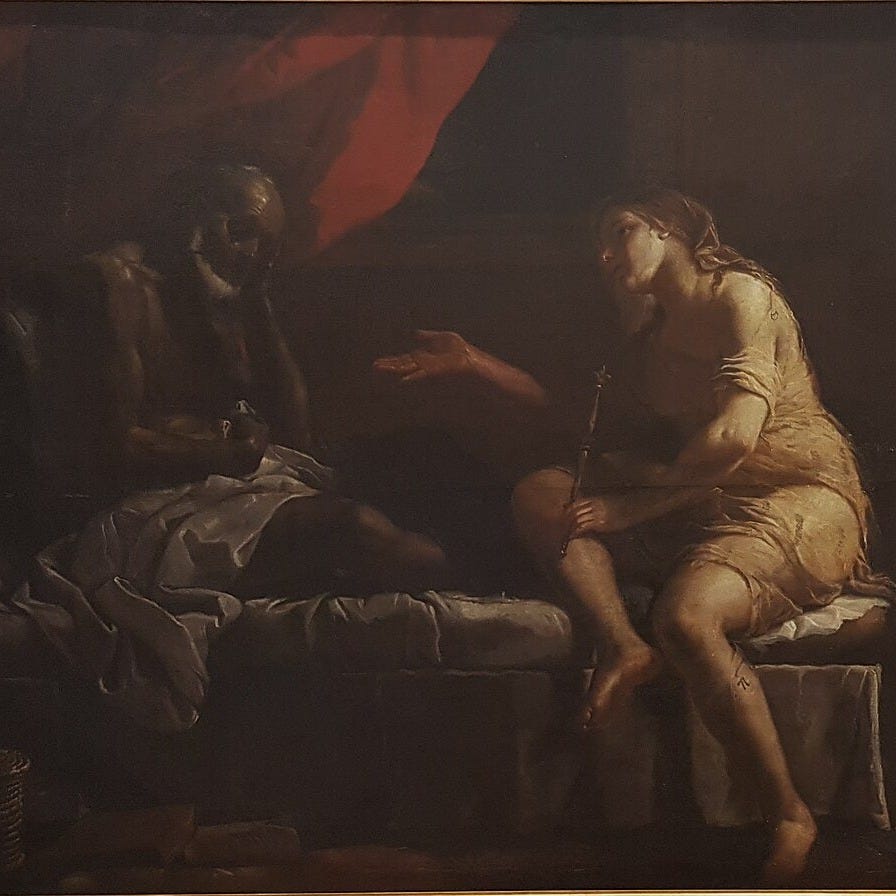
Imagine awaiting your death in prison for a crime you did not commit.
Imagine your anger, resentment, and sorrow. What would you do?
Well, in AD 524, St. Boethius found himself in such a situation—but he did not break. Instead, he wrote The Consolation of Philosophy, one of the greatest works you could read.
Lady Philosophy appears, challenging his despair through difficult questions: Why do the good suffer while the wicked thrive? What is true happiness when fortune betrays us?
Through piercing dialogue, St. Boethius learns suffering strips away illusions—wealth, power, fame—and reveals the unchanging Good to which he must conform himself.
St. Boethius invites you to join him—to allow Lady Philosophy to forge your soul in a beautiful, unbreakable resilience.
Reminder: you can support our mission and get all our members-only content for just a few dollars per month:
New, full-length articles every Tuesday and Friday
The entire archive of members-only essays
Access to our paid subscriber chat room
Who Was St. Boethius?
Anicius Manlius Severinus Boethius (c. 480–524 AD) was a Roman statesman, philosopher, and theologian born into a noble family during a time of profound upheaval. Rome had fallen to the Ostrogoths, and Boethius served as a senator and high official under King Theoderic, the Gothic ruler of Italy. A polymath, he was fluent in Greek and Latin, and he was a politician, philosopher, and Christian theologian.
St. Boethius’ scholarly mission was audacious: he wanted to translate all the works of Plato and Aristotle, comment on them, and reconcile their philosophies for his Latin-speaking audience. He believed the two Greek philosophers were more aligned than often thought, and he aimed to preserve their wisdom amid cultural decline. He produced commentaries on Aristotle’s Categories and Porphyry’s Isagoge, as well as theological tracts on topics like the Trinity and the Incarnation of Jesus Christ.
His life took a tragic turn in 523 when he was accused of treason—likely falsely—for defending a senator against Theoderic’s suspicions of ties to the Byzantine Empire. Imprisoned and awaiting execution, Boethius penned his masterpiece, The Consolation of Philosophy. In this work, Lady Philosophy comes to console St. Boethius in jail, instructing him (and often chastising him) in philosophical truth.
He was brutally executed in 524, beaten and strangled, but his sainthood was later recognized by the Catholic Church for his faith and martyrdom.
What was St. Boethius’ impact on the West?
St. Boethius was an intellectual powerhouse who laid the foundation for the rise of the liberal arts and the medieval invention of the university. Often called “the last of the Romans and the first of the medievals,” he preserved classical knowledge that might otherwise have been lost during the true Dark Ages (c. AD 500-800). In other words, the works he preserved allowed for intellectual rebirth in the West.
His translations of Aristotle’s logic formed the backbone of the medieval Trivium (grammar, logic, rhetoric), heavily influencing the medieval liberal arts and still influencing classical schools today. Often overlooked, his writings on music also served as the foundation to medieval musical education. C.S. Lewis noted that reading The Consolation of Philosophy immerses you in the medieval mindset—its aesthetics, doctrines, and cosmology shaped poets like Dante (who places Boethius in Paradise in The Divine Comedy) and Chaucer.
Have you ever been bewildered by how God can know all things but man can still have free will? If God knows you will do something, does that mean you’re free in doing it? One of the best answers to this dilemma is found in St. Boethius’ The Consolation of Philosophy. In fact, his teachings on happiness, free will, and divine providence are foundational to Christian thought and are incorporated by more well-known thinkers like St. Thomas Aquinas. St. Boethius also anticipated scholastic methods, using Aristotelian logic to tackle theological questions, while infusing them with Platonic philosophy.
Why You Should Read The Consolation of Philosophy
Why do good people suffer while the wicked prosper? How do you handle suffering in your life? Do you have free will? Is there a purpose to this life? In his masterpiece, The Consolation of Philosophy, St. Boethius addresses these issues in a beautiful text that includes dialogues and beautiful Platonic poetry. He gives you a map to be resilient, virtuous, and holy no matter what life throws at you.
Similarly to how Dante the Poet presents Dante the Pilgrim a fearful, lost soul, St. Boethius presents himself, as a character in the dialogue, in self-pity, lamenting his fall from glory and fortune—as he now awaits his death due to false allegations. Lady Philosophy arrives and gently chastises him for forgetting his true self and banishing philosophy from his mind.
She first deconstructs his attachments: the goods of fortune—wealth, power, fame, pleasure—are unreliable and deceptive, mere illusions that Fortune’s ever-turning wheel can grant or revoke at whim, leading only to misery when relied upon for happiness. True beatitude, she teaches, is not found in these mutable externals but in the unchanging Good, which is God Himself, the summum bonum that all seek unconsciously even in their misguided pursuits.
Suffering serves a pedagogical purpose: it detaches the soul from false goods, prompts self-knowledge (know thyself), and redirects the gaze inward and upward toward divine union. Evil, as Lady Philosophy explains, lacks true being—it’s a privation of good—so the wicked, despite apparent success, are ultimately weak and pitiable, powerless to attain what they truly desire, while the just soul remains unharmed in its integrity, growing in virtue through trials (similarly to what you can observe in Socrates’ trial in the Apology or the trial of Jesus Christ—evil men cannot truly harm a good man).
By humbly portraying himself as the struggling prisoner, St. Boethius models humility and the consoling power of philosophy: suffering, rightly understood, matures the soul, fosters resilience, and leads to inner peace, turning despair into grateful alignment with divine providence. To wit, the man unjustly imprisoned had to remember his lessons from Plato and Aristotle in a brutal real-life example.
Like all great authors, the writings of St. Boethius endure because his works address perennial concerns about the condition of man: free will, happiness, suffering, education, injustice, and the search for meaning in this life. The Consolation of Philosophy, specifically, is a spiritual map on enduring suffering and the evil of this life.
Like Dante the Poet after him, St. Boethius shows you the answer by inviting you into the conversation between him and Lady Philosophy.
It is one of the best little books you can read in pursuit of the true, good, and beautiful.
St. Boethius, pray for us!
PS: Plato & St. Boethius with Dr. Thomas Ward
Want to go deeper? Join Dcn. Harrison Garlick and Dr. Thomas Ward from Baylor University this week over at Ascend: The Great Books Podcast as they introduce St. Boethius and discuss Plato’s influence on the saint’s writings. Available on Apple Podcast, Spotify, and YouTube. The good life awaits!
Dcn. Harrison Garlick is a deacon, husband, father, Chancellor, and attorney. He lives in rural Oklahoma with his wife and five children. He is also the host of Ascend: The Great Books Podcast. Follow him on X at Dcn. Garlick or Ascend.
His story is like Edmond Dantès' in The Count of Monte Cristo--how undue suffering elevates on spirit. In both cases, innocent men are confronted with malevolence. But instead of cursing God, they grow closer to the truth. In the darkest depths, they find the most enduring lights.
I’m glad I read this this morning, bravo!.