


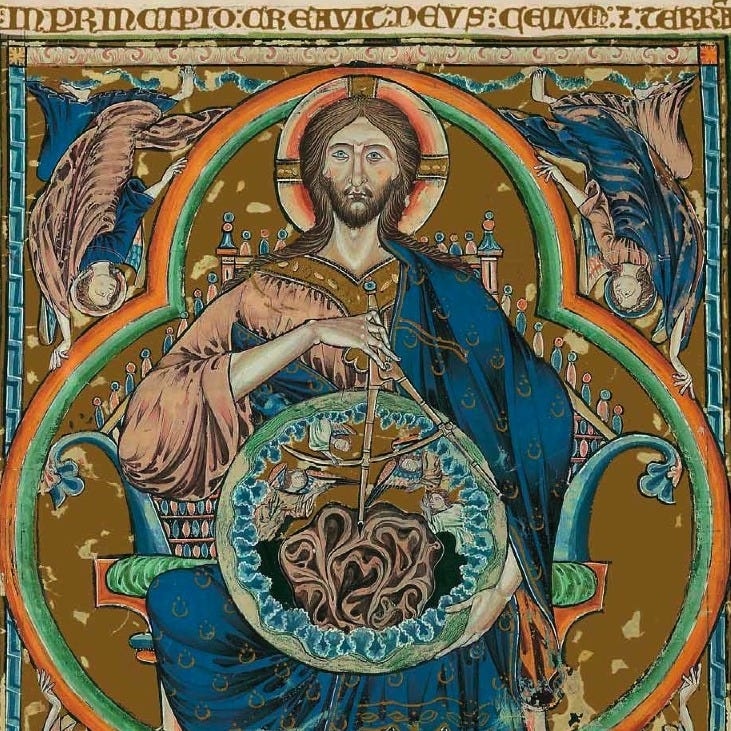
Is God really all-powerful?
Many imagine God’s power means He can do anything—even lie, contradict Himself, or turn evil into good. They view the divine power as meaning that God transcends all boundaries.
But this is not the Christian God.
And those who misunderstand God’s power misuse their own.
If you want to exercise your own power well, you must first understand how God exercises His.
Your moral life depends on it.
Reminder: this is a teaser of our members-only deep dives.
To support our mission and get our premium content every week, upgrade for a few dollars per month. You’ll get:
New, full-length articles every Tuesday and Friday (or Saturday!)
The entire archive of members-only essays
Access to our paid subscriber chat room
Does God change? Is God imperfect?
If someone asked you to describe God, what would you say? Many would immediately say God is all-powerful (omnipotent), all-knowing (omniscience), and all-present (omnipresent). Others would say that He is eternal or rather He is without beginning or end. He is outside of time. A few may suggest that God is not a being but rather Being-itself, as all creation rests within the Divine Mind.
But here, let’s focus on the fact that God is also immutable, which means that God does not change.
Now, some may balk at this suggestion, as the biblical account seems to indicate that God does change. For example, God seems to change His mind, as indicated in His dialogue with Abraham over the fate of Sodom and Gomorrah (Gen 18:22-33) or his dialogue with Moses about the fate of Israel after the golden calf incident (Ex 32:7-14). The prime example of God “changing” is the Incarnation, when God became flesh and dwelt amongst us in Jesus Christ (John 1:14).
Yet, though these biblical examples merit consideration, another way to ask the question is this: Is God perfect?
Now, many who would want to say God does change also want to say God is perfect—but these are a contradiction. Change and perfection are contraries.
How so?
Well, imagine that I presented you a steak dinner that I told you was perfect, but right before I handed it to you I said “wait” and sprinkled some salt on it. What is the problem? The problem is that the steak cannot be perfect and need the salt. To say something is perfect means it needs nothing added or taken away.
In other words, perfection and immutability go together. That which is perfect does not and has no need to change.
Then when we speak of God, we speak of Him as both perfect and immutable.
And this is very important for your own faith in God, as if God could change, then you could not have faith in His promises—He would be a capricious God, a God who could not be trusted.
But God “is the same yesterday and today and for ever” (Heb 13:8).
Does God have potential?
The question of perfection also raises the question of potentiality. Does God have potential?
Imagine I told you that little Timmy had no potential when it came to playing baseball.
Normally, this would mean that Timmy is terrible at baseball. It means he has no potential to actualize. He cannot change into a better baseball player—change being the movement from potency to act.
However, God also has no potential. How?
Unlike Timmy, God has no potential because he has fully actualized His potential. He is the best. He cannot become better than He is. In other words, God has no potential, because He is perfect. He has fully actualized His potential. He has no potential for change. He is perfect, and He is immutable.
Another name for God, philosophically speaking, is “Pure Act.”
It is another way to say truly “perfect.” God has no potential or capacity to change, because He has fully actualized His potential.
Yet, how does the “Pure Act” exercise His power?
Usually, when we say “all-powerful” it means without restraint—to be truly omnipotent would mean to be powerful without limitation.
Is God powerful enough to do whatever He wills?
And if not, how can God be God if he suffers limitations?
And finally, Christianity calls you to be God-like, thus you must exercise your own power as God does—but how can you do this if you do not know how God does it?
Let’s explore the power of God.
