


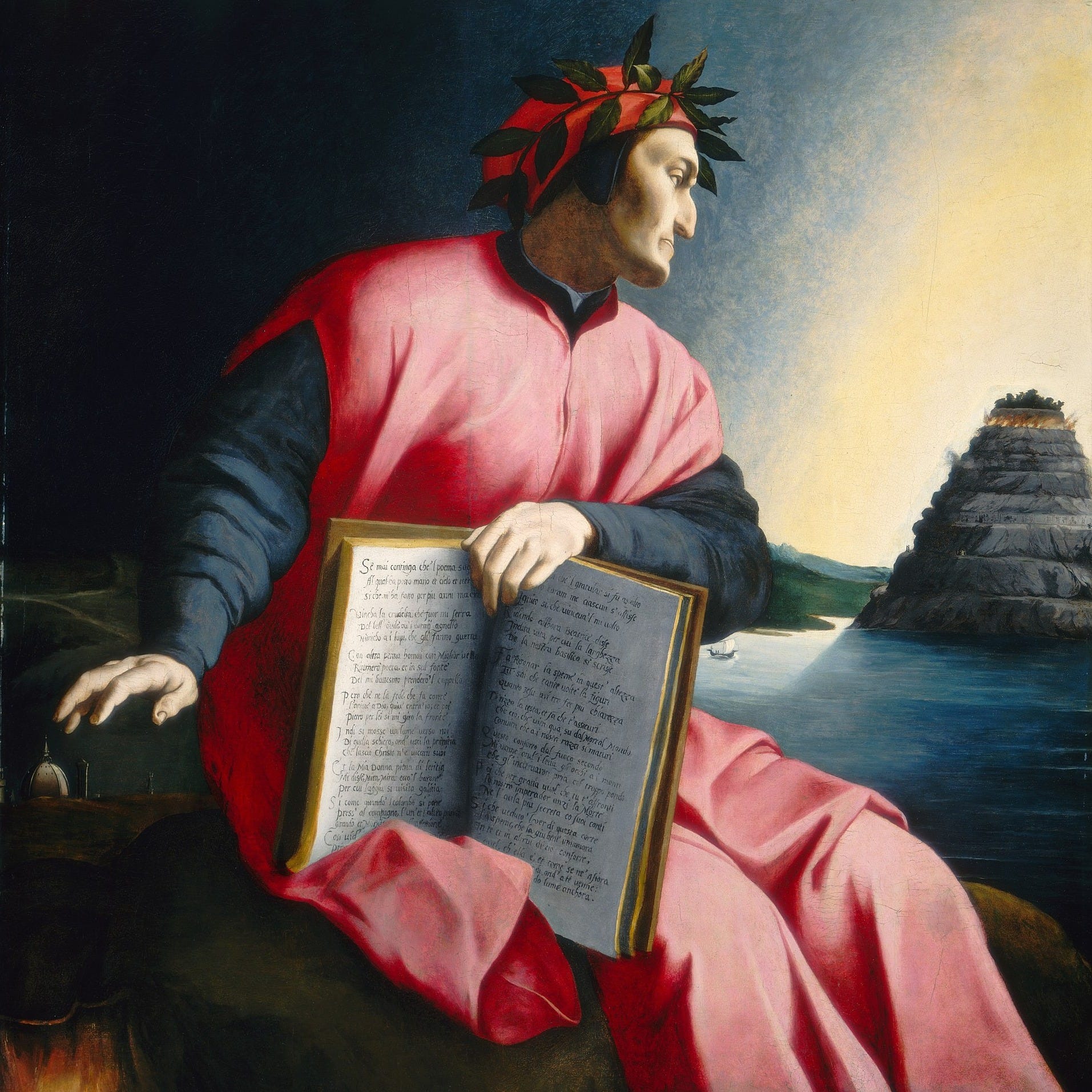
Dante is a master of the soul.
The Inferno shows you the ugliness of sin.
But the Purgatorio shows you how to purge it from your life.
In the first terrace on Mount Purgatory, Dante gives your imagination what it needs to cleanse pride and embrace humility.
3 examples of humility carved into the wall of the mountain.
1 poetic punishment the penitent must suffer to be purged.
13 examples of pride carved into the floor of purgatory.
Dante gives you everything you need. You just have to be willing to do it.
This is a teaser of our members-only deep dives.
We are a 100% reader-supported publication. To support our mission and get our premium content every single week, please consider subscribing for a few dollars per month.
New, full-length articles every Tuesday and Friday
The entire archive of members-only articles essays
Access to our paid subscriber chat room and community
The Gate of Purgatory
Dante is a master of the soul—his Divine Comedy is not a work laying out the literal structure of the afterlife nor a vision of what it will be. The Divine Comedy is a moral tale, an invitation for the soul to understand the ugliness of sin, to purge itself of evil, and to ascend into celestial delights. Dante the Pilgrim is humanity—he is an analogue for you and your own spiritual journey.
In the Inferno, Dante the Poet rips off the veneer of human desire and shows you the ugliness of sin. The souls there are punished by being given into their disordered loves. The Purgatorio is different. The souls in purgatory are punished, but the punishment is to purge the sin—it is medicinal. Moreover, the atmosphere of purgatory is far from the grime of hell, it is a place of sunlight, joy, and hope. The souls want to be purged, as they are desirous to go to heaven and see God.
For those unfamiliar, Catholics hold that souls who die in friendship with God but remain imperfect are cleansed prior to enjoying heaven. Catholics would state that “no unclean thing can enter heaven” (Rev 21:27), and that you fall short of God’s command to be “perfect” as your heavenly Father is perfect (Matt 5:48). Though the souls are saved (as everyone in purgatory will go to heaven) they are imperfect or rather failed to fully conform their souls to Christ in this life. Catholics would point to the Jewish practices of praying for the dead (II Macc 12:39–46), St. Paul’s explanation that souls will be purged by fire after death (1 Cor 3:11–15), Jesus’ parable that there are punishments in the afterlife that are temporary (Matt 5:25–26), and Jesus’ comment that there are sins forgiven after death (Matt 12:32).
For purposes here, it is sufficient to understand that purgatory is a place where the soul cooperates with God’s grace to purge itself of its imperfections in a joyful hope of ascending into heaven proper, the Beatific Vision.
And Dante the Poet uses this reality to give you one of the best spiritual maps you could have in this life—how to flee vice and embrace virtue.
The Gate of Purgatory
After Dante the Pilgrim and his guide, the Roman poet Virgil, navigate “ante-purgatory,” the foot of the mountain, they come to the gate of purgatory. In brief, the gate has three steps symbolizing self-knowledge, contrition, and penance. It is only through humility that souls can start the journey of purgation, and humility comes from a true know thyself that leads to a sorrow for sin and the desire be Christ-like.
The angel who governs the gate then carves seven “Ps” into Dante the Pilgrim’s forehead, representing the seven deadly sins (peccata in Latin) he must purge in his ascent of Mount Purgatory. The angel tells Dante the Pilgrim that St. Peter told him to err on allowing souls in, to err on the side of mercy, and as the hinges of the gate creak open Dante the Pilgrim believes he hears in them the Te Deum Laudamus, a prayer of thanksgiving.
They enter into a narrow path that winds them to the first terrace, the purging of the Queen of Sin, pride.
Remember, Dante the Pilgrim’s journey is your journey.
And here, Dante the Poet shows you that the ascent to Christ starts with humility—even if in a modest, nascent form.
You must know thyself, to see yourself in the greatest mirror of the soul, God, and be spirited enough to desire to purge your vices and embrace your virtues.
And the first sin that must be purged is pride.
The Carvings in the Mountain
Dante the Pilgrim and Virgil see something amazing. Carved into the side of the mountain are beautiful reliefs depicting different scenes of humility—the contrary virtue to pride. He sees three stories:
The Annunciation - This is the story of the angel Gabriel coming to Mary and announcing to her that she would be the mother of Jesus, the Messiah (Luke 1:26-38). Mary gives her fiat, her “let it be,” saying: “Behold, I am the handmaid of the Lord; let it be to me according to your word.” Mother Mary shows a humility in accepting God’s plan for her life. As St Irenaeus says, the knot of Eve’s disobedience was untied by the obedience of Mary.
However, there is subtle narrative of humility here as well—the humility of God. God becoming man is an act of humility—the Creator dwells amongst his Creation, the Divine Mind dwells amongst his thoughts. There is no greater act of humility than the Incarnation.
The Ark - The second relief is of King David dancing before the Ark (2 Samuel 6:14–22). The King lets go of his stately decorum falls into a joyous celebration of the Ark returning to Jerusalem—and is famously despised by his wife, Michal, who sees his actions as undignified.
But before Dante describes this relief, he references the obscure story of Uzzah (2 Sam 6:1–11).
David and Israel were dancing and celebrating before the Ark, which was being brought back in a wagon—and when the ox stumbled the Ark was in danger of toppling over. So, a man named Uzzah reached out his hand to stabilize the Ark.
And God struck him dead.
Why would God do this? The story of Uzzah is a story of pride. Though Uzzah was trying to do something good, he and the rest of the Israelites were in disobedience. God had told them how the Ark must be transported—via poles on the shoulders of Levites and no one was to touch the Ark directly.
The story of Uzzah “makes us fear to take on duties uncommissioned,” as Dante says.
There is also a subtle connection between these two reliefs, one Dante may be suggesting—Mary is also the new Ark of the Covenant. What does this mean? It means that as the Ark of the Covenant in the Old Testament was the dwelling place of God’s presence on earth, so too did Mary become the dwelling place of God on earth at the Incarnation. Inside the Ark there was manna, the ten commandments, and Aaron’s priestly staff, and Christ, made Incarnate in Mary, perfects all three: he’s the bread from heaven, the new lawgiver, and the new high priest.
A basic rule of interpreting Scriptures is that the Old Testament foreshadows the New, and the New perfects the Old. Here Dante gives us the image of the Ark in both the Old and New Testament.
Emperor Trajan - For the pagan example, Dante the Poet gives us the example of Emperor Trajan stopping his imperial procession to assist an elderly woman with justice. In fact, legend has it that St. Gregory the Great found Emperor Trajan to be such an epitome of natural virtue, that the saint prayed for God to find a way for the Emperor, now deceased, to go to heaven. God then raised Emperor Trajan from the dead, St. Gregory baptized him, and the Emperor died in friendship with God.
It is important to note that Dante the Poet provides both sacred and pagan examples of virtue—not because grace is unnecessary, but to show that virtue exists in both a natural and supernatural state, the latter being, of course, more perfect.
The natural virtues—prudence, justice, temperance, and fortitude—are those that are available to all persons due to their humanity—they have an intellect.
The theological virtues—faith, hope, and charity—are those available only to persons who are in friendship with God, who participate in the divine life. They are gifts to be received and participated in.
The carvings give your imagination images of humility—the contrary virtue to pride.
But Dante the Poet offers you much more.
He gives you the punishment the prideful embrace to be purged.
He gives you thirteen examples of pride carved into the floor of purgatory.
In short, he gives you an incredible liturgy of images to help your soul purge pride and embrace humility.
Let’s look.