


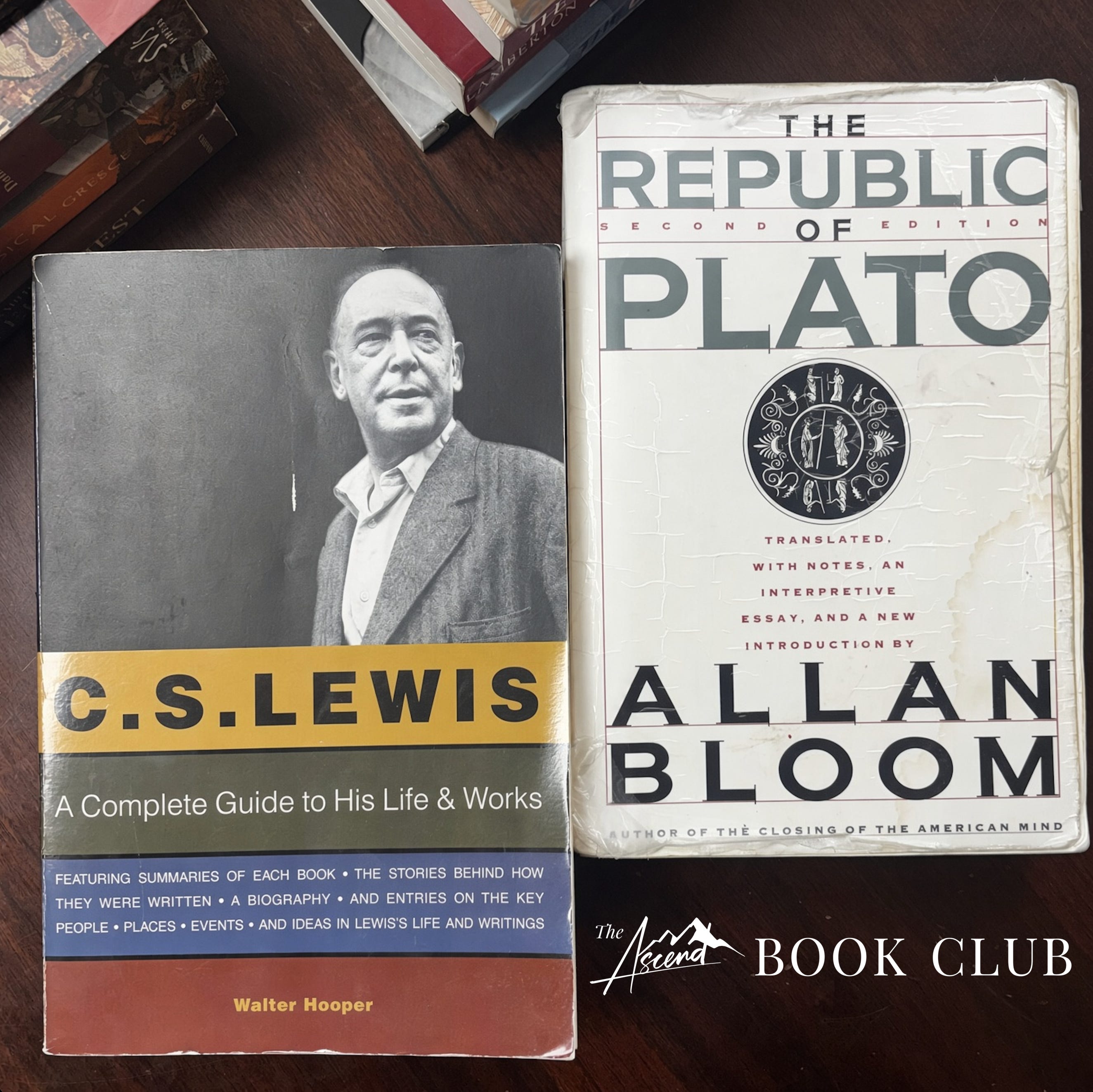
C.S. Lewis wants you to read Plato’s Republic.
Many people think Plato has nothing to do with the Christian Gospel.
But one of the greatest Christian storytellers of all time knows better. At the end of his Narnia series, C.S. Lewis has Professor Digory tell you: “It’s all in Plato, all in Plato.”
Why not say “it’s all in the Bible, all in the Bible?”
C.S. Lewis understood the importance of Plato for the Christian imagination. He used Platonic philosophy to tell the stories of Narnia.
But many miss one of the most powerful Platonic images of the Narnia series.
And it comes from how C.S. Lewis read Plato’s Republic.
Join our slow read-along of Plato’s Republic!
We begin reading this life-changing book on October 6. Check out the full reading schedule here.
To support our mission and get all our resources, become a paid book club member. In addition to the weekly podcast, you’ll get:
Live book club discussions with Dcn. Garlick & guest scholars (monthly)
In-depth reading guides and essays to lead you through the great books
Access to our incredible community of readers
The full archive of members-only content (guides, essays, and podcasts)
Why the Republic is a Must-Read
Plato’s Republic is one of the most influential texts in Western civilization. The text recounts a discussion on justice and whether justice is more profitable to the soul than injustice. To explore this topic, Socrates creates a “city in speech” or rather he uses the example of a city as an analogy to the soul—believing that it would be easier to understand justice in something larger, like a city, and then move to justice in something smaller, like the soul.
But, in pursuit of justice, Socrates addresses a wide-range of topics, including the soul, virtue, education, politics, metaphysics, and the afterlife. In fact, the conversation of the Republic is so rich and encompassing that in reading it you are given a guidepost to the entire Western philosophical tradition. As Alfred North Whitehead famously stated, “The safest general characterization of the European philosophical tradition is that it consists of a series of footnotes to Plato.” In other words, Plato is philosophy. To read Plato is to have a reference point to the rest of Western philosophy—and the Republic is his masterpiece.
And C.S. Lewis understood this well.
C.S. Lewis’ Love of Plato
Those who love the Chronicles of Narnia probably remember Professor Digory Kirke in The Lion, the Witch, and the Wardrobe, after a conversation with the Pevensie children, lamenting “I wonder what they do teach them at these schools.” Yet, in the The Last Battle, it is worth noting that C.S. Lewis gives you a fuller version of that beloved quote. Professor Digory states: “It’s all in Plato, all in Plato: bless me, what do they teach them at these schools?” You have to take this quote seriously. Lewis links a statement on education in his first book with his last book, encompassing the entire Narnia series—a series meant to be educative to young imaginations. Notice the first is a negative statement, lamenting that education is lacking, while the second is a positive statement, telling you where answers can be found: Plato.
In other words, in a book that is written to open a child’s imagination to the reality of Christianity, C.S. Lewis tells you it is all in Plato.
Why would he say this?
Why not say “It’s all in the Bible, all in the Bible: bless me, what do they teach them at these schools?” Would this not make more sense in a story that uses a lion, the great Aslan, as an analogue of Jesus Christ?
The answer comes in understanding how C.S. Lewis used Plato in his series—and how that shows you Plato’s role in the Christian imagination.
And most of all, C.S. Lewis sees a hidden Christian message in Plato’s Republic.
