


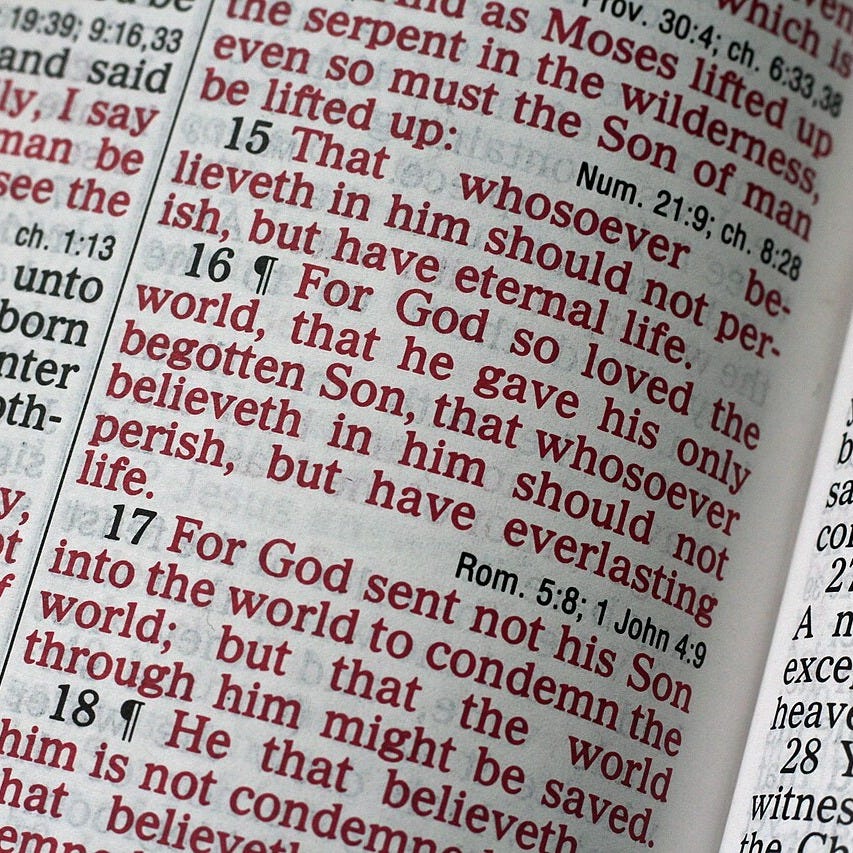
Do you want to start reading the Bible?
But do you have a lot of questions?
What is the Old Testament? Where do I start reading? Do I have to read all of it? How should the Bible be read? What is a Gospel? Who is Moses?
These are all good questions for those thinking about reading the Bible.
And we have answers!
You can read the Bible with just a little help. Come see.
Reminder: you can support our mission and get all our members-only content for just a few dollars per month:
New, full-length articles every Tuesday and Friday (or Saturday!)
The entire archive of members-only essays
Access to our paid subscriber chat room
Everyone is invited to read the Bible, but you want to read it well and with the mind of the Church. The Bible is not a series of loose images from which you extract your own truth, but rather a beautifully woven collection of texts, a sacred library, inspired by God to show you His love for you in Jesus Christ. It is the story of salvation history and it is a history that includes you.
Here are a few basic questions that many first time readers of the Bible have. If you have one not covered in the article, ask in the comments below!
We are here to help.
1. What is the Bible?
The Bible is the story of God’s love for humanity. On its face, it is a collection of different texts that range over different historical time periods from different authors in different genres—it is a complex, beautiful assortment of ancient works; however, Christians believe the Bible is holy, like a sacred library all bound together, inspired by God. The Bible is presented in two parts: the Old Testament (the story prior to the coming of Jesus Christ) and the New Testament (the story of Jesus Christ and His Church).
Its primary purpose is to communicate to you the reality of Jesus Christ, and how you are invited to an unimaginable reality almost too beautiful to comprehend.
Even if you have no faith in Jesus whatsoever (or even of God), the Bible is worth your time as an ancient text with an irrevocable imprint on the Western cultural imagination—like the Iliad or the Odyssey. A lot of fruit can be achieved by comparing these ancient Hebrew texts against ancient Greek texts.
The Bible has something for everyone.
2. What does it mean the Bible is inspired?
Christians believe that the Bible is the inspired word of God. In other words, the diverse collection of texts that make up the Bible share in one divine authorship that worked through human authors. It is the divine authorship that makes the Bible a cohesive, deeply interwoven narrative—but in Christianity, the divine authorship does not negate human agency.
Unlike other religions where God simply dictates what should be said to a human (who is less an author and more a scribe), Christians hold that God subtly inspired human authors and worked through them to produce a holy text.
In other words, there is still a humanity imprinted on the text, which means, for example, if you’re reading the Gospel of Luke (written by St. Luke) then understanding who St. Luke is and how he writes is important to the text. The Bible is somehow both a divine but deeply human text. And in its purpose of communicating to you the reality of Jesus Christ and His offer of salvation, Christians hold the text is infallible or without error. It is a text that merits our faith and trust—that the salvation and God it describes is true and worthy of our lives.
The divine authorship, however, is subtle and best seen in a slow, careful read of the biblical texts and how they deftly interrelate over thousands of years.
3. What is the Old Testament?
The Old Testament (the story from the beginning of the world to right before the coming of Jesus Christ) is composed of 46 distinct texts that are organized into four general categories.1
The Pentateuch (meaning “five books”) represents the first five books of the Bible starting with Genesis. The Pentateuch, traditionally said to be written by Moses, lays the foundation for the entire Bible and covers creation, the patriarchs (like Abraham, Isaac, and Jacob), the story of the Hebrews in slavery in Egypt, and how Israel came together as a nation.
The next group, the Historical Books (like Joshua, 1 & 2 Samuel, etc.), tell of Israel’s journey to the Promised Land, their kings, their fall into exile, and eventual return.
Then come the Wisdom Books (Job, Psalms, Proverbs, etc.), and these are deeply poetic, beautiful texts that praise God, wrestle with the difficulties of life, and offer practical guidance (these books make for great spiritual reading—incorporate them into your prayers, if you’re so inclined, especially the Psalms).
The final group is the Prophets, which has both “major” and “minor” prophets. Many people think of a prophet as someone who gives prophecy, i.e., some prediction of the future—but the prophetic voice is first and foremost those who call mankind out on sin and then invite mankind back to God. The prophets therefore deal a lot with broken, sinful peoples being judged, punished, and returned to order and holiness.
One difficulty for first time readers is that the Bible is not organized chronologically; rather, these categories reflect similar genres, even though certain groups, like the Pentateuch and the Historical Books, largely move in chronological order.
4. What is the New Testament?
The New Testament, the story of Jesus Christ and His Church, is shorter and simpler in organization.
The first four books of the New Testament are called the Gospels, and these texts—Matthew, Mark, Luke, and John—tell the story of Jesus Christ. Each one is written by a different author for a different audience, but together they give harmonious insights into the beautiful mystery that is Jesus.
The second section is like the Historical Books of the Old Testament, but it is only one book: The Book of Acts. It is a historical text that tells of the acts of the apostles (Jesus’ disciples) after Jesus’ Ascension into Heaven. In short, it is the beginning of the Church.
Next comes the Epistles, which means “letters.” Many of the leaders of early Christianity wrote letters to various churches admonishing them or praising them for how they adhered to Jesus Christ. It is a fascinating insight to the early Church and their understanding of Jesus and what it means to be a Christian. The bulk of them, fourteen including Hebrews, are written by St. Paul, and the rest are written by St. James, St. Peter, St. John, and St. Jude.
The final section is again only one book, Revelation, written by St. John, it gives an apocalyptic history of the Church and prophesies about the new heaven and the new earth under the reign of Jesus.
Together, the New Testament explores the reality of Jesus Christ and the Church He founded.
5. Where should I start?
There are a few good answers to this question. Many start with Genesis, the first book of the Bible, as it lays a foundation for the whole salvation history and tells the stories of creation and the patriarchs.
Another good starting place is one of the Gospels, especially the Gospel of Mark. Why? Because it is the shortest and a fairly straightforward Gospel. The Gospel of Luke is another good choice, as Luke is writing to Greeks who may not be familiar with the Old Testament. The Gospel of Matthew is good as well, as it is written to Jews and focuses on Christ as the fulfillment of prophecy.
Matthew, Mark, and Luke all share many similarities—but the Gospel of John is very different. It is more mysterious, mystical, and focuses on Christ as the Logos, the Eternal Word. The Gospel of John is the foundation of Christianity’s mystical tradition, if you find that appealing.
The Gospels are not terribly long and reading all four as an introduction would not be a bad start.
Keep in mind that St. Luke also wrote Acts, so coupling his Gospel with the history of the apostles would be a good start as well.
6. Is there a list of key books I should read first?
Instead of reading the whole Bible, is there a short list of key books that could be read to establish a good framework and understanding? Yes. Nothing definitive, but here would be a good list for a first pass through the Bible:
Genesis—to lay the foundation of creation, the fall, and God’s covenant promises.
Exodus—to understand God’s deliverance of Israel, the Law, and the covenant.
1 & 2 Samuel—to see the rise of the monarchy, the heart of David, and the promise of an eternal kingdom.
Psalms—to experience the full range of human emotion, prayer, and worship in poetry.
Isaiah—to grasp the prophetic hope of the coming Messiah and God’s plan of redemption.
Mark—to encounter the life, death, and resurrection of Jesus in a short, fast-paced narrative.
John—to dive deeper into Jesus’ divine identity.
Acts—to see the birth and spread of the Church through the Holy Spirit.
Romans—to understand the core Gospel: sin, grace, justification by faith, and life in the Spirit.
Much of this list could shift depending on your interests, but the provided list of key books within the Bible would give you a solid foundation in understanding the narrative of salvation history.
7. How should the Bible be read?
The Bible is a complex, ancient library of sacred texts. While all are invited to read it, you should approach it with humility and patience—but one good thing is that the Bible is not new, centuries of Christian saints have reflected upon how to read the Bible and have handed that tradition down to you.
The early Church often read the Bible according to four senses: literal, allegorical, moral, and anagogical. These four sense reveal hidden layers to the Biblical narrative that enrich the soul, make the verses come alive, and testify to the one, divine authorship.
The first sense is the literal, and this focuses on the intentionality of the human author. It includes all the historical details of when and where the text was written. It also includes understanding the genre of the book, e.g., is this a literal history or a poetic praise?
The literal is like the foundation of a house. You must understand the literal structure and reality of the book before you can ascend to more complex, rich readings—and many difficulties with the Bible come from books being read contrary to their genre and historical setting.
It should be stressed that on your first read, it is beneficial enough to simply track the literal and track it well. A slow, attentive, prayerful read of the Bible can bear a lot of fruit.
If you’re interesting in understanding the spiritual sense (i.e., allegorical, moral, and anagogical) of Scripture, see How to Read the Bible like the Saints and How to Read the Bible like Dante and Aquinas.
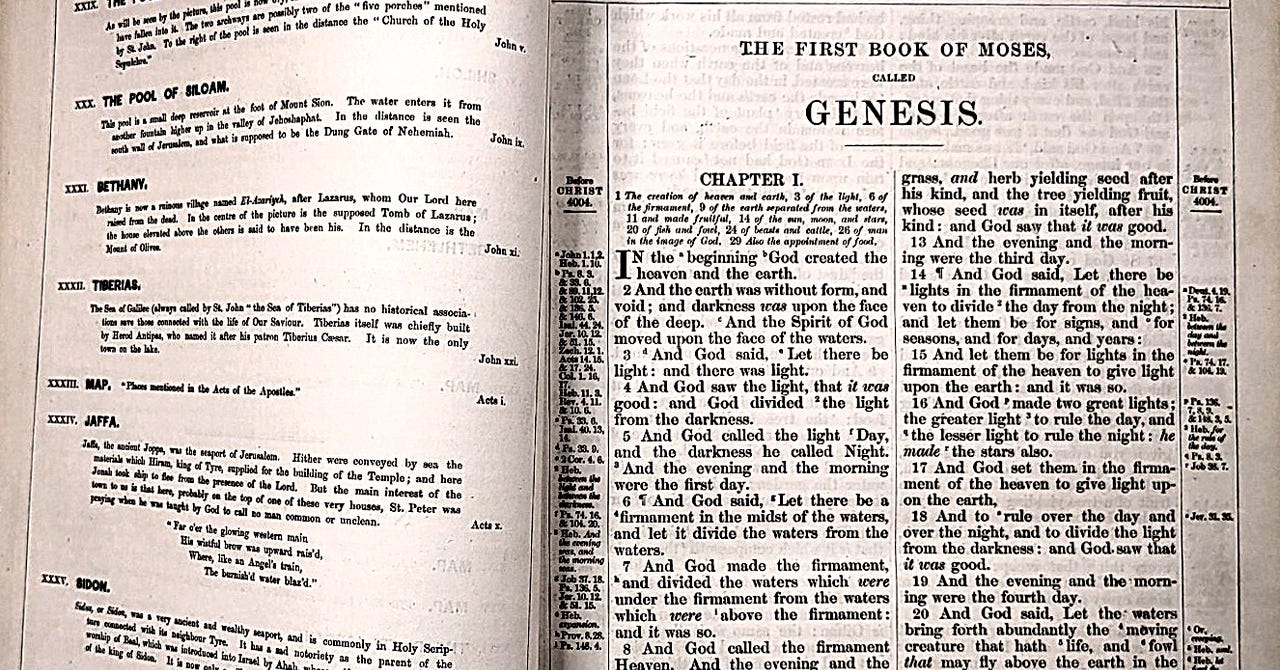
8. What version of the Bible should I read?
There are so many! In Catholicism, one of the best Bibles available is the Ignatius Study Bible, which has copious notes, maps, commentaries, etc., to help you grasp the literal sense of the text and build a good foundation for the spiritual text.
Another good Bible would be Ascension Great Adventure Bible, which tends to focus on understanding the Bible as story—it categorizes the books by color and helps you understand the dynamic narratives of the Bible as one beautiful story of God. The Great Adventure Bible pairs well with the wildly successful Bible in a Year podcast with Fr. Mike Schmitz.
There are many, many translations of the Bible in many different formats.
If you have a favorite, which one would you recommend?
How can we help!?
What questions do you have about reading the Bible?
Or maybe you’re a Christian who wants to offer more advice and encouragement to those who may be thinking about starting the Bible—let us know!
Overall, know that the Bible is a beautiful story of Jesus Christ—and it is a story to which you are invited as a beautiful child of God.
Dcn. Harrison Garlick is a deacon, husband, father, Chancellor, and attorney. He lives in rural Oklahoma with his wife and five children. He is also the host of Ascend: The Great Books Podcast. Follow him on X at Dcn. Garlick or Ascend.
Catholics recognize 46 books in the Old Testament while Protestants recognize 39 because the Catholic canon includes seven Deuterocanonical books (Tobit, Judith, Wisdom, Sirach, Baruch, and 1–2 Maccabees, plus additions to Esther and Daniel). These books were part of the Greek Septuagint used by early Christians and were affirmed by the early Church councils (Rome 382, Hippo 393, Carthage 397) and definitively at Trent (1546). Protestants, following the Jewish Hebrew canon formalized after the time of Christ, classify them as Apocrypha. Both Catholics and Protestants share the same New Testament canon of 27 books.
Why read the Bible? In Paul’s second letter to Timothy (3:16) we read “ All scripture is Inspired by GOD, and profitable for teaching, for reproof, for correction, and for training in righteousness, that the man of God may be complete, equipped for every good work. Jesus states in John 8:31-32 “ If you abide in my word you are truly my disciples and you will know the Truth and the Truth will set you free”. In another place Jesus states “ I am the way, the truth and the life, no one comes to the Father except through Me”. Back in John 8:34 He states “ everyone who sins is a slave to sin. A slave is not a permanent member of the family, but a son is part of the family forever. 36 So if the son sets you free you are truly free. “ In Romans 8:13 Paul states “ If, by the Spirit, you put to death the deeds of the flesh, you will live. “ In Peter’s second letter, starting in 1:3 we read “ By His divine power God has given us everything we need for living a Godly life. We have received all this by coming to know Him, the One who has called us to himself by means of his marvelous glory and excellence. And because of his glory and excellence, He has given us great and precious promises. These are the promises that enable us to share His divine nature and escape the world’s corruption caused by human desires. In John’s first letter 2:15-17 we read “Do not love the world or the things in the world for all that is in the world… the desires of the flesh, the desires of the eyes, and the pride of life, is not of the Father, but is of the world. And this world is fading away, along with everything people desire. But anyone who does what pleases God will live forever. In conclusion, Matthew 7:24-27 “Anyone who listens to my teaching and follows it is wise, like a person who builds a house on solid rock. Though the rain comes in torrents and the flood waters rise and the winds beat against that house, it will not collapse because it is built on bedrock. But anyone who here’s my teaching and doesn’t obey it is foolish, like a person who builds who builds a house on sand. When the rains and floods come and the winds beat against that house, it will collapse with a mighty crash. Oh, one more great and precious promises:Luke 11:11-13 “You fathers-if your children ask for a fish, will you give them a snake instead? Or if they ask for an egg, do you give them a scorpion? Of course not! So if you sinful people know how to give good gifts to your children, how much more will your Heavenly Father give the Holy Spirit to those who ask Him!!” Read the Bible…Taste and see that the Lord is good. 😊
God never promised a infalable book for His people. Nor is Jesus who is the word a bible!?! However, his message is found in the writtings and compilations of the writtings of various men some greater then others. Gods preservation is not an accomplishment of man nor Institution. The problem all these people discussing it have absolutly no idea what the gospel is in the first place though they think they have scripture & authority.
The 2nd comming happened already thats why pope & 95% of all churches -"christians" are just heretical cults created by the devil & strong Delusions
https://allendaves.substack.com/p/the-gospel-simultaneous-doom-and?utm_source=share&utm_medium=android&r=1xhldx