


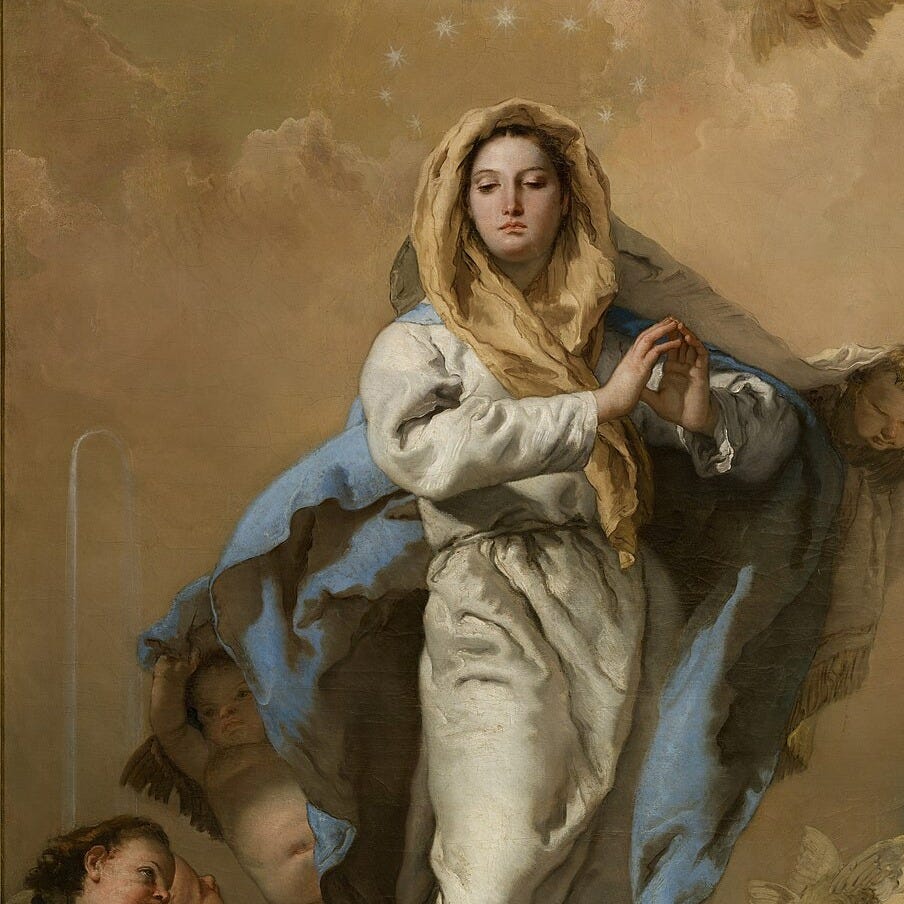
Was Mary truly without sin?
Catholics point first not to any papal document or obscure medieval teaching but to the biblical roles of Jesus Christ. It is only in understanding Jesus, that the biblical roles of Mary start to take shape.
Catholics believe Mary is the New Eve, the New Ark, and the New Queen—and each one of these roles points you to her Son, Jesus Christ.
But, why do Catholics believe Mary’s biblical roles reveal her to be sinless?
Looking into the Immaculate Conception invites you to a whole new way to read the Bible and understand Mary.
Most of all, however, it invites you to a deeper understanding of Jesus.
Reminder: you can support our mission and get all our members-only content for just a few dollars per month:
New, full-length articles every Tuesday and Friday
The entire archive of members-only essays
Access to our paid subscriber chat room
How to Read the Bible
Catholics believe that the Blessed Virgin Mary plays three major typological roles in the Bible. Typology is the study of types, and it looks for analogical connections throughout the Old and New Testaments. For example, Jesus states in His Eucharistic Discourse (John 6:22–71), one of His longest teachings, that the Israelites had manna, a bread from heaven, that fed them in the desert; but now a new manna, a new bread from heaven has come down, Jesus Christ. In other words, manna in the Old Testament foreshadows Jesus, it is a prefigurement, a sign, or a type that points forward to a better, more perfect image.
A very basic principle for biblical interpretation is that the Old Testament foreshadows the New, and the New perfects the Old.
The principle is part of a larger, traditional understanding of how to read the Bible according to the four senses: literal, allegorical, moral, and anagogical. It is important to note that the allegorical, which includes typological, is not something alien to the Bible, but rather a method of interpretation that Jesus used—like with himself and manna (John 6:22–71), himself and Jonah (Matt 12:38–40), the Bronze Serpent (Num 21:4–9), the Temple (John 2:19–21) and more.
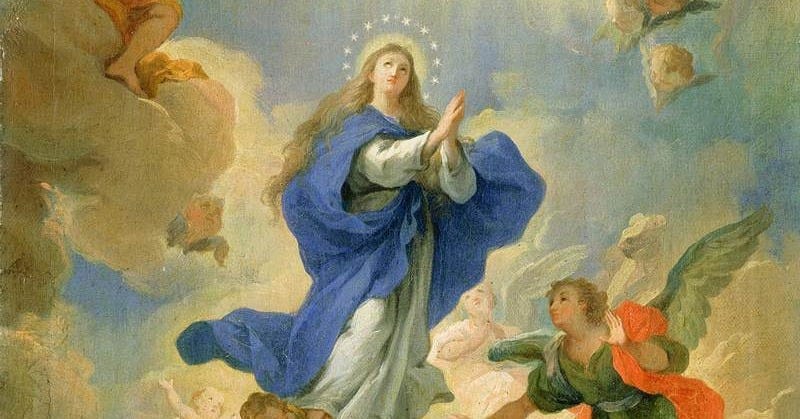
The Biblical Roles of Jesus
All titles for Mary hinge on Jesus. As Catholics note, any honor given to Mary is due to the merits of Jesus Christ, and if you are not familiar with Mary’s role in salvation history, looking to Jesus’ roles is a good place to start.
Jesus has three key biblical roles that include Mary.
First, Jesus is the New Adam or the Second Adam, as St. Paul tells us (Rom 5:12–21; 1 Cor 15:21–22, 45–49). In other words, the New Testament is a new Genesis story with its own tree, serpent, fruit, and radical change to humanity.
Second, Jesus is the total fulfillment of the Old Testament, and this is shown in Jesus being the perfection of what was inside the Ark of the Covenant. In the Old Testament, the presence of God on earth dwelt on the Ark of the Covenant, and inside the Ark was three important artifacts: the Ten Commandments (law), manna (bread from heaven), and Aaron’s rod (priesthood). Jesus fulfills all three of the roles, as he is the new lawgiver as seen on the Sermon on the Mount (Matt 5-7) and the new law Himself, the new manna or bread from heaven, and the new high priest (Heb 2:17, 3:1, 4:14, et al.).
Third, Jesus is the “Son of David” or rather the fulfillment of God’s promise to King David that one of his descendants would sit on his throne forever (2 Sam 7:12–16; Ps 132:11–12). The Annunciation, Gabriel’s proclamation to Mary that she would be the mother of the Messiah, makes clear that the child is the fulfillment of God’s promise to King David (Luke 1:26–38).
For each of these biblical roles of Christ, there is a corresponding biblical role for Mary.
The Biblical Roles of Mary
First, since the earliest days of Christianity, Mary has been seen as the New Eve that helped the New Adam, Jesus, restore humanity. St. Irenaeus (b. AD 130) spoke of Mary untying the knot of Eve’s disobedience. Whereas Eve said yes to the serpent, and brought sin and death into the world; the New Eve, Mary, said yes to the angel, and brought grace and salvation into the world—the New Adam. Like Adam and Eve consummating the Fall before the Tree of the Knowledge of Good and Evil, the New Adam and Eve are gathered under the New Tree (John 19:25–27; Acts 5:30; 10:39; 13:29) to usher in salvation and the new humanity. It is an ancient way of looking at Mary’s role in salvation history, and it is part of a larger allegorical picture between the New Testament and the Old.
Second, if Jesus is the fulfillment of the contents within the Ark, then ancient Christians also saw Mary as the fulfillment of the Ark—a New Ark. Whereas the Old Ark was made of gold and carried objects, the New Ark is made of flesh and carried God-himself, Jesus Christ. It is a role attested to by St. Ambrose and many other early church fathers. She was the dwelling place of God on earth, the place by which God became flesh.
Third, if Jesus is the new King, the descendant of David, who will sit David’s throne forever, then Mary is the new Queen of this eternal kingdom. But, is not Mary his mother and not his wife? Well, in ancient near eastern cultures, the mother was often the queen, and this was true often in Israel as well. Most famously, Bathsheba sat as Queen on the right hand of Solomon, and she helped to intercede for the people (1 Kings 2:19). This unique relationship between Jesus and Mary is seen in the miracle of the wedding at Cana (John 2:1–11), where Jesus tells his mother it is not yet his time and Mary intercedes for the people for Christ to help them—and he does so.
To wit, Catholics hold that Jesus is the New Adam and Mary is the New Eve; Jesus is the fulfillment of the contents of the Ark, and Mary is the New Ark; and Jesus is the Eternal High King, and Mary is the eternal Queen.
All three Biblical roles of Mary are rooted in the biblical roles of Jesus.
But, how do these roles inform the belief that Mary was immaculately conceived?
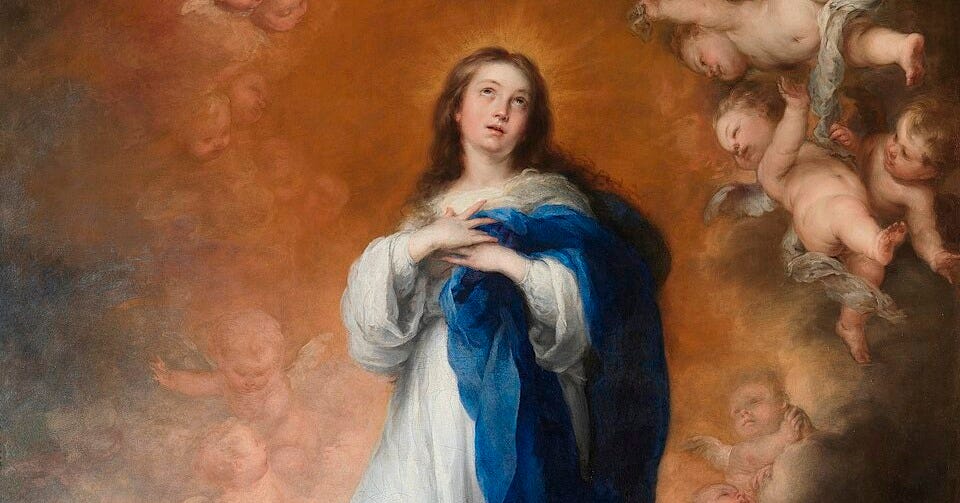
The Immaculate Conception
The Immaculate Conception means that Mary was protected from original sin at the moment of her conception in her mother’s womb. The term is often confused for the Incarnation when Jesus was conceived within Mary. In sum, God protected Mary from original sin in order that she could play her providential role alongside her Son, Jesus. Catholics further believe that Mary, preserved from the stain of original sin, never committed any actual sin either. In other words, Mary was sinless.
One very important distinction to make is that Jesus was sinless on His own merits. He was God. Mary, however, was made sinless by the grace of God and said “yes” to God’s grace at the Annunciation. Catholics will point to the fact that the angel Gabriel refers to Mary as “full of grace” prior to Jesus’ work on the Cross that opened grace, the divine life, for humanity. Mary somehow has this grace prior to Jesus’ mission of salvation. Does this mean she does not need Jesus? No. All humans are saved via Jesus; thus, with Mary, Catholics believe that God applied the grace of Christ to Mary prior to Christ’s Cross in order to bring her into the saving mission of Jesus. In other words, Mary’s grace is still a gift merited by Jesus Christ.
Why would God make Mary sinless?
Here is where it is good to remember the biblical roles of Jesus and Mary. If Jesus and Mary are the New Adam and the New Eve, then they must be part of the new humanity—untainted by the fallen humanity of Adam and Eve. The New Adam and Eve are inviting humanity into a new creation, one under the headship of the New Adam, Jesus Christ. Just as Adam and Eve were sinless at their creation, so too are the New Adam and the New Eve. In other words, Catholics believe Mary was preserved from original sin in order that she may be the New Eve of the new creation. Whereas Eve was the mother of all who live, Mary is the mother of all who live in Christ. It is a restart of humanity, a new garden of Eden.
Many Catholics, however, would immediately point to Mary as the New Ark. God commanded that the Ark of the Covenant in the Old Testament had to be perfect and gave very detailed instructions about its making and care. The New Ark, a woman, is greater than wood and gold, as she is a living being; moreover, unlike the Old Ark, Jesus pulls His flesh from the New Ark. God becomes man, and draws His humanity from Mary, the New Ark. Catholics see her as the perfect vessel, the perfect dwelling place of God on earth from which Jesus draws His perfect humanity.
The role of Mary as the new Queen incorporates perfection less obviously than the other two roles, but here you can see Mary, the new Queen, being the perfect intercessor on behalf of the people. It is important to note that the Queen’s intercession does not replace the intercession of the King, but rather the Queen is like an aide who comes beside you and pleads your case as well. She does not replace the King, but rather she helps to intercede before Him. Such a role would be one that should be done without error; thus, Catholics again tether Mary’s Immaculate Conception to her biblical role as queen.
What do you think?
Catholics see the teaching of the Immaculate Conception as being rooted in the biblical roles of Mary. What do you think?
The first thing to ponder is how to read the Bible, as you cannot discuss what the Bible does and does not teach if you cannot read it correctly.
The second thing to ponder is Jesus Christ. Though Christians often use titles for Jesus, like “King,” they often do not know the biblical details. Before ever coming to study Mary, one must study Jesus Christ and understand His saving work within the biblical narrative.
Then, the third thing to ponder is Mary’s role in salvation history. How is she related to Jesus Christ and how do the allegorical pictures of Jesus as New Adam, contents of the Ark, and King inform how you should view Mary? For example, allegorical pictures are never isolated, and seeing Jesus as the New Adam opens up the entire New Testament as a new Genesis.
The fourth and final contemplation is whether the Immaculate Conception dovetails well into Mary’s biblical roles and her relationship to the saving work of Jesus Christ. Mary, as a good mother, points to her Son—she does not eclipse Him or take away from Him. She should always point you toward Him.
Catholics see Mary’s roles as biblical and her Immaculate Conception as part of those roles.
What do you think?
Let us know!
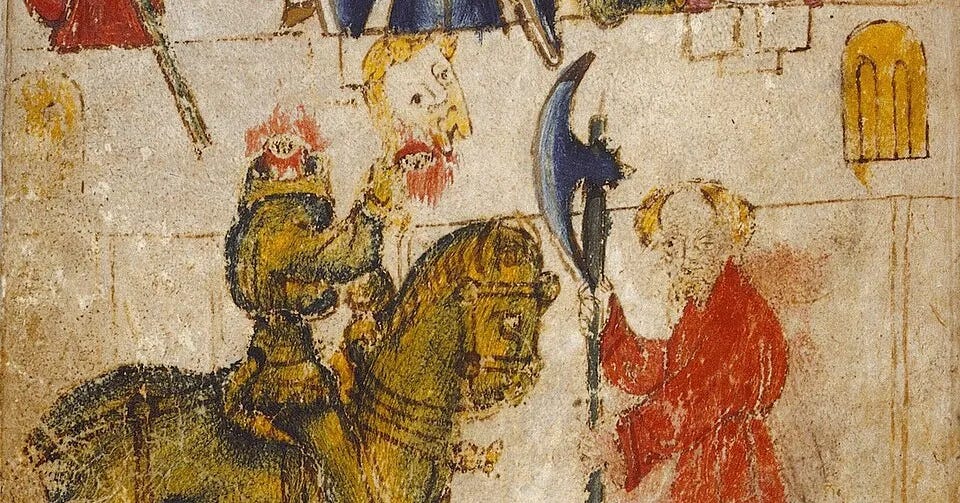
Post Script: A Christmas Reading!
We are reading Sir Gawain and the Green Knight (trans. by Tolkien) for Christmas! Join Dcn. Garlick and others over at Ascend: The Great Books Podcast to read this excellent Christmas tale together! It is a wonderful poem that tells one of the most famous stories from the Arthurian legends. We’ll be discussing an intro and Fitt 1 (12.16), then Fitts 2-3 (12.23), and end the discussion with Fitt 4 (12.30). Just follow the podcast or YouTube channel and join us!
Dcn. Harrison Garlick is a deacon, husband, father, Chancellor, and attorney. He lives in rural Oklahoma with his wife and five children. He is also the host of Ascend: The Great Books Podcast. Follow him on X at Dcn. Garlick or Ascend.
What you describe here touches something deep about how Scripture actually works. The Bible rarely explains holiness. It reveals it by setting things in the right relation to each other.
Adam and Eve echo Christ and Mary.
The Ark foreshadows the Mother who carries the Word.
These aren’t decorative parallels, they’re structural. They show that grace has a shape, and that shape keeps returning through history like a melody rising in a higher key.
Within that pattern, Mary’s purity isn’t an odd exception but the natural unfolding of the story already in motion. The new world begins the way the first one did, only healed. Seeing Mary inside that larger pattern doesn’t push her further away, it makes her feel closer, like a signpost pointing toward the restoration of all things.
To the text as well. Our Lady is “Full of Grace.” Not half full. Nor 99% full. Grace is sanctifying grace, and when “full” there is no room for sin.