


Piety is dangerous.
The Athenians killed God’s gift to them for his impiety.
Later, God came to man, and man killed God for His impiety.
Yet, Socrates and Jesus remain at the heart of the West. Since Homer and the tragedians, piety has been seen as a gratitude for an unrepayable debt toward the family, the polis, and the divine. It creates a threefold cosmic structure that aligns the relations of man and his allegiances.
But, if the polis becomes impious, then it becomes a danger to all true piety.
For both Socrates and Christ brought a true piety that, for either the soul or the polis to accept, would bring radical reorientation—a transformation that is often violently rejected.
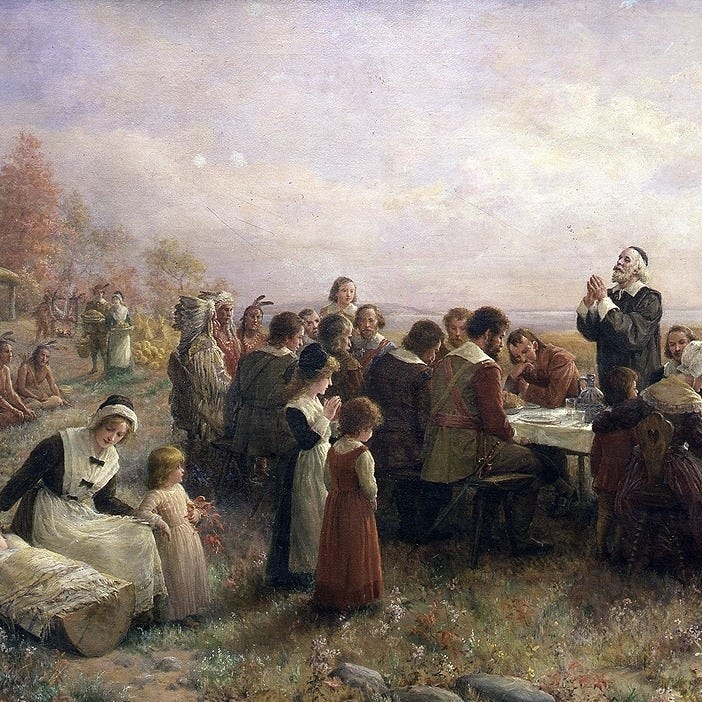
Though often forgotten, it is this ancient threefold piety that is underneath the American holiday of Thanksgiving.
It is an invitation to gratitude and a different way of life.
Reminder: this is a teaser of our members-only deep dives.
To support our mission and get our premium content every week, upgrade for a few dollars per month. You’ll get:
New, full-length articles every Tuesday and Friday
The entire archive of members-only essays
Access to our paid subscriber chat room
The Ancient Virtue of Piety
Homer is called many things—poet, theologian, etc., but he is without doubt a teacher. He is not a flat echo of the culture around him; rather, he intentionally presents educative dramas. And one of the most import lessons in Homer is piety.
Piety is a gratitude. It is a special type of gratitude. It is the understanding that you are in debt. For Homer, you bear an unrepayable debt to your parents, your polis (city-state), and your gods. It is because these three things nourished you when you could contribute nothing. The infant born into a family within a polis overseen by the gods has done nothing to deserve such a fate. Moreover, the child is raised and draws from a common good to which the child has given nothing. It is only once the child has become an adult, a meaningful citizen, that he or she can contribute back to those who have cared for him or her all this time.
A virtuous soul recognizes this debt, and it cultivates in it a gratitude expressed in honor and duty. In other words, piety is a type of justice, it recognizes what is due to the other and, though unrepayable, attempts to give back.
In Homer, you can see this piety at work in Prince Hector. He honors his parents, he lives and dies for Troy, and he honors the gods. Hector also reveals something about this threefold piety: it exists in hierarchal order. If your parents become contrary to what is owed to the polis or the gods, the higher should be followed. Hector’s mother explicitly draws upon this filial piety by exposing her breast and asking Hector to remember who cared for him when he was helpless—as she wants him to return to the polis. Yet, he feels compelled to remain outside the polis and fight. One can only discard the good of filial piety for the sake of a greater one: piety toward the polis (patriotism) or piety toward the gods (religion).
Piety is a nascent pattern within Homer, but it blossomed and found fecundity in the West. Piety animates Aeschylus’ Oresteia, Sophocles’ Antigone, Plato’s Euthyphro, the writings of Cicero, and those of St. Thomas Aquinas. It is a beautiful threefold pattern by which man can orient his life and act justly toward his relations.
It kneads in the soul a disposition of what can I do and not what am I owed.
The Cosmic Ugliness of Impiety
Piety gives structure to the cosmos. If the family, the polis, and the divine are aligned, there is justice. If one of these skews and the hierarchy of pity becomes disjointed, then friction occurs. In fact, the aforementioned Oresteia and Antigone both find the origin of their tragedy in a tension between the levels of piety.
In the Oresteia, Orestes is duty bound to enact justice upon his father’s murderer, for it is the pious duty of the blood-avenger, as governed by the gods, to do so; however, the murderer of his father is his mother, Clytemnestra. Can a man kill his own mother to avenge his father? Here, the piety between parents fractures, and even the divine disagrees on what justice requires. The brilliant triad ends with Athena holding court between the primordial Furies who want to condemn Orestes for shedding the blood of his own mother and Apollo who believes what Orestes did was just and pious.
In Antigone, a similar problem of piety is presented: Antigone wants to bury her brother, but her uncle Creon, now king of Thebes, says that piety toward the polis and the gods demands the brother not be buried—for he’s been labeled a traitor. While piety toward the polis is higher than piety toward the family, what if the polis errors in its understanding of piety toward the gods? Does that give the individual the right to correct the polis according a true understanding of piety toward the divine? The gods back Antigone, and it is a hard lesson for all involved (including Antigone who wavers in her understanding of religion).
If piety can bring a beautiful order to the family, polis, and the divine, then its disorder can bring a violent ugliness.
And it is not without cause that the West is founded upon two men who were both killed for impiety by their polis: Socrates and Jesus.
