


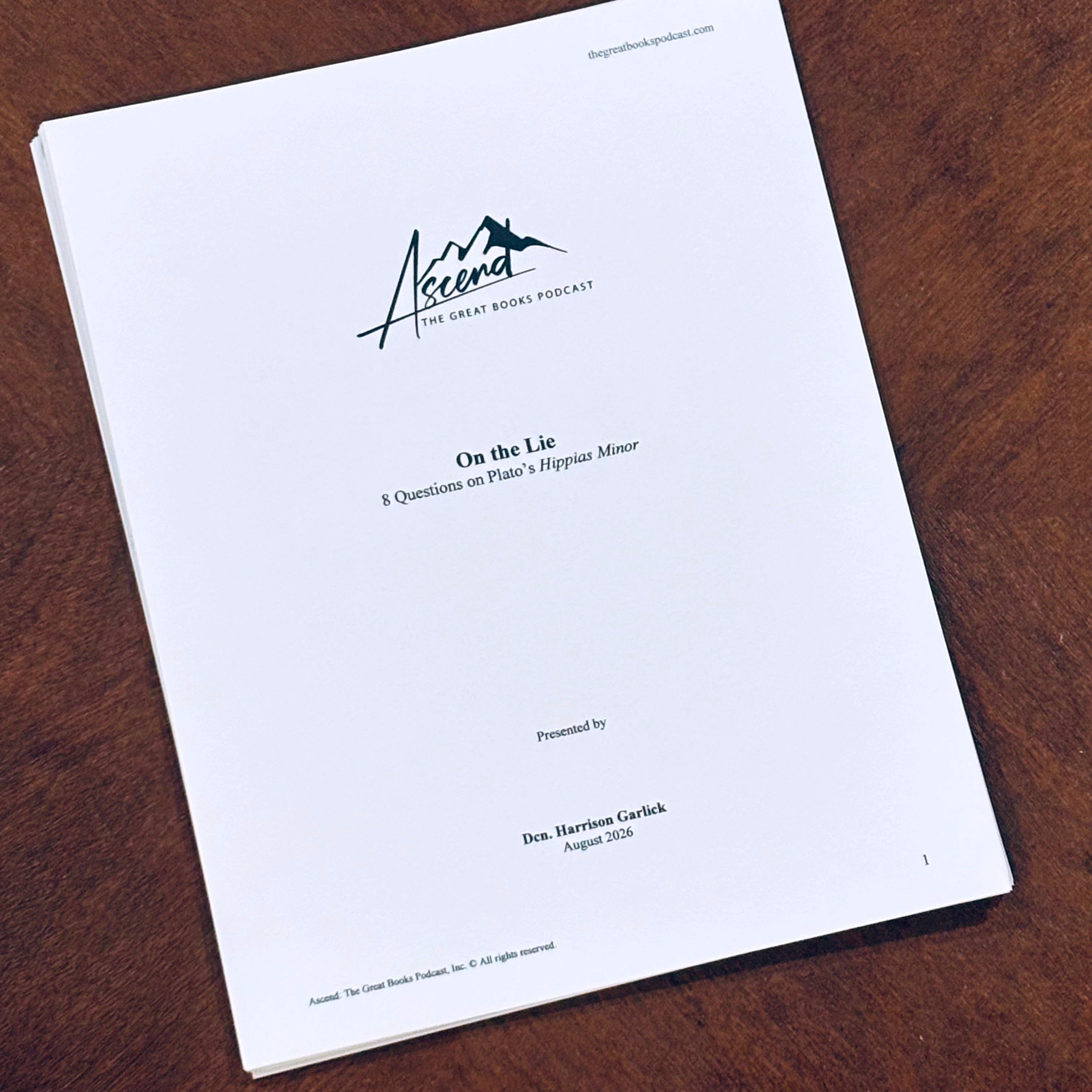
Dear Supporters of Ascend,
Plato’s Hippias Minor (or Lesser Hippias) carries the traditional subtitle “On the Lie.” After a boastful sophist has delivered a speech on Homer, Socrates is drawn into a conversation on lying and the heroic using Achilles and Odysseus as an example—it is somewhat charming to see a “great books” conversation in the ancient world, as Socrates and Hippias discuss a specific passage from the Iliad. And we must ask ourselves whether in this dialogue on lying, Socrates has been lying to us. Many of the dialogues are aporetic—they end without a positive definition, they end in bewilderment—but Hippias Minor is explicit at the end that Socrates does not fully agree with his own conclusion. It is a deeply aporetic dialogue.
Here is everything you receive in the guide:
A 8-page guide (3000+ words)
An introductory letter from Dcn. Garlick
Detailed outline of Hippias Minor
Preliminary reading questions
8 thorough questions on Plato’s Hippias Minor
I am grateful to Dr. Frank Grabowski, Dr. Brett Larson, and Mr. Thomas Lackey for joining me and helping all of us explore the nature of lying, voluntary and involuntary actions, and the nature of knowledge. Hippias Minor is important not only for what questions it raises but for what questions it does not—what concepts are missing from the dialogue that could help resolve its aporetic nature. Overall, the strange, forgotten dialogue of Hippias Minor serves as another excellent forerunner to Plato’s Republic, especially on the conversation of the “noble lie.”
Below is the full guide available to download.
