



Peace is more than you’re told.
The ancient definition of peace was gutted and filled with a modern, vapid meaning that lowers your standards.
Peace is not the absence of conflict.
The true definition of peace reveals a harmony, an ordered cosmos.
True peace sees Jesus’ “peacemakers” not as timid, conflict-avoidant persons, but as those spirited enough to make order out of disorder, harmony out of disharmony—to be co-creators with God, His true sons.
Rework your imagination with the proper grammar of peace.
Reminder: this publication is 100% reader-supported. We are only able to continue writing it thanks to the members who support our mission.
If you find these articles valuable, then please do consider subscribing for a few dollars per month — it helps us out enormously. You’ll get:
New, full-length articles every Tuesday and Friday
The entire archive of members-only articles and essays
Access to our paid subscriber chat room and community
Peace is More than You’re Told
What is the true spirituality of peace? As a modern, you use many of the same words as the ancients, like liberty, peace, and love, but with very different meanings. Few are aware that modernity gutted many of the ancient terms of the West and filled them with new meanings—often flat, vapid definitions.
And the concept of “peace” is no different.
Today, when we speak of peace, the implied definition is often the absence of conflict. It is largely a negative definition, denoting that something is missing—war. And this negative definition of peace, one that is predicated on conflict, is applicable not only to countries but also to neighbors and even the soul. We think our cities are at peace if the conflict is managed to an acceptable degree. We think we are at peace with our neighbors as long as we do not fight. It is a negative definition, one based on whether conflict is absent.
But Christians promote a positive vision of peace.
One that does not take its definition from its negative, war, but promotes a higher standard of being.
So, what is the ancient, Christian definition?
St. Augustine on True Peace
St. Augustine teaches that peace is the “tranquility of order.” It is the famous tranquillitas ordinis from his City of God (Bk 19, Chp 13).
What does this mean?
It is a positive definition that is rooted in teleology. Recall that telos means “end” or “purpose.” So the telos of the eye is to see, like the telos of the intellect is to know. For Christians, everything in nature has a telos, because everything in Creation comes from the mind of the Creator.
The human soul, politics, friendships, marriages, nations, etc., all have a telos that is orchestrated by God, often through nature, as one, ordered cosmos.
So, what is peace?
Peace is when all the parts of the whole are in harmony or are well-ordered, the “tranquility of order.” It is a positive vision of peace that calls humanity not simply to avoid conflict but to move together in harmony.
Think of it this way.
Imagine a room of people fighting and arguing with one another—this is conflict. The absence of conflict is that this fighting simply stops, but the people remain atomized and without order. Peace is like if the people gathered together and sang as a choir—each person playing their part to create a beautiful harmony, one unachievable unless they work together.
This is the true Christian vision of peace.
And this vision of peace radically changes one of Jesus’ most famous sayings.
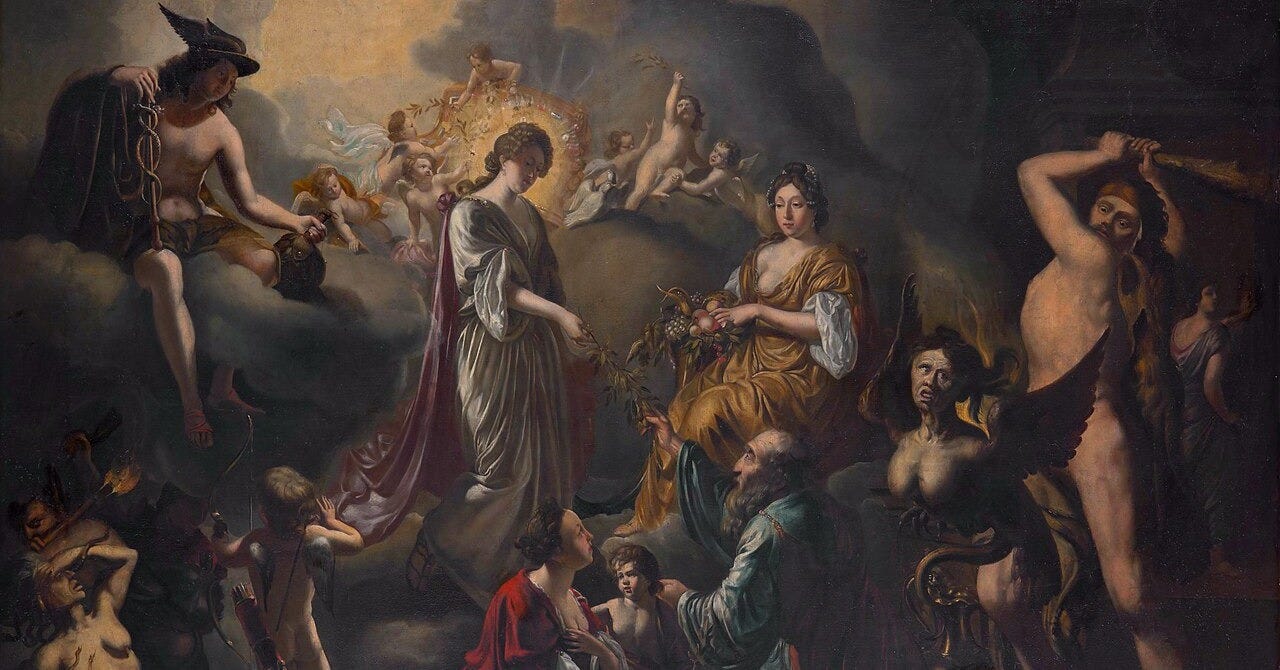
Blessed are the Peacemakers
It is important to bring this definition to Jesus’ famous beatitude:
“Blessed are the peacemakers, for they shall be called sons of God” (Matt 5:9).
If you have a flat, modern understanding of peace, then the “peacemakers” can be read as those who avoid conflict, the passive or timid—those who simply do not rock the boat.
But the robust, Christian understanding of peace shows a very different vision.
The peacemaker is one who brings order to disorder, harmony to discord—to make peace, is a proactive and positive endeavor.
It is difficult work.
Like a choirmaster forming a choir, the peacemaker works in society to harmonize discordant parts according to their proper telos.
In other words, the peacemaker is an agent of the divine, moving a disharmonious creation back into the intent of God.
So, how can this help you ascend in your own spiritual journey?
First, adopt the thicker understanding of peace. Let a better grammar inform your logic and your rhetoric. Do not sell yourself short.
Second, with this new understanding, be a peacemaker, an agent of the divine, bringing order to where there is disorder, beauty to where there is ugliness.
It is hard work—but it is a cooperation with the divine.
Be a true child of God.
Dcn. Harrison Garlick is a deacon, husband, father, Chancellor, and attorney. He lives in rural Oklahoma with his wife and five children. He is also the host of Ascend: The Great Books Podcast. Follow him on X at Dcn. Garlick or Ascend.
This is a topic I have longed to hear explained from the pulpit. I don't think pastors know either. They seem to have bought into the pacifist vision of Christ - lay down and die until your oppressors feel so guilty, they stop.
this got me thinking about what it means when we say “Rest in Peace” to our loved ones when they pass away. we’re not saying “rest in the absence of conflict” or “rest underground where the only ones around to bother you are the worms.” to say “Rest in Peace” is to recognize the hope we have through Jesus that after death we will be welcomed into true Peace: full reunion and alignment with the source of all goodness and beauty, the God that died for us that we may know Him. THAT is true peace.