


Plato’s Gorgias is a war, as the first line already declares (“In war and battle, this is the way to do your part,” 447a), for the souls of Athens’ youth and for every reader who has ever wondered how we ought to live. Socrates faces three escalating confrontations—the celebrity rhetorician Gorgias, his spirited student Polus, and the shameless Callicles—and what begins as a polite inquiry into rhetoric quickly exposes a terrifying truth: rhetoric divorced from philosophy is tyrannical, a “freedom for oneself and empire over everyone else” (452d) that leaves both speaker and polis diseased.
Against the shameful art that panders to pleasure like pastry-baking for the soul, Socrates sets the rare, noble rhetoric that “makes the souls of citizens as good as possible” and dares to say “what is best” whether the crowd likes it or not (503a)—the kind he claims to be the only Athenian practicing (521d).
Through relentless dialectic, shocking analogies, and the great myth of naked souls judged by dead judges (523a–527e), he proves that doing injustice is always worse than suffering it, that the unpunished tyrant is the most miserable of men, and that the cosmos itself is ordered toward a final justice no rhetoric can escape.
Athens is about to kill its only true statesman, yet the dialogue ends with the quiet, defiant promise that the just soul will ultimately shine while the scarred souls of the unjust stand exposed. This is not a polite discussion about public speaking. It is a war over whether life is mere power and pleasure or something infinitely higher—and though a challenging read, it is very much worth your time.
Here are the Ascend Book Club materials to help you read:
A detailed Q&A guide with everything you need to know about the Gorgias
Three excellent conversations on the three main parts of the dialogue (below)
All three conversations are also posted as podcasts
Check out related articles: “When Loving Your Enemy Means Justice” and “The Greatest Threat to Your Freedom is You.”
The Gorgias is a long dialogue but one worth the time and effort. What starts as a conversation on rhetoric matures (or devolves) into a rough dialectic on the purpose of life. Astute readers will note that there are strong parallels between the Gorgias and Book One of the Republic.
Join our reading group and study the great books with us!
To support our mission and get all our resources, become a paid book club member. In addition to the weekly podcast, you’ll get:
Live book club discussions with Dcn. Garlick & guest scholars (monthly)
In-depth reading guides and essays to lead you through the great books
Access to our incredible community of readers
The full archive of members-only content (guides, essays, and podcasts)

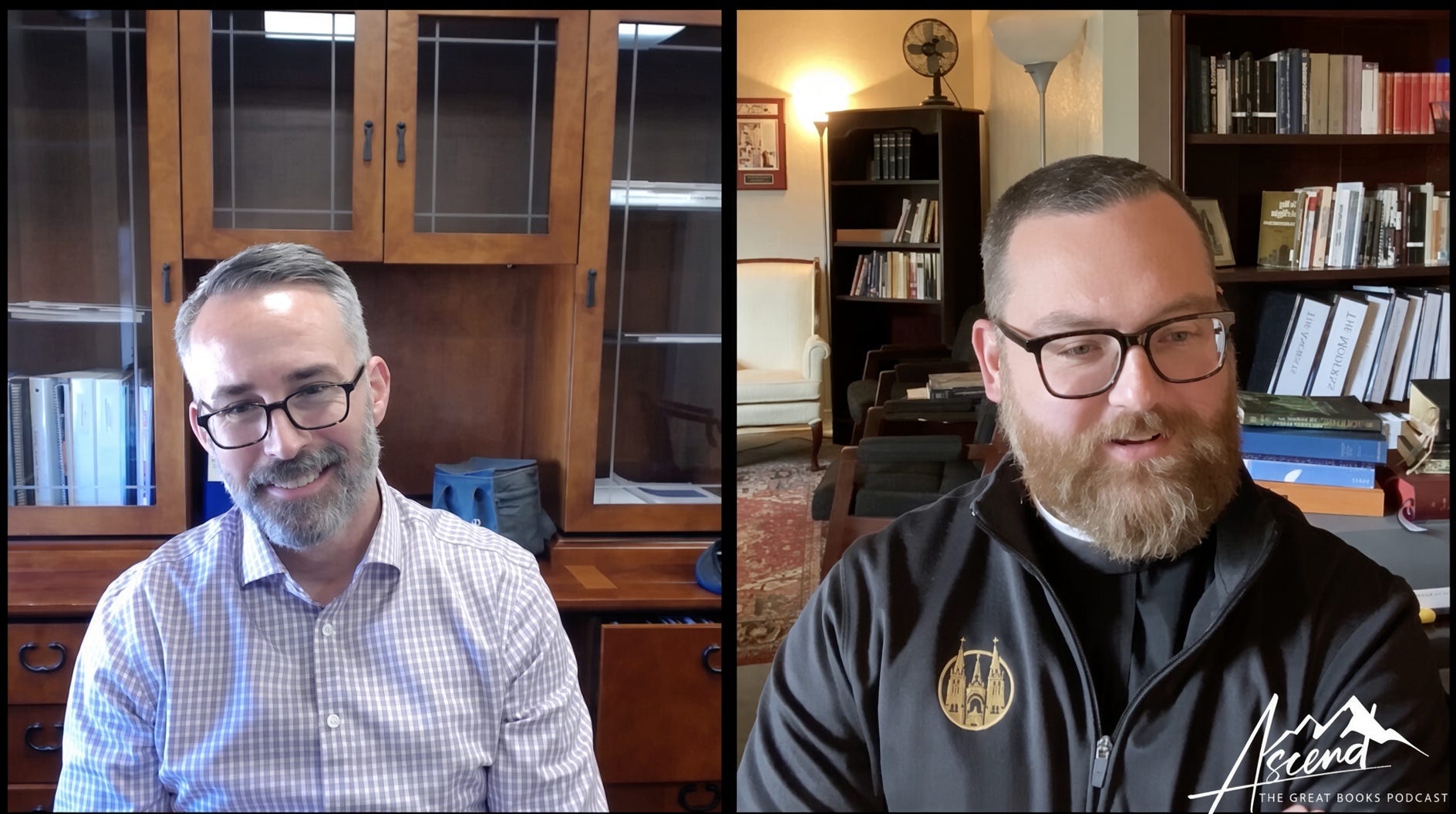
Video Discussions on the Gorgias
The Gorgias is a war. It is a war for the souls of the young men of Athens. The battle lines for the contest are not always as clear, however, and one must approach the Gorgias with humility and subtlety to understand its movements. It is worth a slow, attentive read.
The Dialogue with Gorgias (447–461)
In this episode, Athenian Stranger frames the conflict as two competing “technologies” of speech: Gorgias’ art that grants “freedom for oneself and empire over everyone else” (452d) versus Socrates’ dialectical practice that knows “the natures and causes of things” (464b–465a). The dialogue’s three-part structure—shortest with reserved Gorgias, medium with spirited Polus, longest with shameless Callicles—spirals downward, exposing pleonexia (infinite grasping desire) beneath all three souls.
The Dialogue with Polus (461–481)
In this episode, Dcn. Harrison Garlick and Dr. Matthew Bianco of the Circe Institute discuss the second part of Plato's Gorgias, the dialogue between Socrates and Polus—Gorgias’ spirited, “colt-like” student who bursts in at 461b accusing his own teacher of being “too ashamed” to admit rhetoric needs no justice, only the power to persuade.
The Dialogue with Callicles (481–527)
Discussing the incredible final act of Plato’s Gorgias (481–527), Dcn. Harrison Garlick and Dr. Greg McBrayer tackle the longest and most brutal confrontation: Socrates versus Callicles, the most shameless, most ambitious, and—as Greg insists—nastiest character in all of Plato.
Good work! The myth at the end of the Gorgias is one of the most beautiful in the Platonic corpus. It is easily one of the most memorable images of Socrates’ teachings on virtue as a beauty of the soul and vice as an ugliness. Next up on the docket in our Platonic studies here at Ascend are some of the so-called “forgotten dialogues.” These are dialogues that are often neglected nowadays and rarely discussed. We’ll be reading Hipparchus, Lovers, Hippias Minor, and Ion.
Join us.
Dcn. Harrison Garlick lives in rural Oklahoma with his wife and five children. He serves as a deacon at Holy Family Cathedral and as Chancellor & General Counsel for the Roman Catholic Diocese of Tulsa. Follow him on X at Dcn. Garlick or Ascend.