



Eros is the primal desire to satiate in beauty and be happy.
Yet many Christians view eros through either a pornographic or puritan lens.
But the question of the human condition is the question of erotics—it is the primordial force of the familial, the political, and the divine.
It is the call to ascend—to move from lesser beauties to higher beauties until the soul satiates in that for which it was made, Beauty-itself.
Everyone from the Old Testament prophets to Hesiod, Plato, Jesus, St. Gregory of Nyssa, and Dante tells you to take the erotic seriously.
Eros is the question of your restless heart.
Eros shows you a path to excellence, happiness, and bliss.
This is a teaser of our members-only deep dives.
We are a 100% reader-supported publication. To support our mission and get our premium content every single week, please consider subscribing for a few dollars per month.
New, full-length articles every Tuesday and Friday
The entire archive of members-only articles and essays
Access to our paid subscriber chat room and community
The Mystery of Eros
You have a primal desire to satiate in beauty and be happy—to feel fulfilled, whole, and at rest. You want to attain what is beautiful and delight in it—and this resounding, primordial yearning in the human heart is called eros.
C.S. Lewis calls eros a “Need-love” that finds satisfaction in the beloved.1 Joseph Pieper says eros is the “desire for full existence, for existential exaltation, for happiness and bliss.”2 You want someone to look upon you and say: “It is good that you exist; how wonderful you are!”3 Leo Strauss describes eros as a “love for the sempiternal possession of the good.”4 Allan Bloom says: “Eros… is the clearest and most powerful inclination toward lost wholeness:”5 Pope Benedict XVI defends eros as an “ecstasy” of the soul, an upward movement toward the divine.6
Many Christians, however, see eros as a disordered love that must be suppressed in the name of Christian charity.
But eros is your natural love given to you by God—a complement to the supernatural love of charity.
Many Christians limit eros to the erotic love between man and woman, which is perfected in marriage.
But eros is not reducible to sexuality—the erotic love for the beloved is simply the first step of the soul’s erotic ascendency to Beauty-itself, the divine.
The beauty of eros has been largely lost—but eros is central to the Christian narrative, because eros is the mystery at the heart of the human condition.
The restlessness of the heart of man is the question of erotics.
And the question of erotics is thus central to civilization—family, politics, and religion.
The Old Testament, Plato, Jesus, St. Gregory of Nyssa, St. Bernard of Clairvaux, and Dante all ask you to take the erotic seriously—for your good and for the good of others.
How can you rediscover this ancient beauty?
Recovering the lost grammar of eros is not easy—there are many presuppositions that need to be unworked and set aside.
Here is your path to ponder eros as a spiritual good.
I. Erotics in Homer & Pre-Plato
II. Plato & the Problem of Eros
III. Plato & the Ladder of Love
IV. What Plato Believes about Eros
V. Eros in the Old Testament
VI. Old Testament Erotics & Plato
VII. Eros in the New Testament
VIII. The Agape of St. Paul and the Eros of Plato
IX. Eros as the Ascent to God
X. Ascent: Eros & Christian Grace
XI. Agape as the Descent from God
XII. Eros & the Greatest Commandments
XIII. Ascend—Eros as Your New Beginning
To understand the human condition, you must understand eros. It is older than mankind and born afresh in every human soul. Those who master their erotics are those of self-discipline, virtue, and a relationship with God, Beauty-itself.
Though this is but a glimpse—a beautiful new way to look at the world awaits below.
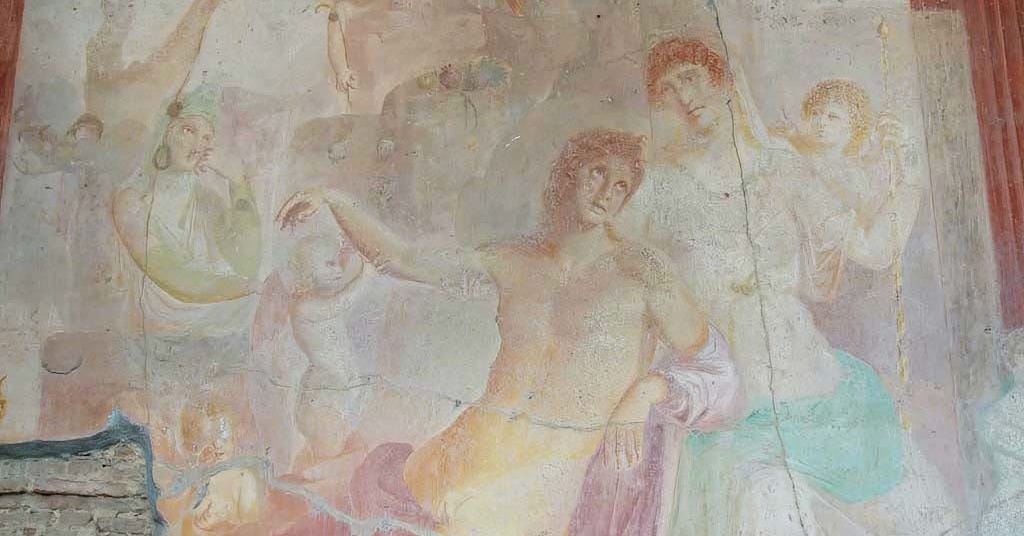
I. Erotics in Homer & Pre-Plato
In Homer’s Iliad, an antecedent to Eros is seen in Hera praising erotic Love (philótēs) who may “overwhelm all gods and mortal men.”7 Hera wears Aphrodite’s band—which “the world lies in its weaving”—and uses it to seduce Zeus, and Homer tells us the king of gods and men is “conquered by… the strong assaults of Love.”8 In short, erotic Love is presented as a personified cosmic force, like Sleep, Death, or Dream, that affects both mortals and immortals alike.
In Hesiod’s Theogony, Eros is presented as one of the four primordial gods, alongside Chaos, Earth (Gaia), and Abyss (Tartarus). Though Eros has no offspring of its own, Eros’ role in the primal cosmos is fecundity—to be the generative force within existence. Uranus and Gaia, for example, generate the Titans, and Cronos and Rhea generate the Olympian gods. In other words, without Eros the universe would be sterile and stagnant, because the fecundity of Eros grants life and movement to the cosmos. In fact, Aristotle will later praise Hesiod for his insight that Eros animates existence. In his Metaphysics, Aristotle takes up the question: how does the Unmoved Mover move all things if the Unmoved Mover does not move? Aristotle’s answer is eros—it is love that animates the cosmos.9 All things desire to return to the divine origin according to their telos (purpose, end).
In other words, the erotic desire between man and woman that breeds life is also at work in all creation. Eros, whether a god or a force, is one of attraction, satiation, fecundity, and existence. The many become one, and the one becomes many. Eros is always fecund.
Eros, however, also has a destructive quality.
In Antigone by Sophocles, the chorus sings of the madness that accompanies Eros.10 It is Eros, who is “never conquered in battle,” who neither men nor gods can escape (like Zeus in the Iliad). The chorus says of Eros: “whoever feels your grip is driven mad… you wrench the minds of the righteous into outrage, swerve them to their ruin.” For example in the play, eros transforms Hamon, the calm, rational prince into a patricidal maniac and suicide.
Eros overcomes reason. The desire for beauty, to love and be loved, brings bliss, ecstasy, and elation—what C.S. Lewis associated with our phrase “to fall in love”—but it can also bring a mania or madness that ends in ruin. It is notable, however, that as observed in Antigone, even in its unconquered madness, eros still bends toward justice and the will of fate.11
In a broad sketch, eros prior to Plato is seen as a primordial force of attraction and satiation, of madness and fruitfulness—one that moves the cosmos, the gods, and mankind.
It is this multifaceted and rich tradition that is inherited by Plato.