


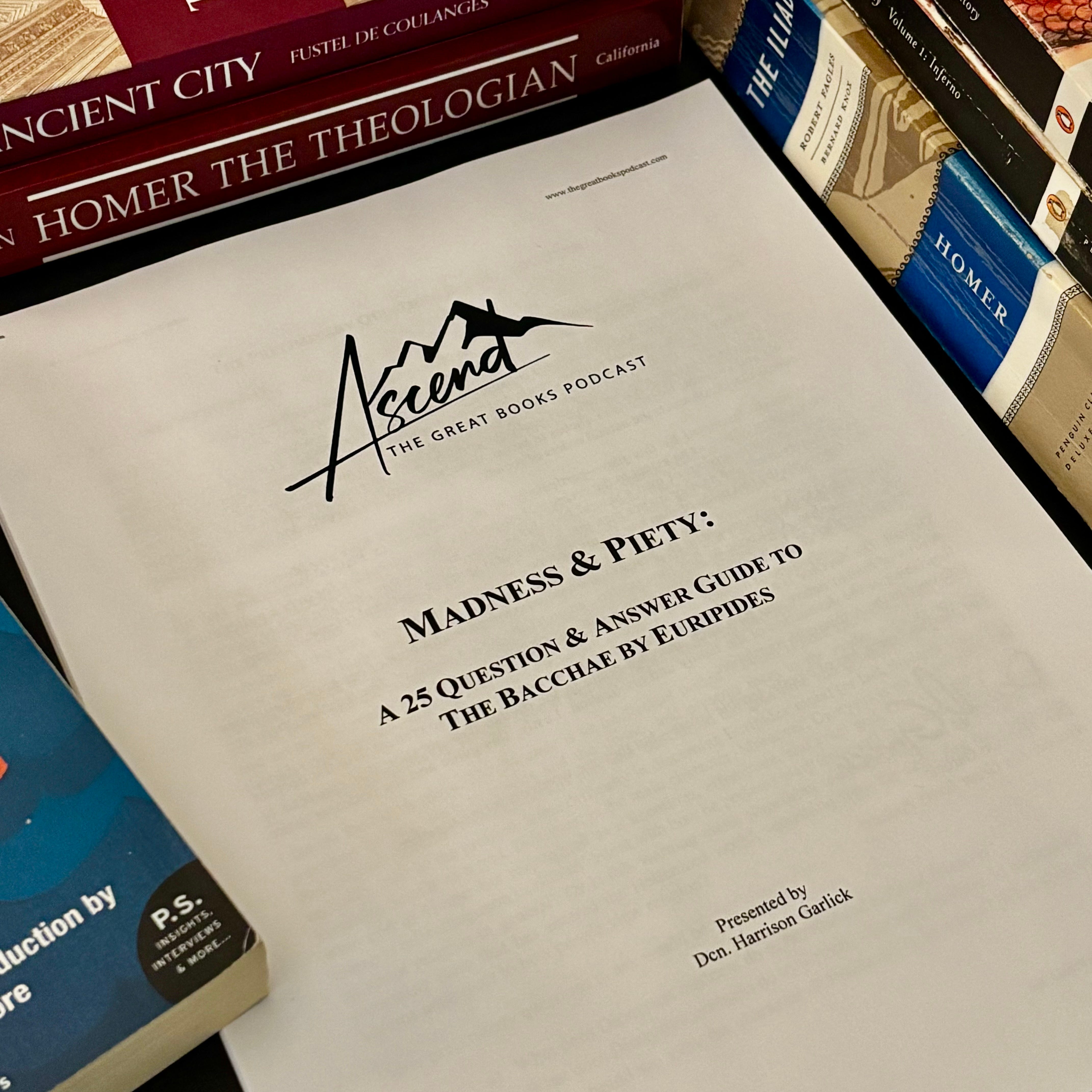
The Bacchae is a play about madness, piety, gore, and civilizational collapse. Though unsettling, it is well worth your time and attention. It tells the story of the god Dionysus, yet, he is not the jovial god of wine—he is a licentious, cruel, and vindictive god who drives women to unspeakable horrors amongst other depravities.
So, why read the play?
Well, first, it provides a stark contrast to how Aeschylus and Sophocles present the gods, and this contrast creates a notable antecedent to Plato’s Euthyphro. You are joining the great conversation in seeing the dialogue of these texts. Second, it presents an image of Dionysus that will be memorable when reading Plato’s Symposium, a dialogue on erotic love and the divine.
Here is everything you receive in our written guide to The Bacchae:
13 pages to help you understand the text
Introductory letter by Dcn. Garlick
List of preliminary questions to help you prepare for the work
25 rich questions on the body of the play itself
You can read The Bacchae with the Ascend Book Club. We are here to help.
Join our reading group and study the great books with us!
To support our mission and get all our resources, become a paid book club member. In addition to the weekly podcast, you’ll get:
Live book club discussions / Q&A with Dcn. Garlick & guest scholars
In-depth reading guides and essays to lead you through the great books
Access to our incredible community of readers
The full archive of members-only content (guides, essays, and podcasts)

Introductory Letter from Dcn. Garlick
Dear Ascend Book Club Members,
Madness, piety, gore, and civilizational collapse—the Bacchae by Euripides is a chilling yet captivating Greek tragedy that explores religion, erotic desire, the divine, and political stability through its graphic imagery and raw intensity. The story tells of the god Dionysus who is no longer the jovial, timid wine-god of Homer but a licentious, cruel, and vindictive god who is worshipped through an irrational release of sex and violence. He returns to Thebes to punish those who deny his divinity and leads Thebes into madness that deconstructs the natural orders of society.
I am utterly fascinated by this play—particularly as an antecedent to Plato’s Symposium and his understanding of eros as an ascent to the divine that shaped Western spirituality for over a millennium. We see contrasting visions of man’s natural love, his desires, in which one calls the soul to ascend to God, Beauty-itself and another invites man into a downward spiral of irrational release. In many ways, this represents the two paths of man and his civilization.
