


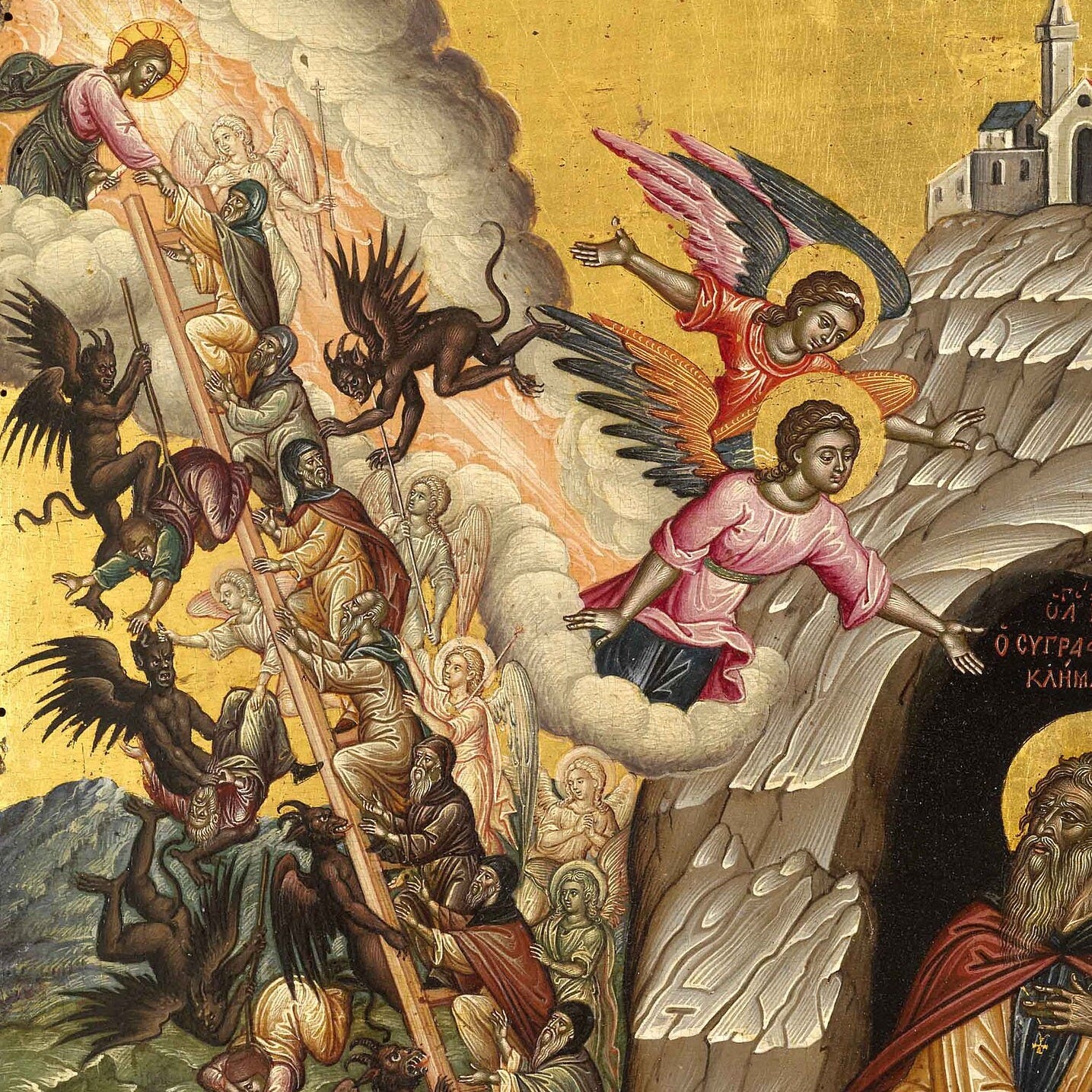
The purpose of the Christian life is not to avoid sin.
Christianity is not reducible to a list of things not to do.
Rather, the wings of the soul are desirous of flight—to soar to the higher beauties of God and become more beautiful as Christ is beautiful.
Yet too many focus on cleaning their wings while never leaving the ground.
St. Gregory of Nyssa can teach you a better way.
Reminder: you can support our mission and get all our members-only content for just a few dollars per month:
New, full-length articles every Tuesday and Friday
The entire archive of members-only essays
Access to our paid subscriber chat room
The Wings of the Soul
Imagine your soul had wings. Like fire, the purpose of the soul is to ascend—to soar to the higher levels of truth, goodness, and beauty. Now imagine that sin is like a sordid filth, a muck that covers your wings and inhibits flight.
God, in His mercy, allows you to find forgiveness—to cleanse your soul of sin. Yet, here is where many people misunderstand the Christian spiritual life.
They think that the purpose of the spiritual life is to maintain clean wings—to avoid sin. In other words, they think Christian spirituality is about not doing things, it is about a negative. Christianity is reduced to a list of things not to do.
But this is not true.
The purpose of wings is to soar. The purpose of wings is not being clean—that is necessary but not sufficient for true Christian spiritual growth.
Wings were made for flight—but too many struggle on the ground worried about what not to do.
You were made for so much more than a minimum standard.
The Saint who Knew this Well
In Christianity, the concept of “soaring” is called sanctification that is the process of being sanctified, of becoming holy. In the Christian East, it is called theosis, the process of becoming like God. The goal of Christian spirituality is to become God-like, to become more beautiful as Christ is beautiful. God gives you His Divine Life, grace, and invites you to ascend into the mystery of Jesus Christ.
The wings of the soul were meant for soaring.
An excellent Christian thinker on the need of the soul to ascend is St. Gregory of Nyssa (AD c. 335 to c. 394) who is often seen as the father of Christian mysticism. St. Gregory, pulling from a Platonic tradition, often characterizes the Christian journey of the soul as some type of upward journey. For example, in his famous The Life of Moses, he presents Moses climbing Mount Sinai as an act of eros (love) that, at the top, allows him to satiate in the “bright darkness of God.” He also sees an image of the soul in the story of Elijah being drawn up into heaven by the whirlwind and fiery chariot.
At other times, St. Gregory will speak of the wings of the soul, and how the soul must soar away from this world into celestial delights. He even will speak of the soul as having within it a great link of a chain—a chain that goes all the way to heaven that the soul must climb. St. Gregory of Nyssa understood that your natural love, eros, was like a fire desirous of always moving upward, and he understood how that love, baptized in God’s grace, then called the soul to fly higher into the Divine life—the mystery of Jesus Christ and the life of the Triune God.
Do not sell yourself short!
You were meant to soar. You were meant to clean your wings of sin and fly into the celestial delights of those who become more God-like, who undergo theosis. You weren’t meant to do the bare minimum—to be given godly wings only to tend to them on the ground of complacency.
And how do you start to soar? Christians will tell you to avoid the heavy muck of sin, but then purify the soul through prayer (intellect), almsgiving (spiritedness), and fasting (appetites). Work with God to make your soul more beautiful as Christ is beautiful. If you err, return to God’s infinite mercy and start the flight of the soul again.
Do not settle.
Soar.
PS: We are reading Dante’s Purgatorio for Lent!

We are reading Dante’s Purgatorio for Lent with our friends at Ascend!
The Purgatorio is an incredible spiritual guide, one of the best maps for the soul’s ascent toward the divine. Dante the Poet shows you the path the holiness and invites you to join him in his pilgrimage up the Mount Purgatory.
We have partnered with the Center of Beauty and Culture at Benedictine College and Dr. Jason Baxter to read the Purgatorio together. We are reading Dr. Jason Baxter’s excellent new translation, and he’ll be joining us first to introduce the Purgatorio and discuss what it is like to translate Dante.
2.10.26: Introduction with Dr. Jason Baxter, Benedictine College
2.17.26: Cantos 1-5 (Ante-Purgatory) with Dr. Donald Prudlo, University of Tulsa
2.24.26: Cantos 6-12 (Ante-Purgatory, Gate, First Terrace) with Luke Heintschel, Headmaster, Coeur du Christ Academy
3.3.26: Cantos 13-17 (Envy and Wrath) with Dr. Jessica Hooten Wilson, Pepperdine University
3.10.26: Cantos 18-22 (Avarice and Prodigality) with Dr. Sarah Berry, University of Dallas
3.17.26: Cantos 23-27 (Gluttony and Lust) with Fr. Patrick Briscoe, OP
3.24.26: Cantos 28-31 (Earthly Paradise)
3.31.26: Cantos 32-33 (Beatrice)
Join us by just following the YouTube page or subscribing on Apple or Spotify!
Dcn. Harrison Garlick is a deacon, husband, father, Chancellor, and attorney. He lives in rural Oklahoma with his wife and five children. He is also the host of Ascend: The Great Books Podcast. Follow him on X at Dcn. Garlick or Ascend.
Thank you for your article. Another metaphor for your point about soaring, is that of a farmer. A farmer’s goal is not to purge his land of weeds, but rather to produce fruit.
Wonderful. Thank you! I find that being truly Christian means finding a way to live with your sin and ask Christ to be with you and help you to overcome your weaknesses. When we fall down He can forgive us if we are truly able to see our wrong doing and see our weakness. We can ask for his strength and guidance and He will walk with us in the darkness. Teaching us how to "soar" to new heights through what we are enduring and learning