


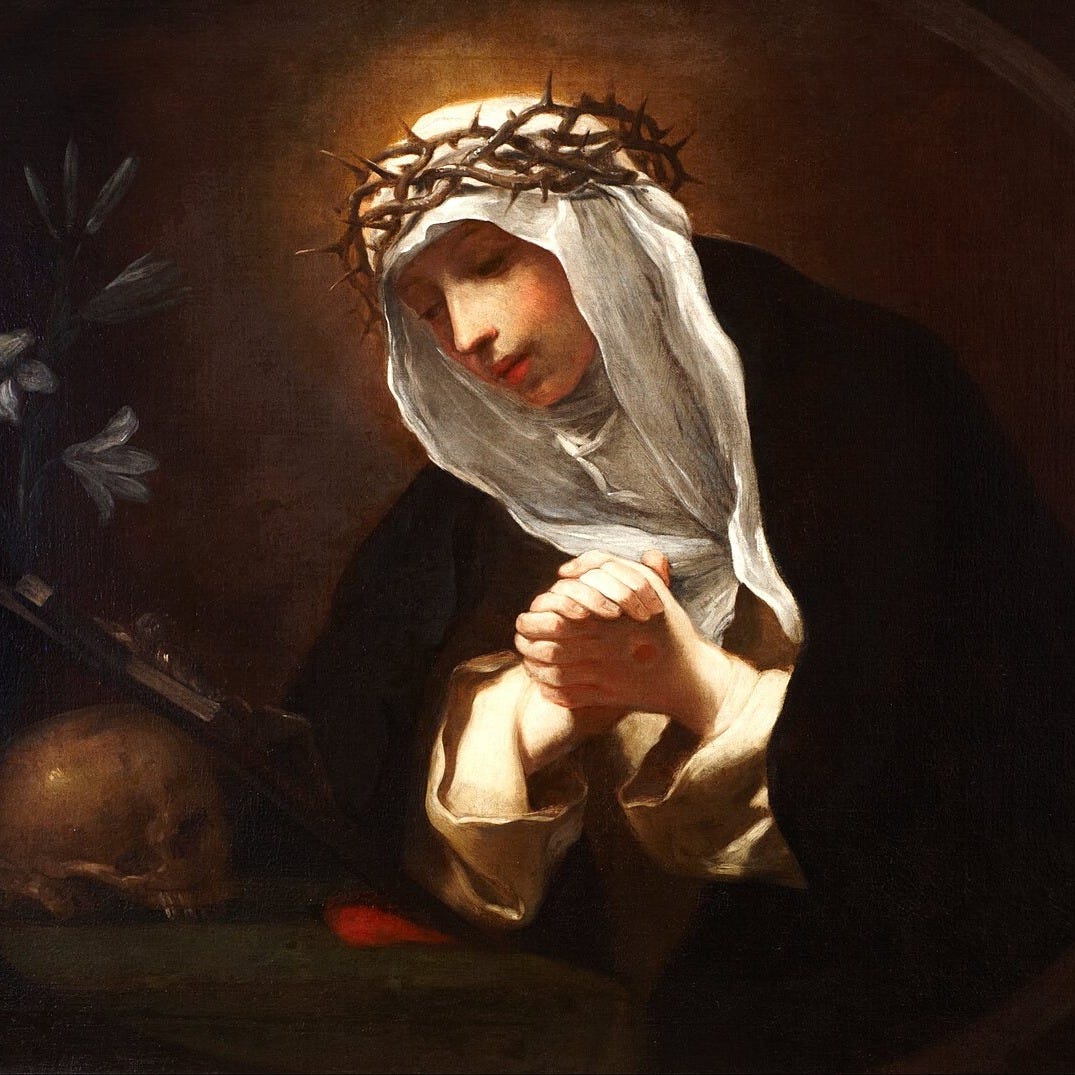
How do you correct the pope?
St. Catherine of Siena gives us a model that is alien to our modern sensibilities.
Many rush to claim her as a proto-feminist icon who boldly defied male authority—an example of using a leader’s mistake to subvert the hierarchy.
Yet the real St. Catherine was something far more rare: a woman whose burning personal love for Jesus overflowed into a public, prophetic voice.
She spoke truth to power not to tear down hierarchy, but to purify and restore it. Do not let modern misreadings rob you of her lesson.
Find out more about her life and those working to promote it.
Reminder: you can support our mission and get all our members-only content for just a few dollars per month:
New, full-length articles every Tuesday and Friday (or Saturday!)
The entire archive of members-only essays
Access to our paid subscriber chat room

Why is there no great art anymore? Well, there can be. Check out the efforts by our sister publication, the Culturist and Evan Amato as they commission a beautiful work of St. Catherine of Siena.
Who was St. Catherine of Siena?
Our age is always eager to take truths of antiquity and press them into the service of modern ideologies. St. Catherine of Siena (1347–1380) is no exception. She is sometimes hailed as a proto-feminist icon—a woman who dared to lecture popes, traveled freely, and wielded spiritual authority in a male-dominated Church.
Yet the real Catherine resists such framing.
She was not rebelling against authority; she was submitting to it in its deepest form. Her life offers a clearer, older pattern: the biblical way of speaking truth to power while honoring the office God has established.
Catherine was born the twenty-third or twenty-fifth child of a Sienese dyer. From childhood she consecrated her virginity to Christ and resisted her family’s attempts to arrange a marriage. At sixteen or eighteen she joined the Dominican Third Order as a laywoman, living a hidden life of prayer and austerity in a small room of her parents’ house. There, in solitude, she received the mystical experiences that would define her: visions of Christ, a “spiritual espousal,” and eventually the invisible stigmata.
These graces, however, did not remain private. They propelled her out of her quiet contemplations and into a public, prophetic role.
By her mid-twenties St. Catherine had become a spiritual mother to a growing circle of disciples—priests, politicians, and ordinary souls—who called her “Mama.” She cared for the sick during plagues, mediated disputes, and dictated hundreds of letters.
Her most famous intervention came during the Avignon Papacy.
What was the crisis of the Avignon Papacy?
For nearly seventy years the popes had resided in France, far from Rome, entangled in political intrigue and worldly comfort. The Church suffered from this displacement: weakened leadership, divided cardinals, and a sense that the Bride of Christ had lost her home, the eternal city of Rome. The absence of the pope wasn’t just a question of geography, but a sign the spiritual power of the Church was currently subservient to a temporal authority, France (see the end of Dante’s Purgatorio where the French monarchy is like a violent giant who turns the Church into his paramour).
St. Catherine saw the scandal clearly.
In letters of remarkable directness she urged Pope Gregory XI to return to Rome. She addressed him as “sweetest father” and “Christ on earth,” yet did not hesitate to call the situation what it was—a wound in the Body of Christ. She offered a prophetic voice limned in sweet obedience. Her words, combined with the movement of grace, helped convince the pope to make the difficult journey back in 1377. She spent her final years in Rome, laboring for unity even as the Western Schism loomed. Exhausted by fasting, travel, and the weight of souls, she died at thirty-three.
The quiet saint of contemplation shared her prophetic voice—and she helped correct a mistake of the pope!
Yet the good Saint’s humble, yet direct words have been often misinterpreted.
And if you receive a false image of this Doctor of the Church, then you miss her extraordinary lesson.
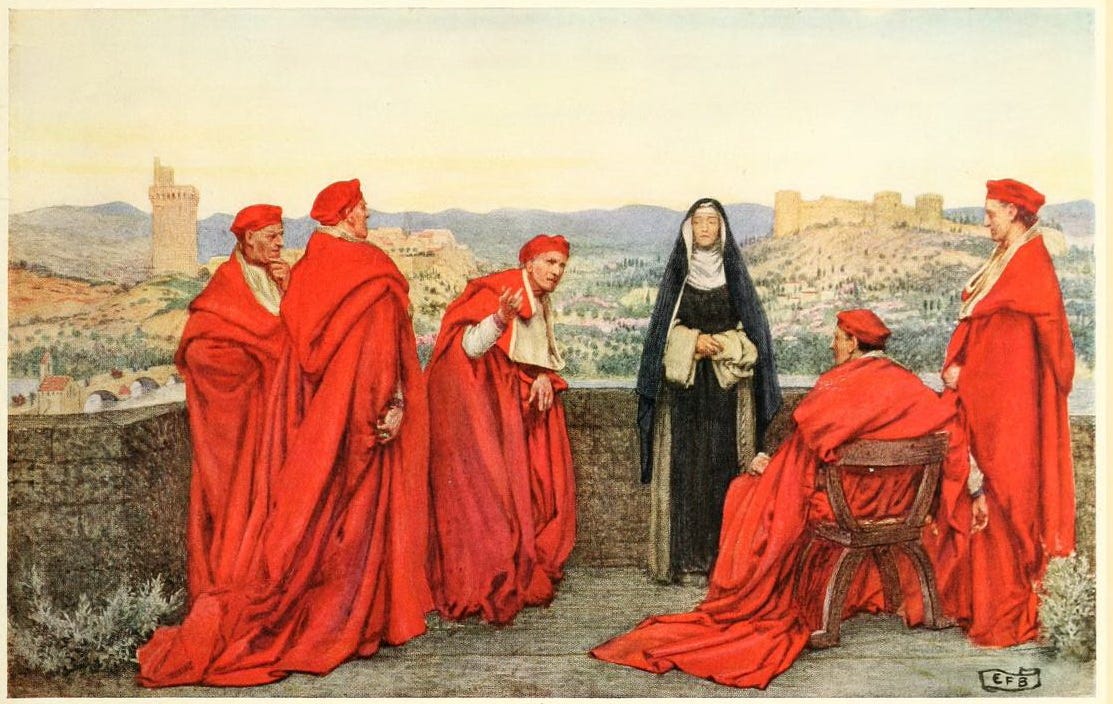
How is St. Catherine Misinterpreted?
It is easy to see why modern readers might claim her. Here was an uneducated laywoman who left her humble beginnings, confronted cardinals, and even corrected the pope.
Some interpreters, however, present her as a woman who “defied the papacy,” as though her mission was to subvert the patriarchal structure of the Catholic Church and claim some power denied to her due to being a woman.
Such readings miss the heart of the matter.
St. Catherine was not a modern. She did not seek to dismantle hierarchy. She was not suspect of authority. She did not read antagonisms and distrust into relations (e.g., male to female, cleric to lay, pope to Christian faithful). She spoke as a daughter of the Church who loved the papacy too much to remain silent while it wandered into error. Her words weren’t a subversion of the papacy but an invitation for it to return to its own authority.
For Saint Catherine, the world needed the pope to be the pope and help Christian live a good and holy life.
Her condemnations were not a dismantling of the papacy, but rather a restoration of it.
Are St. Catherine’s Actions Biblical?
St. Catherine followed a thoroughly biblical pattern. Think of David, who twice had the opportunity to strike down Saul, the Lord’s anointed, yet refused: “I will not stretch out my hand against my lord, for he is the Lord’s anointed” (1 Sam 24:10). David honored the office even while the man who held it sought his life. Or consider the prophets who confronted kings—Nathan before David, Elijah before Ahab—always in service of covenant fidelity, never in rejection of God-given authority.
Catherine’s letters reveal the same spirit.
She could write with fiery clarity about clerical corruption and the need for reform, yet she insisted that even a flawed pope must be obeyed for the sake of Christ.
Her authority came not from a claim to autonomous power (like radical modern individualism) but from mystical union with the Bridegroom, Jesus Christ. In her work The Dialogue, she presents the soul as a bride, drunk with love for Christ, called to share in His redemptive suffering. That bridal love overflowed into bold service, but it never became rebellion. She sought to purify the Church, not to redefine it.
The prophetic voice is never a voice of rebellion.
What is the Lesson of St. Catherine of Siena?
The actions of St. Catherine of Siena are a model of courageous and prophetic submission. She “forgot her sex,” as she put it, not to assert herself against men but to serve the salvation of souls without regard for worldly categories. In other words, she called men back to their role of authority—to be good priests, bishops, and popes for the glory of God and the salvation of souls.
She does not deconstruct the hierarchy but rather lifts it up to its actual purpose.
What might it look like to imitate her today?
First, St. Catherine had a radical understanding of the Church as the Bride of Christ. It was not a political arena in which one vies for power. Her public witness was always fueled by a private, mystical devotion. In other words, she loved Jesus Christ personally, and that at times called her to a prophetic, public witness of that love.
Second, it means that even the prophetic voice—which often calls out sin—is always saturated in charity and respect. As moderns, we want to conflate the prophetic voice with one that deconstructs—one that calls out the errors of another in order to gain their power, to destabilize for the sake of self-gratification. Such a rebellious, luciferian notion remains complete absent in Saint Catherine of Siena—even though it is ubiquitous in modern politics.
Third, most of all, it means trusting in God that He can speak through even the most unlikely of voices. Yes, there are those who hold offices of authority, like a pope, but that does not preclude God speaking from others—or even speaking a word of correction to those in office.
St. Catherine of Siena was not the feminist saint some imagine.
She was something far more rare and enduring: a simple soul whose love of Jesus allowed her to speak with both fiery boldness and humble submission. She did not dismantle the hierarchy. She called it to fulfill its purpose.
In an age that prizes personal autonomy and abhors submission, her life remains an invitation to something more ancient, more beautiful, and ultimately more liberating.
Listen to the good St. Catherine, and ascend.
And go check out this amazing project to bring St. Catherine to life in a newly commission piece of art!

Dcn. Harrison Garlick is a deacon, husband, father, Chancellor, and attorney. He lives in rural Oklahoma with his wife and five children. He is also the host of Ascend: The Great Books Podcast. Follow him on X at Dcn. Garlick or Ascend.
St. Catherine, Pray for us.
"Truth to power": That's a phrase people now use. WHAT does it mean?