


Courage is necessary for a good life.
Sir Gawain, a knight of the Round Table, painted an image on the inside of his shield to sustain his fortitude in battle.
Many find courage an outdated virtue, one for battling creatures of fay-magic in fairy tales.
But courage is demanded of the soul daily in many subtle, quiet ways.
And the inside of Sir Gawain’s shield invites you to see the necessity of fortitude and creates reminders in your own life.
Reminder: you can support our mission and get all our members-only content for just a few dollars per month:
New, full-length articles every Tuesday and Friday
The entire archive of members-only essays
Access to our paid subscriber chat room
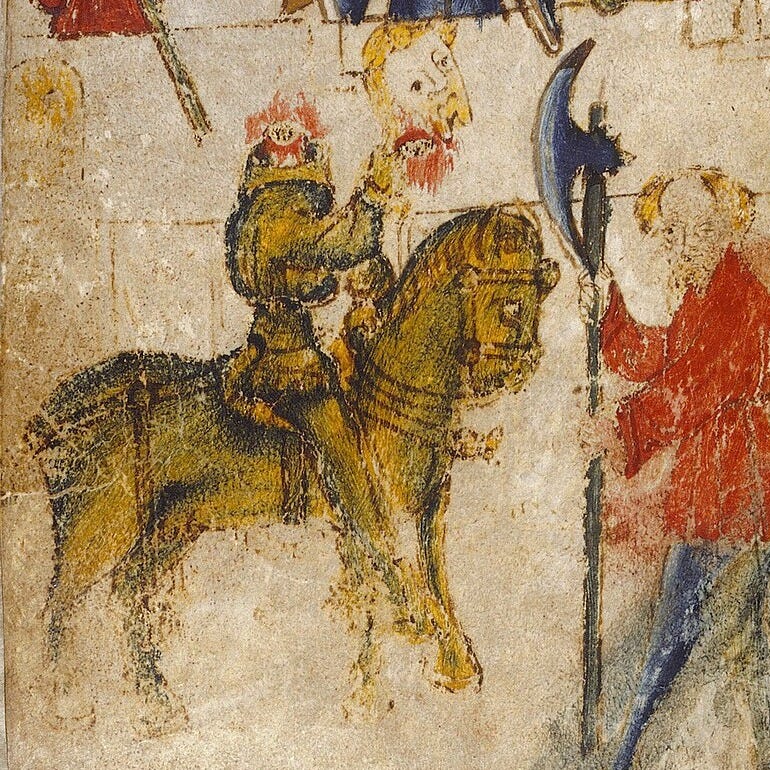
The Beheading
On New Year’s Eve, King Arthur is with his knights and guests at the round table. As was his custom, King Arthur would not begin to eat until he had heard some story of wonder and renown or seen some marvel. Suddenly, a man on horseback came riding into his hall. He seemed a half-giant clothed completely in the color green bearing a holly branch in one hand (a sign of peace) and a huge, ornate green axe in the other. In fact, to the amazement of the knights, the giant had green skin and hair—even his horse was green. Aptly known as the “Green Knight,” he offered a Christmas game of stroke for stroke. One knight would be permitted to strike the Green Knight first and win the giant, ornate axe. Then, in a year and a day, the Green Knight would be able to strike him in return.
The hall was silent before the massive, green man, but King Arthur stood up and gripped the axe ready to swing—until his nephew, Sir Gawain, offered to take his place. Sir Gawain stood before the Green Knight and brokered terms of the holiday game: Sir Gawain would strike the Green Knight and then have to journey to the Green Chapel to receive his strike from the Green Knight.
Sir Gawain, on the advice of his king, lifted the axe and swung with all his might—the head of the Green Knight went rolling across the floor. The game had apparently come to an end. Yet, to the amazement of King Arthur’s court, the headless knight walked over, picked up his head, and galloped away, reminding Sir Gawain he would see him one year hence.
The Shield of Sir Gawain
In this 14th century anonymous poem, Sir Gawain and the Green Knight, the hero must find the fortitude to journey and face his green foe. While his overall pilgrimage is certainly worth reading (please do not watch the 2021 movie), the poet gives a minor detail about the shield of Sir Gawain that reveals a substantial motif in the poem. The poet spends a notable amount of text on Sir Gawain’s armor but then tells you that on the inside of Sir Gawain’s shield he has there painted an image of the Blessed Virgin Mary.
In this manner, when he lifts his shield in battle, he will be eye-to-eye with Mary, the Theotokos (Mother of God), and be encouraged—and find the fortitude and spiritedness (thumos) he needs to overcome evil.
Throughout the poem, Mary plays a subtle but integral part guiding Sir Gawain on his journey—a strong contrast to Morgan le Fay, the fay-magic “goddess,” who works her own secret machinations against the knight.
But the lesson of Sir Gawain, even in this simple part, is that fortitude is necessary for any journey—and that Mary, and Christianity as a whole, perfects fortitude and encourages the soul to do well.
Fortitude, however, is often underrated.
Many think it is a virtue only needed for great deeds—and opportunities for acts of valor will never come.
But fortitude is necessary for simply living a good life.
Grace Perfects Nature
Sir Gawain invites you to understand that fortitude is necessary for a virtuous life. It does not matter if you are smart enough to understand what is right if you are too afraid to do it. Many Christians often know what the Gospel asks of them, but they buckle under the pressure of a worldly culture.
Christians believe, however, that grace perfects nature. In other words, participating in the life of God perfects what it means to be human—which means it elevates the natural virtues as well, like fortitude. The Christian life is not contrary to bravery but a perfection of it.
Think of it this way, if grace perfects nature, that also means that nature is a foundation for grace. If you’re going to build a Christian ethic in your life, you need a solid natural foundation. Grace helps to heal nature and strengthen it so that it may serve as a foundation of what is above nature, the supernatural.
And Christians would hold that fortitude is necessary for a good life.
Courage is Required
The good life requires bravery. And bravery is much more than fighting enemies—bravery is required in other more subtle areas, like education. In Plato’s Republic, one of the preliminaries in education is gymnastics—the cultivation of the body. Why? Well, at first it seems the body should be cultivated for its own sake, for the sake of excellent health and figure. But ultimately, the training of the body is also beneficial to the soul, especially in cultivating the thumos, the spirited part of man’s soul. The spirited part is that part which loves nobility and is perfected by fortitude. It overcomes difficulties to achieve some good, and delights in honors, glory, and victory.
Socrates saw that this spiritedness was also necessary for education. That education, the philosophic life, was difficult. It was having the capacity to turn around and make the arduous climb out of the cave and into the light. In other words, spiritedness is needed for a philosophic life, and the virtue that perfects our thumos is fortitude.
Fortitude is necessary for education and for the philosophic life.
It is also necessary for the Christian life, which presents itself as the perfection of the natural life. Without question, one can see the fortitude in David before Goliath or Moses before Pharaoh. But, there are more subtle examples of bravery in the biblical narratives, as Christians would point to Noah’s courage to build the ark, Abraham’s courage to leave Ur, or Daniel’s courage to pray under threat of the lion’s den.
Christians also argue that Jesus is often misinterpreted. People often see Jesus as gentle and mild—not spirited or a paragon of courage. Yet, Christians point to the cleansing of the temple, where Jesus made a whip and drove out the moneychangers. The thumos of Christ, however, is seen in more subtle ways. For example, no one could argue it did not take courage to suffer the crucifixion. It is a courage, a thumotic act, that echoed in the martyrs. Does it not take fortitude to be crucified upside down as St. Peter was, to deny the emperor and be mauled by the beasts in the colosseum as St. Perpetua was, or grilled alive as St. Lawrence, the good deacon.
It may not always take the form you think it will.
The good life requires fortitude.
The Courage of Sir Gawain
Sir Gawain understood the necessity of bravery. He had Mary painted inside his shield so he could see her eye-to-eye on the battlefield. He looked to his Christian faith to sustain his courage in times of evil and trial.
Where do you need to paint a picture of Mary?
Where in your life do you need that reminder of the Christian faith to help sustain you against the trials of your life?
Take Sir Gawain as an example. Fortitude is necessary.
Give yourself a reminder—and fight well.
Post Script: TODAY A Christmas Reading!
We are reading Sir Gawain and the Green Knight (trans. by Tolkien) for Christmas! Join Dcn. Garlick and others over at Ascend: The Great Books Podcast to read this excellent Christmas tale together! It is a wonderful poem that tells one of the most famous stories from the Arthurian legends. We’ll be discussing an intro and Fitt 1 (12.16), then Fitts 2-3 (12.23), and end the discussion with Fitt 4 (12.30). Just follow the podcast or YouTube channel and join us!
Dcn. Harrison Garlick is a deacon, husband, father, Chancellor, and attorney. He lives in rural Oklahoma with his wife and five children. He is also the host of Ascend: The Great Books Podcast. Follow him on X at Dcn. Garlick or Ascend.
Interesting to contrast Mary inside Gawain's shield with Hera's outwardly terrifying aegis.
Appreciate you Deacon and the ascending journey we are on together. Thank you for the beautiful posts.