


Everyone knows Aslan, the great lion who dies and rises again, is an image of Christ.
But why did C.S. Lewis choose a White Witch and an endless, Christmas-less winter to represent evil?
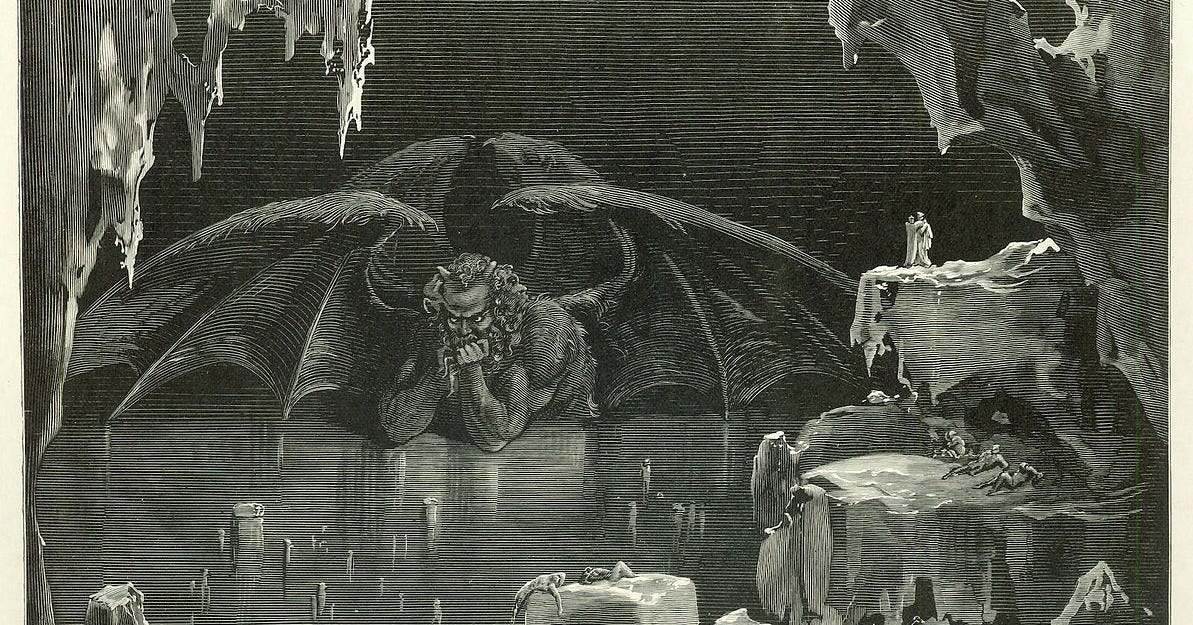
The answer connects Narnia to one of the most startling images in Dante’s Inferno—and it quietly unlocks one of the deepest and most troubling questions in Christianity:
How can a good God permit suffering?
Lewis and Dante do not lecture you.
They show you the answer.
Reminder: this is a teaser of our members-only deep dives.
To support our mission and get our premium content every week, upgrade for a few dollars per month. You’ll get:
New, full-length articles every Tuesday and Friday
The entire archive of members-only essays
Access to our paid subscriber chat room
Another look at Narnia
During World War II, the Pevensie children flee to the English countryside to escape the Nazi air raids on London. The children – Peter, Susan, Edmund, and Lucy – are the guests of an eccentric but kind professor who welcomes them to his large country estate. One day, as the children are playing in the old house, the youngest child, Lucy, stumbles through the back of a wardrobe and enters into an enchanted land filled with mythological creatures and adventure.
The children come to know the land as Narnia, and that Narnia is held under the wicked rule of the White Witch, a tyrant who has cast a spell over Narnia to make it always winter but never Christmas. Yet, through their relationship with a couple of talkative beavers, the children come to understand that Aslan, the lion, has returned to Narnia to liberate it from the perpetual winter of the White Witch. Through a series of charming adventures, the children join forces with Aslan; yet, Aslan’s victory over the Witch is not what they expect.
Where they expect him to be a military hero, to find victory in power and conquest, Aslan instead offers himself as a willing victim, a sacrifice, to save the life of another. He lays down his life, and in that ultimate act of love, he is able to receive his life again. It is only in the death and resurrection of Aslan that Narnia finds its ultimate victory over the evil of the White Witch.
C.S. Lewis’ 1950 classic The Lion, the Witch, and the Wardrobe has an enduring benefit for children, because it serves as an excellent introduction for their young minds to the concept of allegory. Habituating a child’s intellect to note the signs of allegory amongst the literal text is a great service to them. It stretches their imagination to observe the layers of a text, and to have patience in unfolding a narrative. In understanding the signs and symbols of the death and resurrection of Aslan, they may grasp a deeper understanding of the death and resurrection of our Lord. Just as Aslan died to liberate Narnia from the power of the White Witch, so too did Christ die to liberate us from Satan, the prince of this world, and the power of sin and death.
Yet, there is another allegory in Narnia not often discussed—why C.S. Lewis used perpetual winter as an analogue for evil.
The Problem of Evil
In Christianity, there is something called theodicy or “the problem of evil.” You may see the problem like this: God is good. Everything God created is good. Evil exists. How can this be true? Many other religions and cults have solved the problem by stating there are two gods or forces of equal power, good and evil, and our world is a tension between the two. But, in Christianity, God is the Almighty, the Creator, Being-itself, while Satan is a finite creature, an angel—they are not equal opposites.
Christians face a distinct problem in claiming that God is good. You could ask why a good God would allow people to suffer, but you could also ask why a good God allows evil at all. In Dostoevsky’s The Brothers Karamazov, one of the characters gives a list of horrific acts that have happened against children. It is a difficult read. He uses this not to claim there is no God—but to claim that God must not be good. Many believe that evil shows that either God is not good or He is not all-powerful.
The problem of evil is a serious problem for Christianity.
And one of the first problems that you have to unravel is what is evil. You cannot discuss why God permits evil or whether evil shows God is not good if you do not know what evil is.
To learn this lesson, you should turn to two great Christian masters: Dante and C.S. Lewis.
These two Christian intellectual giants do not tell you the answer. They show you the answer.
And these answers are found in the commonality between Narnia and the pit of hell.