


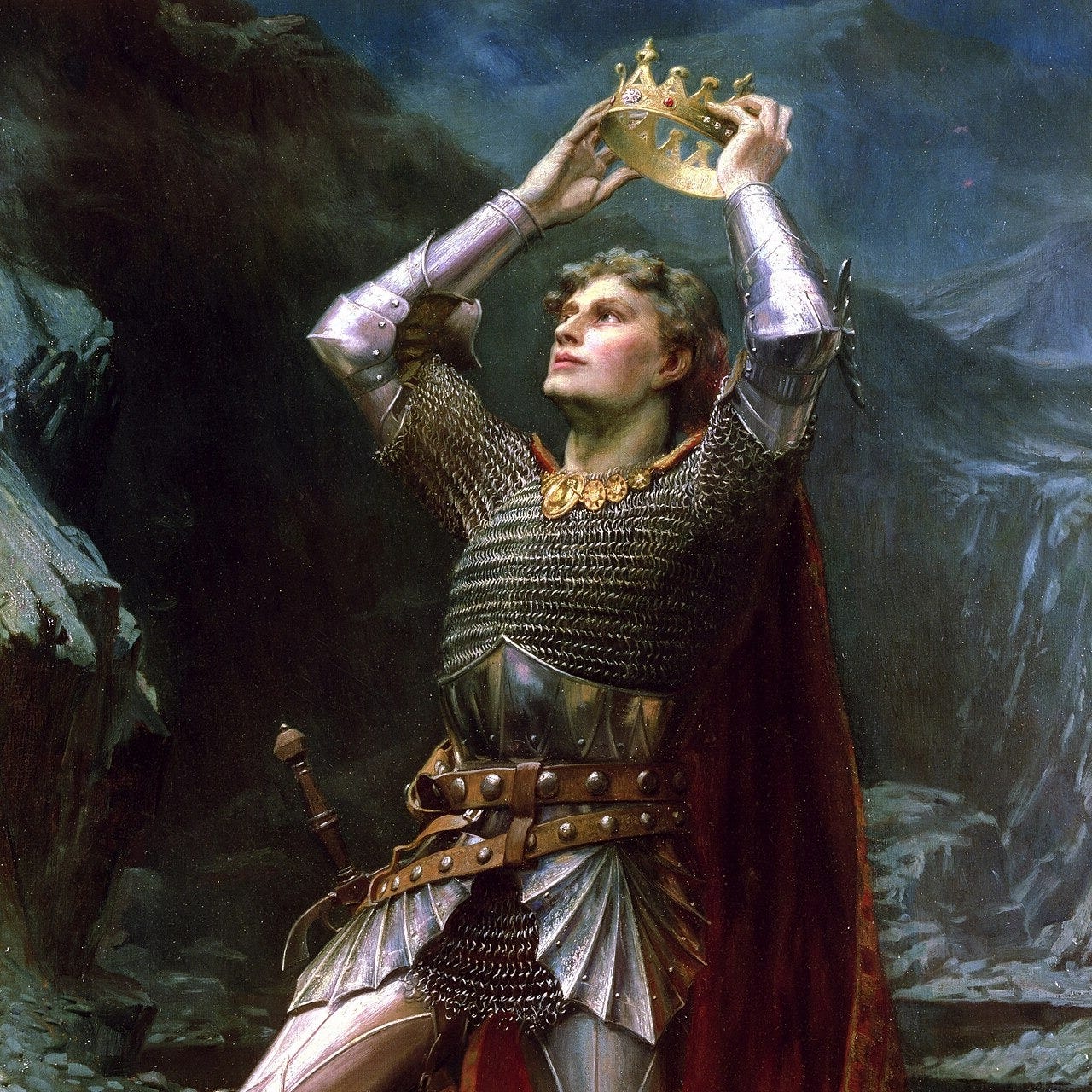
The chivalric heart is one of balance.
As Sir Gawain dons his armor, the Poet tells us that upon his shield and surcoat rests a mysterious symbol, an endless knot of perfect balance and symmetry.
Legend states it was first set in place by King Solomon—now a flawless figure of martial prowess, courtly grace, and piety.
Yet the story of Sir Gawain is relentless in asking one question: can the Christian and the chivalric be held together? Or is this a misguided ideal?
The unbroken knot set upon Sir Gawain’s shield is the ideal for the Christian knight.
The question is whether this strange sign has a lesson for Christians today.
Reminder: this is a teaser of our members-only deep dives.
To support our mission and get our premium content every week, upgrade for a few dollars per month. You’ll get:
New, full-length articles every Tuesday and Friday
The entire archive of members-only essays
Access to our paid subscriber chat room
The Deadly Christmas Game
In the midst of a joyous Christmas feast at King Arthur’s Camelot, where the young king and his knights revel in merriment, a colossal intruder bursts through the doors—a knight clad entirely in green, from his skin and hair to his horse and garments, wielding a holly bough of peace in one hand and a monstrous axe in the other. Towering like a half-giant, he mocks the court’s renown, proposing a simple yet terrifying “Christmas game” of “stroke for stroke”—any knight may strike him one blow, provided the Green Knight can return a stroke one year and day later.
King Arthur’s knights cower in silence before the fae creature—who mocks them as “beardless children”—until King Arthur himself, boyish and busy-blooded, rises to take on the challenge; however, before he strike the Green Knight, his nephew, Sir Gawain humbly intervenes, pleading to take the challenge as the “least of the knights.” Sir Gawain takes on “the game,” and, with his King’s rash counsel to cut off the Green Knight’s head and be done with it, Sir Gawain decapitates the fae creature in a single stroke.
Yet, the headless body walks over and retrieves his head.
The Green Knight holds his head aloft and reminds Sir Gawain he must receive his stroke in return in a year and day at the Green Chapel—and rides away laughing amid the court’s stunned horror.
A Place of Bliss & Blunder
This wondrous and eerie opening comes from Sir Gawain and the Green Knight, a late 14th-century Middle English masterpiece, composed around the 1370s–1390s during the reign of King Richard II. It survives in a single exquisite manuscript (Cotton Nero A.x), alongside three other works by the same anonymous poet—known as the Gawain-Poet or Pearl-Poet—who demonstrates an extraordinary mastery of the alliterative tradition, deep biblical and theological literacy, and intimate knowledge of chivalric romance.
Before the episode of the Christmas game, the Poet opens Sir Gawain and the Green Knight with a reference to the Trojan Prince Aeneas as both the noble, pious legendary founder of Rome (through his descendent Romulus) and the traitor who betrayed Troy and let in the Achaeans. In other words, Aeneas is a character in tension—both noble and treacherous. And this tension flows through Aeneas into Brutus, his descendent, who founded England—a place of “bliss and blunder.”
The tension is not limited, however, to Aeneas. It is an opening pattern, a blueprint by which the poem is to be read. Many things within the poem—King Arthur, Sir Gawain, the Green Knight, etc.—are intentional dualities, seemingly contradictory elements bound together. It tests the reader to see if he or she can note the dichotomy—or if the reader, failing to notice one side of the tension, will fall into a misreading.
At the heart of the poem, however, is the tension between the Christian and the chivalric.
Is chivalry something alien to Christianity—a corruptive element? Does the Christian ethos have room for martial prowess and courtly love?
Is there a harmony between Christianity and the chivalric—or is this a discordant venture from the start?
The Poet gives us an answer—the pentangle. A mysterious symbol, the “endless knot,” that legend says King Solomon set in place.
What is this sign and how does it show balance to the Christian and the chivalric?
And is there a lesson for today?
