


Imagine a mechanic who claims he can fix your car—but admits he doesn’t know the engine’s parts or how they work.
Would you trust him?
The same applies to your soul.
How can you grow spiritually if you do not understand the parts of the soul, their loves, or their virtues?
This Lent, immerse yourself in the Platonic Christian tradition and truly know your soul and its loves.
By Easter, you could be a whole new person.
Reminder: this publication is 100% reader-supported. We are only able to continue writing it thanks to the members who support our mission.
If these you find these articles valuable, then please do consider subscribing for a few dollars per month — it helps us out enormously. You’ll get:
New, full-length articles every Tuesday and Friday
The entire archive of members-only articles essays
Access to our paid subscriber chat room and community
A Quick Map of your Soul
The soul has three main parts: the intellect (nous), the spirited (thumos), and the appetitive (epithumia). And each of these parts has a natural love, an eros, for a particular beauty. The intellect loves truth, the spirited loves nobility, and the appetitive loves pleasure. And this natural love, eros, is always fecund—in other words, it is always fruitful when it satiates in its desired beauty. As such, the intellect’s satiation in truth begets wisdom, the spiritedness’ satiation in nobility begets glory, honor, and fame, and the appetitive’s satiation in pleasure, in its highest sense, begets children.
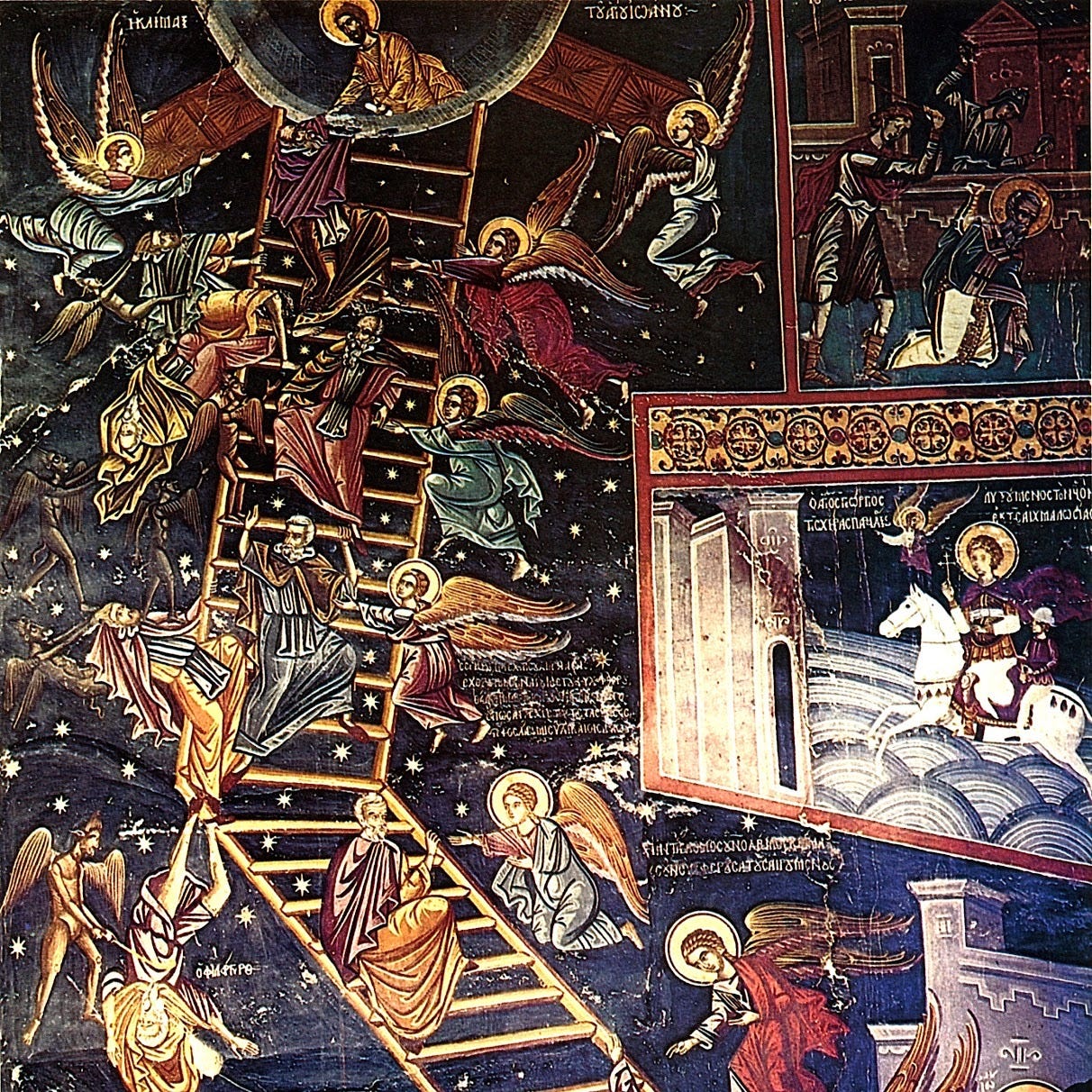
In fact, the hierarchy of the soul and its loves can be seen as a “ladder of love,” which has its genesis in Plato’s Symposium but is expanded throughout Middle and Late Platonism and into Christianity—where the soul moves from lesser beauties of pleasure, to greater beauties of nobility and wisdom until it satiates in God, beauty-itself. Plato called this the “divine beauty-itself,” but Christian writers, like St. Augustine and Dionysius, saw God, Beauty-itself, the top of the great hierarchy of love.
But, what does the ladder of love have to do with being happy?
The Desire for Happiness
Here is an incredibly important truth—the soul was made for God. Your eros, your natural erotic appetite to satiate in beauty and be happy, is infinite. You want to be happy all of the time. Yet, all the beauties of this life—whether it be a good meal, friendship, marriage, victory, philosophy, etc.—are finite. They are exhaustible and only give pleasure in certain ways. As such, the soul (and its parts) move from one beauty to the next in an endless pattern of consumption.
Is this what life is?
An infinite desire for happiness satisfied poorly on finite beauties?
No. The hunger of eros, the erotic appetites of the soul is infinite because it desires an infinite beauty—and there is only one, Beauty-itself, God. In other words, your eros was enkindled in you by God to lead you back to Him—to climb the ladder of love from lesser beauties to greater beauties until you satiate in the one beauty that gives your soul true rest: The Ancient Beauty, Ever New, as St. Augustine called God.
The soul can rest in God—freed from its relentless appetites—and work to order all the desires and beauties in its life in proper hierarchy. In other words, loving God does not take away the lesser loves, but rather ensures they are not loved disproportionately—and allows those loves to be loved well. From the top of the ladder of love, God is like a divine refulgence that cascades back down illuminating all the lesser beauties of your life.
For example, the man who loves God will love his wife better, because he will love her proportionately to who she is and not attempt to place the entire weight of his erotic desire to be happy (which only God can fulfill) on her. Many relations fail because the lover places a desire on the beloved that only God can satisfy.
So, how can you better your soul and its loves?
How to Have a Beautiful, Healthy Soul
As Socrates notes in the Republic, virtue is a type of health and beauty of the soul, whereas vice is a certain sickness and ugliness. Each part of the soul has a virtue that assists it in loving its beauty well. The intellect’s love of truth is perfected by prudence, the virtue that helps it to reason well. The spirited part loves nobility (which begets glory), but true nobility is difficult to obtain—think Achilles or King David; thus, the virtue that helps perfect the thumos is courage. The appetitive part of the soul that loves pleasure needs to be bridled, and the virtue that assists in this moderation is temperance.
Where is justice?
Justice is the virtue of being well-ordered. It takes the parts and makes them well-proportioned to the whole—it is a certain harmony. As such, justice perfects the whole soul, moving it into a well-ordered, beautiful creation.
These are the Cardinal virtues or natural virtues—so-called because they are available to all persons by nature—and they are listed both in the Old Testament and in the writings of Plato.
So, how can you work toward virtue this Lent?

The Spiritual Disciplines of the Soul
In his Four Centuries on Love, St. Maximus the Confessor takes prayer, fasting, and almsgiving—the three traditional spiritual pillars of Lent—and aligns them to the soul.
First, prayer is a perfection of the intellect and assists with its desire for truth. If you want to increase in wisdom this Lent, spend time in prayer. You could read your Bible in a prayerful manner and pray along with the teachings of Jesus. You could meditate on the Paternoster (Our Father). Catholics will turn toward the Holy Rosary, while eastern Christians will meditate with the beautiful Jesus Prayer. Set a goal this Lent and keep it—start small, if needed, as consistency is more important than depth.
Second, almsgiving perfects the spirited part of the soul and assists with its desire for nobility. Now, how does giving to the poor perfect the thumotic? When we think of a spirited man, the examples are generally Achilles, Hector, King David, and Emperor Charlemagne. It is a good question.
St. Maximus does not teach that a Christian soul should not be spirited. The idea that Christians must be weak, frail, and timid is untrue; rather, the spirited part—which is often characterized by zeal, courage, prowess, strength, etc.—must be tempered by gentleness. It is akin to Socrates’ use of noble dogs as an example to Glaucon and Adeimantus in the Republic, as a shepherd dog is gentle to its friends and ferocious toward its enemies. A similar dichotomy is found in the writings of Christian chivalry, such as with Sir Gawain or King Arthur—a ferocity tempered by gentleness.
Therefore, almsgiving is a way to temper the thumotic, which tends to err toward pride, self-reliance, and elitism. It is not a repudiation of the thumotic, but rather a Christian bridling of it—it is the difference between an Achilles figure and Godfrey of Bouillon, the crusader king. Even the most noble man must remain humble before God. Set a goal this Lent to give alms—and see it as a step toward true nobility.
Third, fasting perfects the appetitive part of the soul and assists with its seemingly unending hunger for pleasure. The soul is often beset by the dangers of lust and gluttony—as Aristotle said we are the worst animals when it comes to food and sex. Fasting helps to discipline the appetitive—to practice the virtue of temperance and moderation. Fasting is like lifting weights before you need to lift something heavy in the real world—you practice moderation so when temptation comes, you will be ready. Set a goal to fast. Catholics fast (abstain) from meat on Fridays in Lent, a small gesture. You could abstain from meat for all of Lent or give up all sugar or fast food. You could also truly fast and moderate the amount of food you eat each day.
There are many ways to participate in the pillars of Lent—prayer, fasting, and almsgiving—and they all assist in cultivating virtue and perfecting the soul.
What do you feel called to do this Lent?
Making a Choice
Do you know how to become a saint? Will it. This was the famous advice of St. Thomas Aquinas. This Lent is no different. Look at the parts of the soul, look at their loves, and then look at their virtues.
It is a map.
Where has your soul lost its way?
Discern your own soul. Where could you improve? Once that is determined, lean into the spiritual disciplines of prayer, almsgiving, and fasting. Lent usually includes all three, but lean heavily into the one that would be most beneficial to your soul.
Make a commitment.
And, by God’s grace, be a better human come Easter—a truly happy human.
Dcn. Harrison Garlick is a deacon, husband, father, Chancellor, and attorney. He lives in rural Oklahoma with his wife and five children. He is also the host of Ascend: The Great Books Podcast. Follow him on X at Dcn. Garlick or Ascend.
This is sooo good. Thank you for providing a simple but deep guide for lent. Beautiful.
Incredibly insightful as always Deacon. This makes me not only understand the importance of Fasting from another dimension but makes me even enthusiastic for it when approached in this POV.