


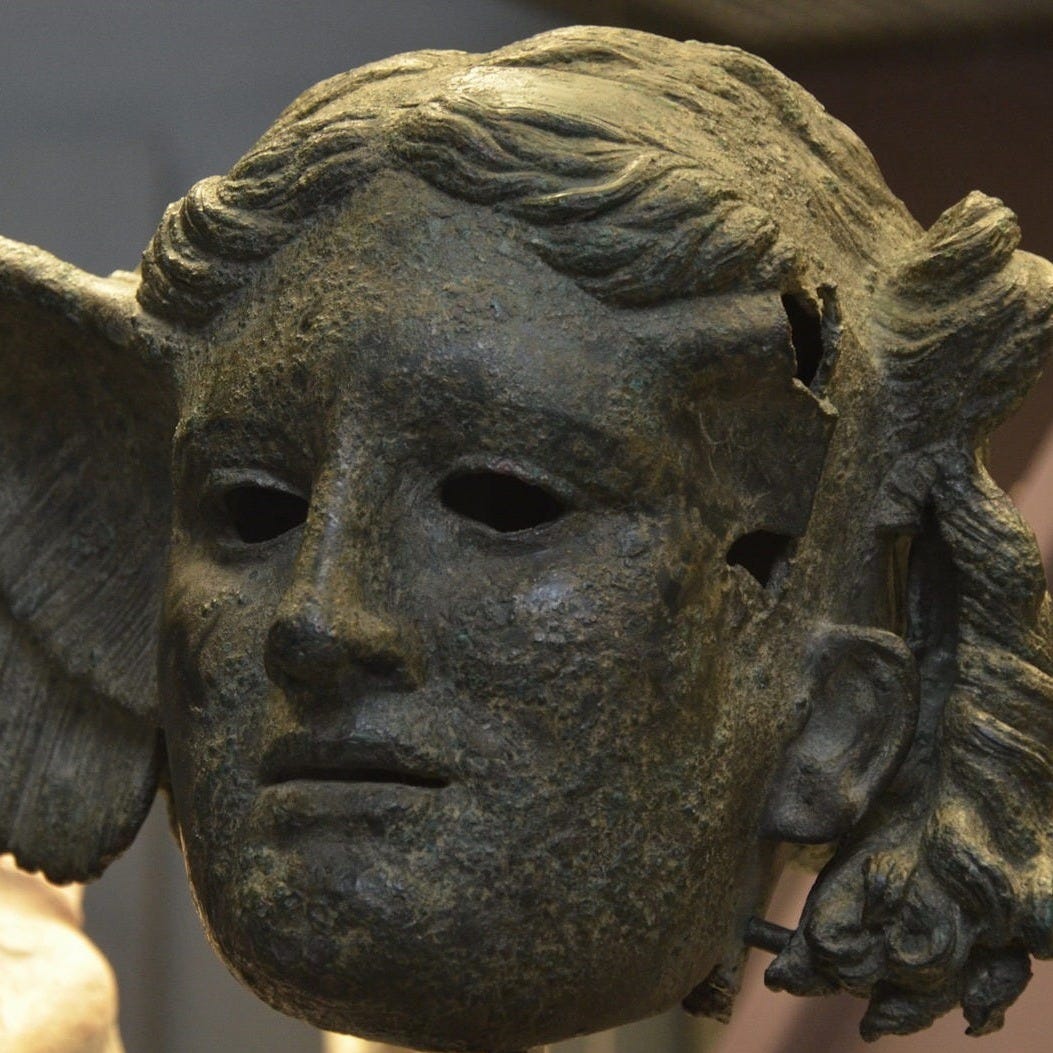
God spits the lukewarm from His mouth.
It is a lesson Dante the Poet knows well, and he shows you the spiritual harm of being lukewarm in his Inferno.
Heaven rejects the milquetoast—but hell doesn’t want them either.
And their suffering is your spiritual lesson.
You were not made in the image of God to be some half-hearted beta.
Dante feels so strongly about this lesson that he places a canonized saint in hell.
Do not miss his warning.
Reminder: this is a teaser of our members-only deep dives.
To support our mission and get our premium content every week, upgrade for a few dollars per month. You’ll get:
New, full-length articles every Tuesday and Friday (or Saturday!)
The entire archive of members-only essays
Access to our paid subscriber chat room
The Gates of Hell
We find Dante the Pilgrim before the gates of hell. In his Inferno, Dante the Poet offers you a moral tale, a drama of the soul, that has the purpose of trying to save your soul. Dante the Pilgrim, the character in the Divine Comedy, is lost in the dark woods and meets Virgil, the Roman poet, who has been sent by Beatrice to help guide the Pilgrim. In fact, it is only by enduring hell and purgatory and then ascending into heaven that Dante the Pilgrim might be saved.
Virgil takes Dante down a “deep and rugged road” until they stand before the gates of hell. What is written on the gates is worth consideration:
I AM THE WAY INTO THE DOLEFUL CITY / I AM THE WAY INTO ETERNAL GRIEF / I AM THE WAY TO A FORSAKEN RACE.
JUSTICE IT WAS THAT MOVED MY GREAT CREATOR; / DIVINE OMNIPOTENCE CREATED ME, / AND HIGHEST WISDOM JOINED WITH PRIMAL LOVE.
BEFORE ME NOTHING BUT ETERNAL THINGS / WERE MADE, AND I SHALL LAST ETERNALLY. / ABANDON EVERY HOPE, ALL WHO ENTER.
Notice that Dante the Poet predicates the gate on three attributes: justice, divine omnipotence (power), and highest wisdom. It is a subtle allusion to the Trinity or rather that the creation of the gates of hell is a Trinitarian act—as is all creation.
Why does the gate say to abandon hope?
Well, in Christianity, hope is a theological virtue—that means it is a virtue infused in you by participating in the life of God, grace. Unlike the natural virtues, like prudence, it is not a virtue to which you can habituate yourself—it must first be given to you and then you can participate in it like a habit. Hope is a gift.
Moreover, we tend to have a very flat understanding of hope. You often hear “hope” used as a synonym for “wish.” “I hope my team wins” is little more than “I wish my team wins.”
But the theological virtue of hope is not a wish but a belief in man’s eternal happiness with God—it is an understanding of the end of man, his telos, his purpose. In other words, “I have hope in God” means “I live my life according to the reality of God and His promises for me.” Often times in sacred art, the virtue of hope is depicted as an anchor. You anchor your soul to God, an immovable understanding in the truth of God and His desire to for you to be happy with Him in heaven.
There is no hope in hell.
No souls participate in the divine life—they are cut off from the reality of happiness with God for eternity. The soul is released from its anchor and drifts in endless despair, the contrary vice to hope.
Yet, there is also no hope in heaven!
Why? Because in heaven there is no future desire for happiness with God for eternity, because the souls are participating in it now. It is not a future reality but a present one. In fact, there is no faith in heaven either, because “faith is the realization of what is hoped for and evidence of things not seen” (Heb 11:1). In heaven, the beatific vision, God is now seen—there is no reason for faith. Since hope and faith are fulfilled in heaven, this is why St. Paul says the greatest theological virtue is charity (love)—because we continue to love in heaven (1 Cor 13:13). Charity is eternal.
In fact, how you practice charity in this life determines how you experience heaven in the next.
But the souls in hell are deprived of hope—and of faith and charity. It is an endless churning of despair, disbelief, and hate.
What is more interesting, however, is what Dante the Pilgrim and Virgil see once they’ve entered the gate.
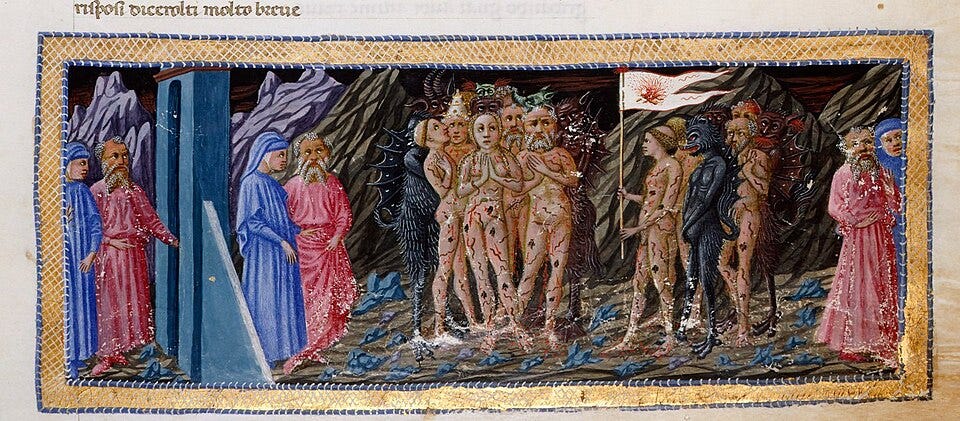
The Vestibule of Hell
As they pass through the gates of hell, Virgil and Dante the Pilgrim hear the “sights and cries and shrieks of lamentations echo[ing] throught the starless air of Hell.” Pay special attention to the fact that hell is “starless,” as Dante will use the stars as a sign of hope (each one of the canticles of volumes of the Divine Comedy ends with a reference to the stars…).
But the Pilgrim and Virgil stumble upon a unique place.
The vestibule of hell—or rather, the lobby of hell.
It is a space beyond the gates of hell but before the judgment that casts souls somewhere within the nine circles.
It is the holding place for souls that were rejected by heaven and hell.
Who are these souls?
These are the lukewarm, the milquetoast, the souls who lived for nothing.
And their brutal punishment is your spiritual lesson—a gut-check for the soul.
Dante will not allow you to lessen the effects of being lukewarm—he knows well the harm it does to your soul and those around you.
Your real lesson here is knowing who the unnamed soul is who suffers here.
