


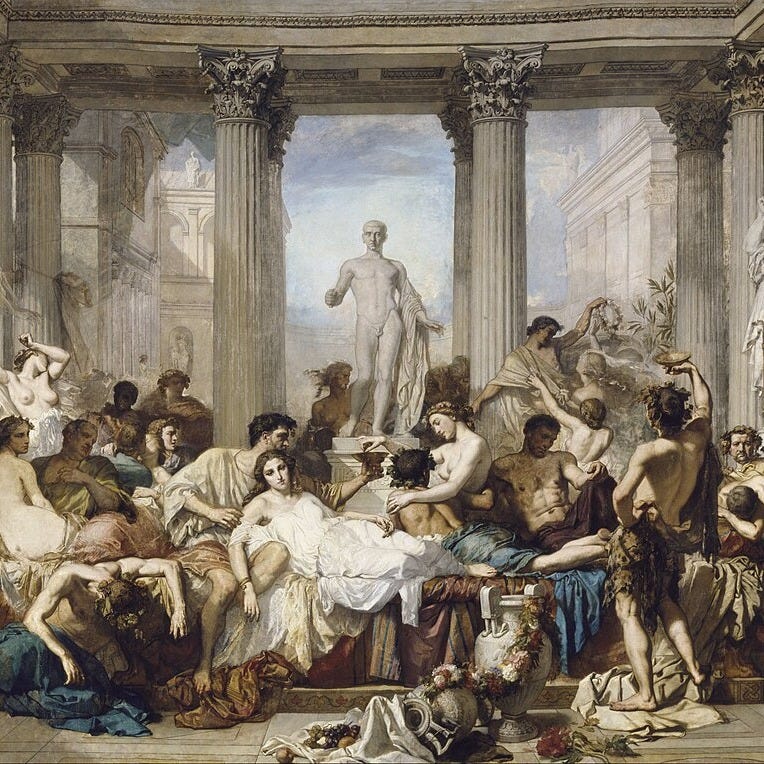
Something is wrong with democracy.
Fathers fear their sons, teachers appease their students, foreigners are made equal to citizens, and even criminals are treated gently.
In Book VIII of the Republic, Socrates warns of the effects of democracy and its blind praise of freedom and equality.
Yet, Socrates has something more in mind. For it is easy to critique democracy (for those willing to do it), but it is harder to critique the democratic qualities of your own soul. Would you be considered a democratic man?
Socrates offers a discussion on regimes as a mirror of your soul—a mirror we often hesitate to look within.
And within democratic soul lurks something that seems impossible—within the regime that gives the greatest praise of freedom dwells the greatest capacity for slavery.
Plato has something to teach you—if you are willing to listen.
Reminder: this is a teaser of our members-only deep dives.
To support our mission and get our premium content every week, upgrade for a few dollars per month. You’ll get:
New, full-length articles every Tuesday and Friday (or Saturday!)
The entire archive of members-only essays
Access to our paid subscriber chat room
What are the different regimes?
What do different types of regimes tell us about our souls? In Plato’s Republic, Socrates takes up the questions of what is justice and is justice beneficial. To examine this question, he proposes to discuss a city, because he suggests it would be easier to understand what justice is in something larger, like a polis,1 than something smaller, like a soul. As such, Socrates creates the city-in-speech, a model polis of the best regime2 that is examined in the pursuit of understanding justice.
Now, if the city-in-speech is a model for justice in the soul, then the city-in-speech must model justice. But what is a just city? By Book VIII, the city-in-speech has been established as an aristocracy led by an elite guardian class that eschews both private property and family life and is led by a philosopher-king. It is worth noting whether the city-in-speech is possible is a distinct and separate question, as its main purpose is to serve as a rhetorical tool to discover what justice is.
In the course of the Republic, justice is held to be the virtue of harmony. In the city, this means all the parts of the polis are arranged in hierarchy and perform their function.
In the soul, the justice of virtue makes the soul beautiful by arranging all of its parts in hierarchy and according to their proper loves.3
But Socrates knows that regimes, like souls, are fragile. They degenerate. In Book VIII, the conversation turns to other types of regimes and the souls that correspond to them.
In sum, Socrates sets forth five types of regimes (544c):
Aristocracy (a regime of a few, focused on virtue)
Timocracy (a regime of a few, focused on love of honor)
Oligarchy (a regime of a few focused on love of money)
Democracy (a regime of many focused on freedom)
Tyranny (a regime of one focused on pleasure)
And Socrates sets forth a loose template by which aristocracy collapses into timocracy, and timocracy collapses into oligarchy and so forth. Socrates is clear, however, that these are general guideposts, as there are as many types of regimes as there are dispositions of the human soul.
And this raises the question of what Socrates’ main purpose is in this passage.
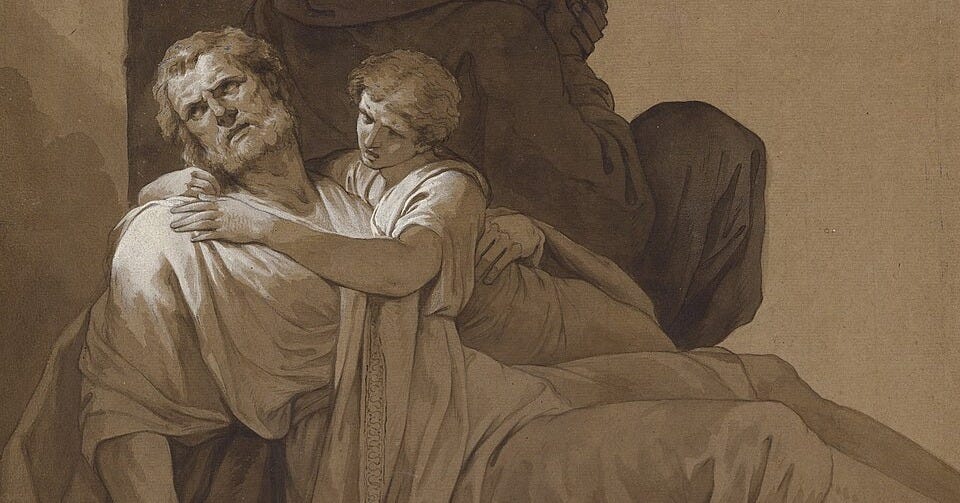
How are the regimes a mirror of the soul?
It is here that Plato offers you something tremendous. His text on the character of the regimes is less an attempt at political science and more a diagnostic tool for the soul. For the regimes all take their character from the souls within them; thus, in understanding the nature of the regime, we understand the nature of our soul.
The regime is a spiritual mirror.
For the aristocracy is born from those with aristocratic souls, timocracies are both from those with timocratic souls, and so forth. Like the city-in-speech, the discussion on the regimes is a self-reflection. What regime is my soul most like? Plato understood that soulcraft comes before statecraft. Regimes are born from the souls that populate the polis. Again, those inclined to critique Plato here that the political reality is much more complicated miss the main purpose of the exercise: know thyself.
Book VIII of the Republic presents a sobering diagnostic tool for modern souls saturated in the democratic spirit. It is a mirror for the soul to which we hesitate to look—as we are slow to even admit that there could be deep, spiritual problems with living in a democracy.
Questioning whether having a “democratic soul” is bad seems almost profane, an offensive question in an age obsessed with freedom.
Yet Socrates shows you many problems with the democratic obsession with freedom and equality.
And somehow, within the tender, pusillanimous soul of the democratic man lurks the tyrant.