


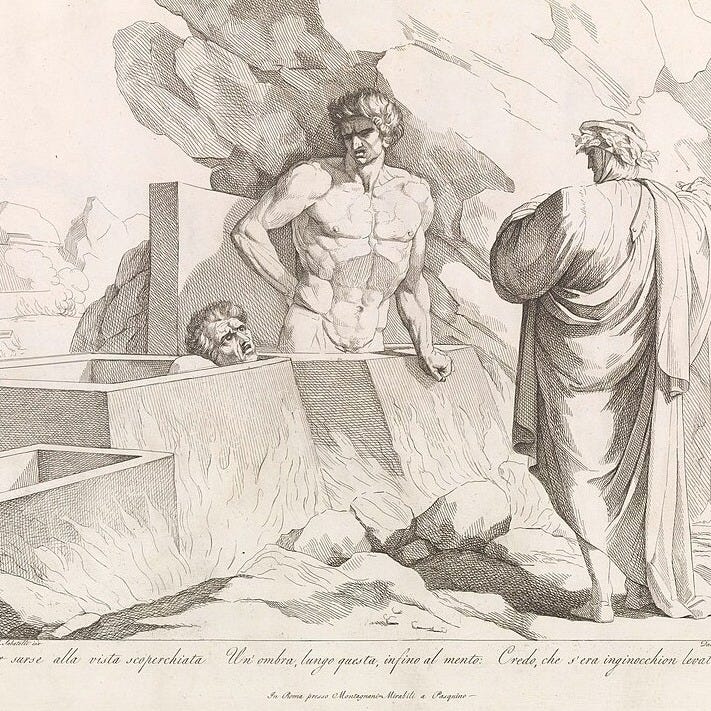
Heresy is intellectual enslavement.
But, in the Inferno, Dante the Poet deviates from Aquinas.
Dante’s lesson on heresy is surprising—going as far as asking whether a non-Christian can be a heretic against reason and nature.
Heresy harms the soul—but how Dante thinks it harms the soul is far from straightforward.
And… it is a lesson that modern man is slow to learn, as the sin of heresy tends to grate against our cherished belief in liberty as self-creation, freedom of thought.
But heresy only brings disorder and slavery.
Dante’s lesson on heresy is as brilliant as it is mysterious.
This is a teaser of our members-only deep dives.
We are a 100% reader-supported publication. To support our mission and get our premium content every single week, please consider subscribing for a few dollars per month.
New, full-length articles every Tuesday and Friday
The entire archive of members-only articles essays
Access to our paid subscriber chat room and community
The Mystery of the Sixth Circle
In the dark woods, before Dante the Pilgrim descended into hell, he was impeded by three animals: a she-wolf, a lion, and a leopard. And these three beasts are a foreshadowing of the three major sections of hell: the upper hell that punishes sins of incontinence (i.e., an inability to control desire, like lust or gluttony) is represented by the she-wolf; the first section of lower hell, circle seven, punishes the violent and is represented by the lion; and the bottom two circles of lower hell, eight and nine punishing fraud and treachery, represented by the leopard. Overall, upper hell is incontinence, while lower hell is malice, a malevolent will toward another in either violence or fraud.
Yet, where is heresy?
There are two circles in Dante’s Inferno that stand unique. The first is the first circle of hell, limbo, because it is a paradise without punishment—but also without the Beatific Vision (i.e., the intimacy with God in heaven). This is where righteous souls dwelt prior to Jesus’ death and resurrection (e.g., Adam, Moses, David, Ruth, etc.)—and then he “harrowed hell” by preaching the Gospel to these captive souls and leading them to heaven (1 Peter 3:18-20; 4:6). It is why Christians state that Christ “descended into hell” in the Apostles’ Creed. Dante the Poet, following the tradition, holds that limbo endured after Christ’s harrowing and remains a place God can place souls that are not saved but otherwise lived a naturally virtuous life.
The second, however, is the circle of heresy. Dante the Poet’s placement of heresy generates much debate. He places it in the City of Dis (Satan), a city that constitutes the sixth circle of hell separating upper hell (incontinence) from lower hell (malice in violence and fraud)—yet it seems to neither be a sin of incontinence nor malice.
How Dante the Poet views heresy is a bit of a mystery—but he gives us creatures, tortures, and famous characters as clues to discern his meaning.
Everything in the Inferno is a lesson for your soul—a lesson on the ugliness of sin.
So, what even is heresy?
And how are the heretics in the sixth circle punished?
Well the first problem is that Dante and Virgil cannot enter the City of Dis—the demons will not let them pass.
Outside the City of Dis and the Angel
Virgil and Dante the Pilgrim approach the terrifying ringed city, Dis. The Pilgrim observes: “the clear glow of its mosques above the valley, burning bright red, as though just forged, and left to smolder” (8.67-73). First, “Dis” was a name given to the Roman god of the underworld, Pluto (in Greek, Hades), but is here applied to Satan. Second, Dante the Poet associates mosques with a city of heretics, because medieval Christians saw Islam as a Christian heresy—not a separate religion. Notably, the glow of Dis illuminates all of lower hell.
Dis is an impenetrable city.
It is surrounded by moats and walls of iron—and upon the walls Dante the Pilgrim sees “a thousand fiendish angels perching above the gates enraged, screaming: ’Who is the one approaching? Who, without death, dares walk into the kingdom of the dead?” (8.82-5). The fallen angels bar the Pilgrim’s path, to which Virgil comments: “The insolence of theirs is nothing new; they used it once at a less secret gate, which is, and will forever be, unlocked” (8.124-26).
What is the less secret gate that Virgil says was already made unlocked?
Virgil is referring to when Christ harrowed hell after his death on Holy Saturday. Jesus both led the righteous souls of limbo out of their long captivity but also conquered hell. But Virgil and the Pilgrim are at a different gate, and it remains locked.
What is interesting here is that even though Virgil, a damned pagan, has a divine mandate to help Dante the Pilgrim, he cannot force the demons to open the gate. It is a subtle nod at the need for grace to conquer evil—natural goodness is not sufficient.
As Virgil and Dante are outside the gates being harassed by demons and mythological creatures, like the Furies, a “blast of sound, shot through with fear, exploded, making both shores of Hell begin to tremble,” as an angel sent from heaven “walking the Styx, his feet dry on the water” (9.64-6, 79-81). The angel does not fight the demons, no more than a lit candle must fight the darkness—there is no real resistance evil can give to the good. The demons flee like frogs jumping back into a pond, as Dante the Poet tells.
The angel opens the gate without issue and rebukes the evil creatures of Dis.
Virgil and the Pilgrim enter into Dis without an issue.
But what they find in the City of Dis is horrifying.