


Do not dismiss lust.
Lust is soul-shattering: a corruptive force that enslaves reason, breeds internal chaos, and promotes self-idolatry.
In the Inferno, Dante the Poet tears away every romantic illusion of human desire, exposing the raw ugliness of sin.
While many are quick to minimize its severity, Dante the Poet shows you lust’s true devastation: an internal soul-storm that turns your heart against God.
In the second circle of hell, as the lustful treated their souls in life, so are they now treated for all eternity.
Dante gives you a warning—if you will receive it.
Reminder: this is a teaser of our members-only deep dives.
To support our mission and get our premium content every week, upgrade for a few dollars per month. You’ll get:
New, full-length articles every Tuesday and Friday
The entire archive of members-only essays
Access to our paid subscriber chat room
The Judge of Hell
As Virgil, the Roman poet and author of the Aeneid, and Dante the Pilgrim descend further into the circles of hell, they encounter King Minos, the judge and gatekeeper of hell. Rooted in classical mythology, King Minos was the legendary son of Zeus and Europa, who ruled as the king of Crete and was renowned for his profound wisdom and unparalleled judicial acumen.
King Minos is one of the three judges of the afterlife in Plato’s religious myth at the end of the Gorgias. King Minos also appears in Virgil’s own Aeneid as the “chief magistrate of the underworld,” presiding over the fates of the dead with impartial authority. Dante the Poet faithfully draws upon this classical archetype, preserving Minos’s role as the arbiter of souls; yet, he transforms the king into a grotesque, bestial creature.
Most strikingly, Minos now possesses a serpentine tail that serves as an instrument of judgment: when an “evil soul appears before him, it confesses all,” and Minos judges the soul according to his sins. The bestial king then wraps his tail around his body equal to the circle of hell into which the damned should be justly tossed. For instance, a soul destined for the third circle—the realm of the gluttonous—would prompt Minos to coil his tail three times before launching the soul into his eternal damnation.
Each circle of hell punishes a specific type of sin.
And the punishment for each sin is catechetical—it instructs you in the nature of the sin.
The lesson underneath the punishment for the lustful, however, is not immediately apparent.
The Second Circle of Hell
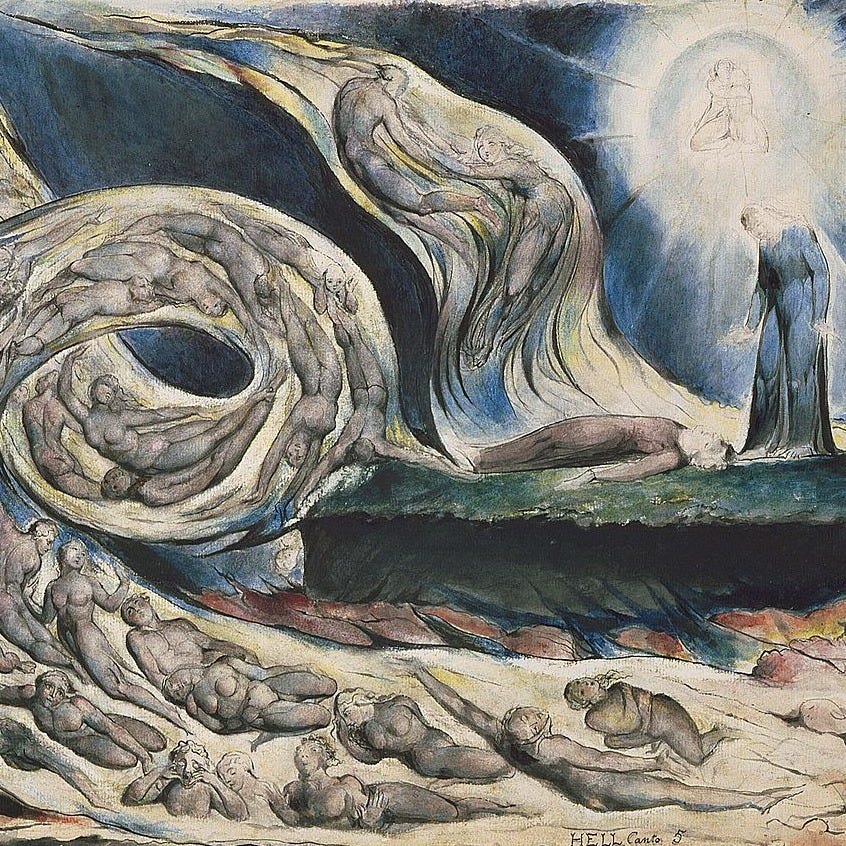
As Virgil and the Pilgrim descend into the second circle of hell, they encounter an unrelenting “infernal storm, eternal in its rage” that whips thousands of souls through the air in a violent whirlwind. Among the shades driven by the winds are famous figures such as Semiramis, Dido, Cleopatra, Helen, Achilles, Paris, and Tristan.
The Pilgrim calls out to two lovers who move together in the storm: Francesca da Rimini and her brother-in-law Paolo—and here is one of the most important scenes in the Inferno. Francesca recounts her salacious affair with Paolo (her husband’s younger brother), as the two were reading a tale of Lancelot and Guinevere (a famous story of lust and adultery), they allowed their lustful passions to batter their reason and they fell into sin—and then, when Francesca’s husband discovered them, he murdered them both.
Dante the Pilgrim, however, is moved with pity for Francesca. He states: “Francesca, the torment that you suffer brings painful tears of pity to my eyes,” before fainting from the intensity of emotion.
What lesson should you learn from this tale?
You should recall that the damned are placed in hell by God, for it is God alone who has the power to judge the soul. God is also good, true, and beautiful. In other words, His proclamations are always just and good. Yet, Dante the Pilgrim pities Francesca. He feels sorry for her, which places his will contrary to the Divine Will. He is so overcome by Francesca’s romantic rhetoric amongst her torment, that he swoons.
Dante the Pilgrim will have to mature throughout the Inferno, and one of his hard-earned lessons will be not pitying those who are justly punished—he must conform his will to Divine justice.
It is a difficult lesson for many, as you, like Dante the Pilgrim, may think that falling into lust is not that serious of a sin—certainly not one worthy of eternal torment.
But as Francesca seduces Dante the Pilgrim, so too does she often seduce the reader—falling for the rhetoric of the damned over what is good and just.
Even if you are not the one who falls into lust, Dante the Pilgrim shows how lust can cloud the judgment, treat a grave evil as a minor affair—and then before you know it your will is contrary to God.
Yet, though this is one of the most important lessons in the Inferno, it does not answer the question of why the lustful are battered by the winds.
What is it about a raging storm that makes it a fitting punishment for lust?