


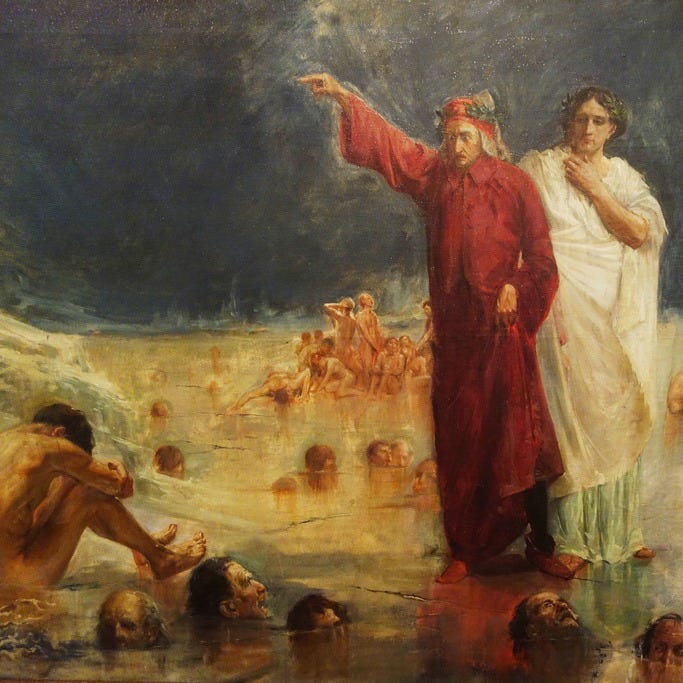
Is lying worse than murder?
In the Inferno, Dante the Poet places the sin of flattery in a worse section of hell than murder. How could this be?
Dante is a master of the soul, and what he offers you is a tremendous insight into the spiritual harm of lying and its corruptive effect upon the intellect of man.
He presents a brilliant catechesis on the soul, truth, and the reality of Jesus Christ.
You will never see lying the same way again.
Reminder: this is a teaser of our members-only deep dives.
To support our mission and get our premium content every week, upgrade for a few dollars per month. You’ll get:
New, full-length articles every Tuesday and Friday
The entire archive of members-only essays
Access to our paid subscriber chat room
The Depths of Hell
Having journeyed through most of hell, Dante the Pilgrim and his guide, the poet Virgil, arrive at the Eighth Circle. In Dante’s Inferno, hell is presented as nine concentric circles plummeting into the earth—with each consecutive circle representing a greater sin and thus a worse punishment. As such, those near the top of the Inferno suffer lighter punishments for less serious sins, while those in the depths of hell suffer the most for the most egregious crimes against God and neighbor.
Having already traversed the first seven circles, Dante has seen souls punished for sins such as lust, gluttony, wrath, acedia, and heresy. He observed that tyrants—those who brought untold suffering to mankind—were punished for violence against their neighbor by being boiled in a river of blood.
Having just witnessed such a brutal punishment for tyrants, Dante leaves those who engaged in violence and enters the Eighth Circle. Expecting to see a sin worse than the circle before, Dante the Pilgrim sees those souls who engaged in pandering, seduction, and flattery.
How is flattery a worse sin than heresy or murder?
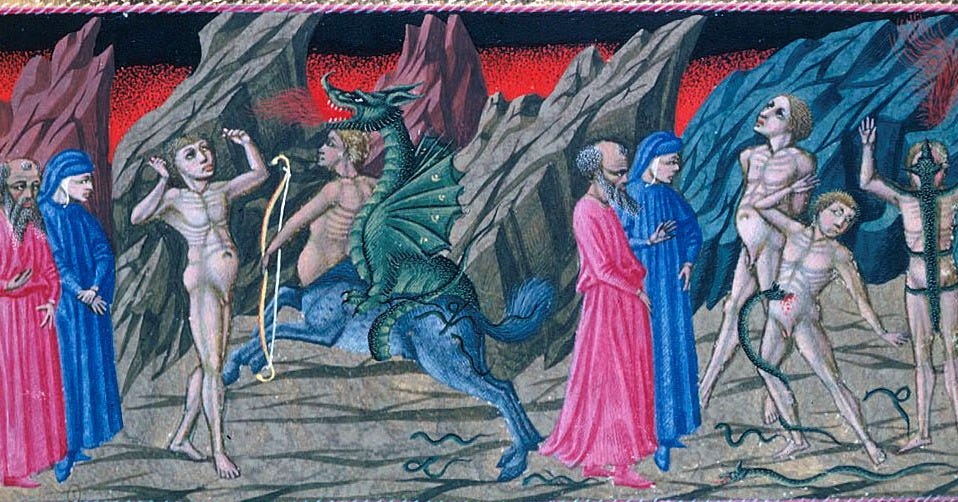
What is Truth?
Virgil tells Dante the Pilgrim that the souls in the Eighth Circle are guilty of simple fraud (while those in the Ninth and final circle are guilty of complex fraud or treachery).
Dante the Poet does not present the Inferno as an actual mapping of hell but rather as a mapping of the depravity of sin. Dante the Poet is a master of the soul, and the Inferno rips the polite veneer off sin and reveals the ugliness of human desire. It is a story of vice and what leads souls into choosing evil. What, then, is Dante the Poet trying to teach you about the nature of evil by placing a sin such as flattery, a species of fraud, in a lower section of hell than violence?
Two preliminary considerations to start to see his wisdom.
First, you must understand that truth is the conformity of the mind to reality. When you say something is true, you mean it represents authentic existence, an objective realism. Modern man often wants reality to conform to his mind, but truth is the conformity of the mind to reality—this definition of truth comes from St. Augustine and leaned upon by St. Thomas Aquinas.
Christians teach the world is intelligible. You can come to know truth in this life, as the cosmos is ordered and knowable. St. Paul teaches in the opening of his letter to the Romans that you can come to understand the reality around you and determine what is good and what is evil—and you are responsible to live in accordance with those rational observations (Romans 1:18-32).
Second, the purpose (telos) of speech is to convey truth. If truth is the conformity of your mind to reality, then your speech has the purpose of sharing truth with another. Speech is not neutral. It is ordered toward reality, toward what is true. Your speech should always help you and your neighbor come to understand what is true. Iron sharpens iron—and speech is the way you pursue truth with those around you.
The corruption of the best is the worst—or, in a more poetic fashion, the higher the angel, the greater the demon.
It is in understanding the loftiness of truth and speech that you can start to understand the depravity of lying—a lesson that Dante carves into his Inferno.
But, how is lying worse than murder?
And how does the structure of man’s soul reflect the order of the Inferno?
And how does the reality of Jesus Christ shed light on the depravity of lying?
Dante has the answers.