


What is “Zeus’ law”?
In the new Odyssey movie, Christopher Nolan presents “Zeus’ law” as a sign of civilization, a moral standard that governs guest and host, and even an equivalent to Christ’s golden rule—do unto others as you would have them do unto you.
But is this true?
What is the so-called “Zeus’ law” in Homer’s Odyssey?
Let’s look at the truth of this ancient ritual in Homer, the Bible, and in Christianity.
Reminder: you can support our mission and get all our members-only content for just a few dollars per month:
New, full-length articles every Tuesday and Friday (or Saturday!)
The entire archive of members-only essays
Access to our paid subscriber chat room
Hospitality Amongst the Ancient Greeks
In Christopher Nolan’s adaptation of the Odyssey, the characters speak of “Zeus’ law” as a moral standard by which to welcome and treat guests.
But what is the historic truth behind this movie reference?
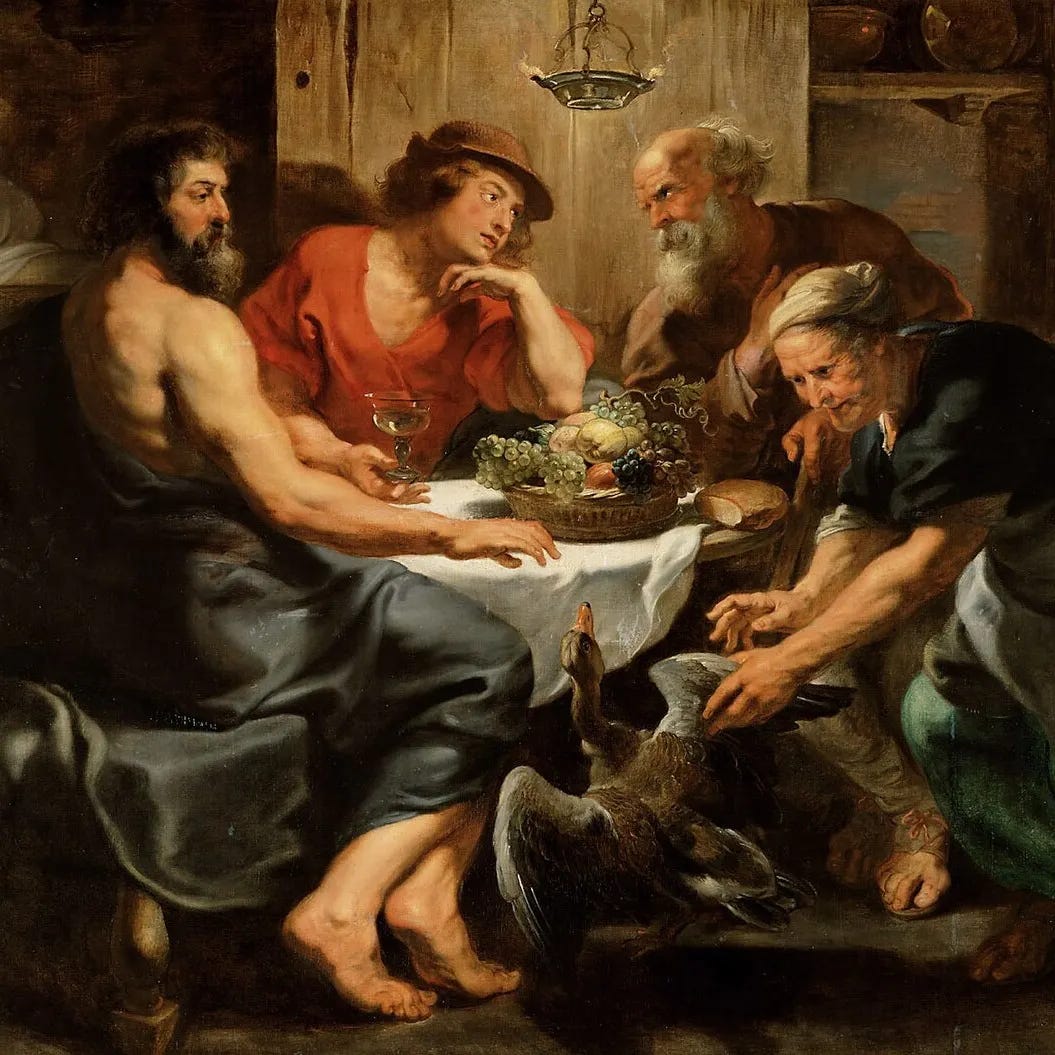
In the ancient Greek world, the practice was called xenia, which is often translated to “guest-friendship.” It was a sign of civilization. It was a sacred ritual, overseen by Zeus (hence Nolan’s moniker, “Zeus’ law”), that protected both the guest and host—and built bonds of friendship and peace.
To wit, a guest would arrive at the house of his host, the host would welcome him without even asking his name or purpose, bathe him, clothe him, and feast him. The host cared for his guest as if the guest was a god in disguise. In Homer’s Odyssey, this scene is played out many times, as Telemachus is welcomed by Nestor and then by Menelaus, and Odysseus is welcomed by King Alcinous.
Only after the guest had been welcomed and cared for would the host ask the guest his name and purpose. Here, you can see that xenia is reciprocal to a degree or rather the guest has a proactive role in this sacred, civilizing ritual. The guest would state his name and tell his story. With Telemachus, for example, he speaks about his efforts to discover news about his father, Odysseus. With Odysseus, he takes on a role similar to the bard, telling of his famous journey home to his hosts, the Phaeacians (a scene not in the movie). The host would then give “guest-gifts” to his guest to help him in his purpose (and sometimes the guest would give a gift to his host).
Overall, there was a deep openness and vulnerability expressed by both host and guest in xenia, and it was piety towards the gods, especially Zeus, that held the ritual together—not simply a religious cultural norm, but a societal practice that stabilizes the relations between city-states and civilization overall.
In the Christopher Nolan movie, Nolan presents Odysseus’ deception with the Trojan horse as a violation of xenia, “Zeus’ law,” that started to unravel the civilizational norms of the Mediterranean.
Homer’s Odyssey does not share this view, as the gods blessed the deception of the Trojan horse—but later generations in the West traced their lineages not to the Greeks but to Troy, through the founding of Rome by a Trojan survivor, Aeneas. As such, Odysseus and his deception was perceived as evil, as Dante places him in hell amongst the evil counselors of the eighth circle.
The Ritual of Guest-Friendship and Piety
The ritual of xenia is deeply tethered to the concept of piety. For the ancient Greeks (and for the West until at least St. Thomas Aquinas), piety represented a gratitude for an unpayable debt. And this gratitude was threefold: a piety toward your parents, a piety toward your polis (homeland), and a piety toward the divine. It was these three that nurtured you in a common good—the family, the political, and the divine—long before you could even contribute (see Recovering a Politics of Gratitude).
In fact, for the ancients, becoming a man included finally being able to contribute toward the common good that nourished you. Piety (gratitude) led to duty.
And the hierarchy of piety must remain in order—with gratitude due first to the gods, then the polis, and then the parents. Many of the Greek tragedies, like the Oresteia or Antigone, play with the tension between these three layers and what happens if they become disordered.
The ritual of guest-friendship is a sign of civilization, because it incorporates all three levels of piety into a single, concrete act that facilities societal flourishing. In Homer’s Odyssey, Odysseus tests whether the locals adhere to xenia to determine whether they are lawless—like the cyclops, Polyphemus—or civilized—like the Phaeacians.
But what if the host or the guest acts unjustly?
What if the ritual is violated?
When Paris, a Trojan, absconded with Helen in violation of xenia, Zeus backed the Achaeans (Greeks) sieging and sacking Troy. In fact, when Menelaus duels Paris in the Iliad, he asks Zeus to let him show to the world what happens when a man violates xenia.
Similarly, Zeus blesses Odysseus slaughtering the guests in his house, the suitors, because the suitors have violated xenia.
Xenia requires vulnerability on the part of the host and guest, and it is fear of the gods, piety, that governs it.
And xenia is not necessarily reducible to the Greeks, as analogous practices existed throughout the ancient world—including the Bible.
Guest-Friendship in Christianity
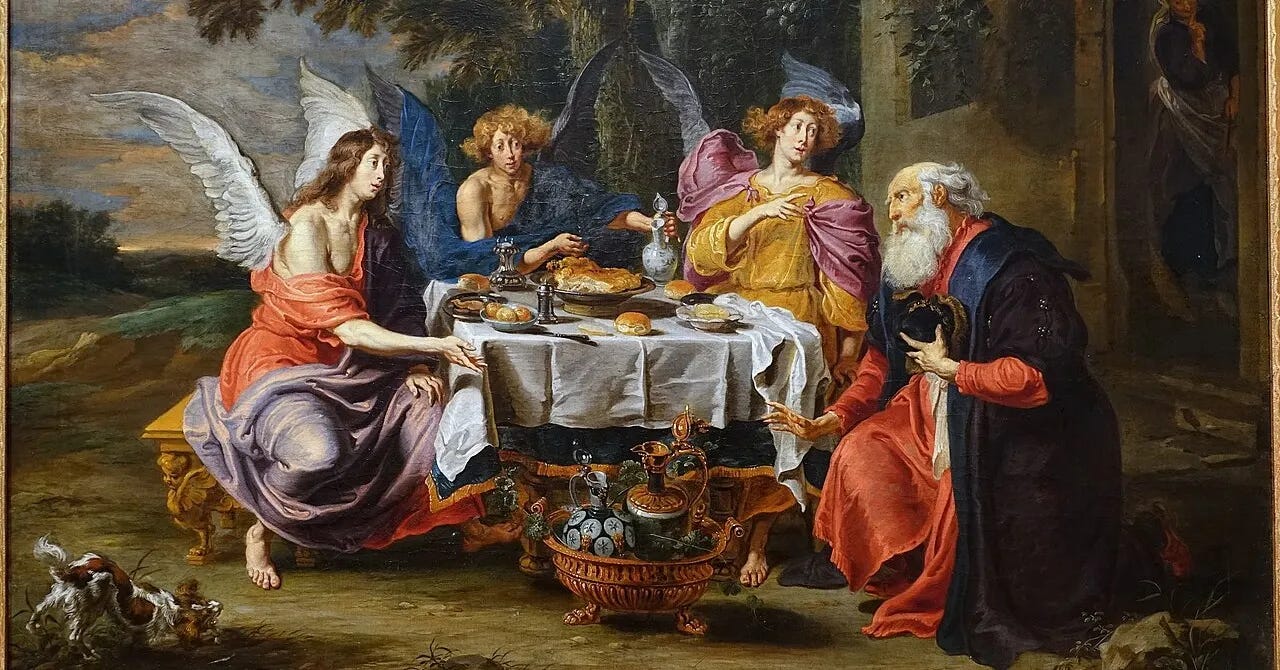
The ancient Hellenistic practice of guest-friendship has parallels in the Old Testament as well. You could recall the story of Abraham welcoming the three angelic strangers (Gen 18:1-15), the story of Sodom and the angelic visitors who come to Lot’s house (Gen 19:1-11), the angelic stranger who shares a meal with Samson’s parents (Judges 13), or that Job claims he never let a stranger sleep on the street (Job 31:32).
Similarly to the ancient Greeks with the gods, the Old Testament presents that the strangers who need your hospitality may be angels—an observation St. Paul makes in the Book of Hebrews: “Do not neglect to show hospitality to strangers, for thereby some have entertained angels unawares” (Heb 13:2).
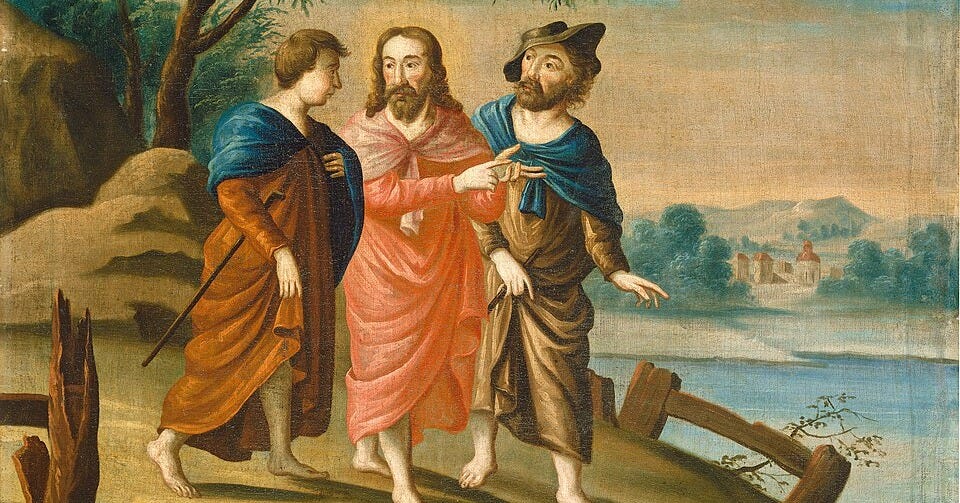
In the New Testament, you could see parallels with the famous road to Emmaus narrative, especially since they welcome in the Christ-stranger and only see Him for who He is in the breaking of the bread, a Eucharistic image (Luke 24:13-35). Another good example would be the famous parable of Matthew 25, in which God separates the sheep from the goats (saved from the damned) based on how they treated those in need, including the stranger. Finally, the New Testament exhorts Christians to be hospitable on several occasions (Rom 12:13; I Peter 4:9; Titus 1:7-8).
The practice of hospitality in the Church is probably best seen in the practices of the Benedictine monks who welcome each guest to the monastery as Christ. He is welcomed in honor with usually the Abbot washing his hands or feet before the guest is permitted to eat with the monks—being served by the monks as well.
Modern Christianity, whether it knows it or not, has its own ancient roots in guest-friendship and hospitality.
Practicing the Spirituality of Hospitality
In Christopher Nolan’s movie, he oddly merges the practice of Hellenistic ritual of xenia with Jesus Christ’s golden rule, i.e., do unto others as you would have them do unto you. The movie is explicit on this point—but the concept of xenia was never that expansive. Also, xenia was predicated on the will of the gods, not the individual, and at times bringing bloodshed through deception (Trojan horse) or slaughtering your guests (Book XXII of the Odyssey) was permissible.
Nolan takes two ancient moral maxims and mixes them, which tends to do a disservice to both Homer and Christ by conflating the historical relation between the two.
But xenia, as baptized in the truth of Christ, is an important spiritual practice for Christians.
And one often forgotten in our age of individualism, materialism, and skepticism.
Hospitality is an art, a spiritual art, that makes the home a place where friendships are forged and communities are founded.
It draws the host out of himself and detaches him from his goods—placing them in service to higher ends. Moreover, in both the Greek and Hebrew side, the stranger is welcomed as divinity—and in Christianity this continues as the guest being welcomed as Christ.
What are some ways you practice hospitality?
How can you better use hospitality to build the community around you?
Hospitality is another way to ascend, to be Christ-like. Explore it!
Dcn. Harrison Garlick is a deacon, husband, father, Chancellor, and attorney. He lives in rural Oklahoma with his wife and five children. He is also the host of Ascend: The Great Books Podcast. Follow him on X at Dcn. Garlick or Ascend.
It is bemusing, to say the least, to notice just how alien the concepts of piety and guest-friendship are in the context of MODERNITY. They are either perverted or ignored altogether.
Appreciated this information and great read. Especially the note regarding how modern Christianity has its roots in guest rite. I'd add, Christianity looks the way it does today because Europeans propagated it. Separate Korean, Nigerian, and Colombian Christians in space and time - and you'll find different expressions of "Christianity."