


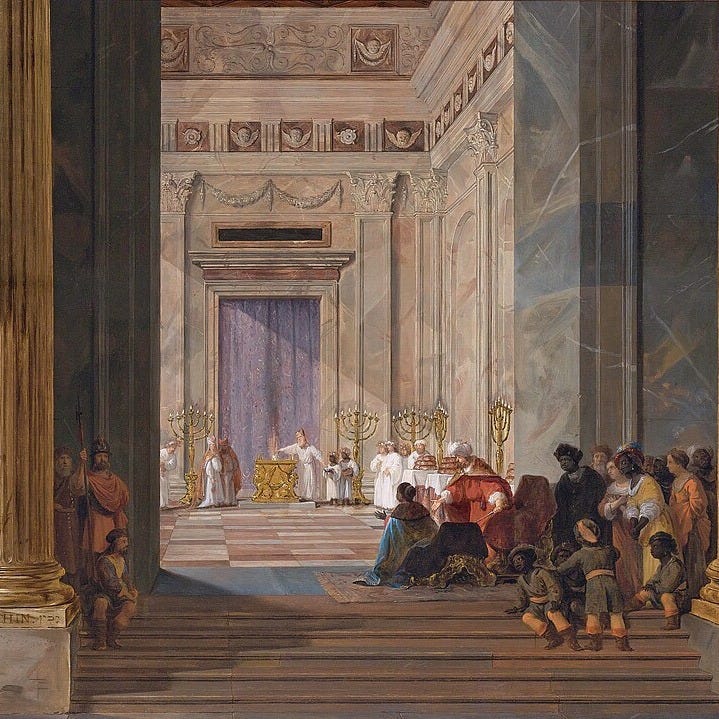
King Solomon’s Temple held a hidden story.
The carvings of olive wood overlaid with gold spoke of a primordial time.
And why is this important?
Because it revealed the world as a cosmic Temple, a holy sanctuary set aside for the glory and grandeur of God.
And why is that important?
Because you are part of the story—the world is not a sterile, neutral existence, but one of meaning and beauty.
A subtle lesson in the Bible invites you to see your life in a whole new way.
Reminder: you can support our mission and get all our members-only content for just a few dollars per month:
New, full-length articles every Tuesday and Friday
The entire archive of members-only essays
Access to our paid subscriber chat room
How to Read Genesis Well
First, how do you read the Bible in general? Well, the Christian tradition has passed down four senses that help you read Scripture like the early Christians: a literal sense, an allegorical sense, a moral sense, and an anagogical sense. Christians see these senses as interconnecting to reveal various strata within the Scriptures that testify to a Divine authorship and lessons for your own spiritual journey (read more: How to Read the Bible like the Early Church).
Second, using the four senses, recall that Genesis sets the stage for the New Testament. In fact, the New Testament can be seen as a retelling of the Genesis narrative. Christ is the new Adam, Mary is the new Eve, the Cross is the new Tree, et al., and these reveal to you a new creation under Christ that invites you to participate—to be a new creature (read more: The New Testament as a New Genesis).
Third, we have seen how to read the first chapter of Genesis as a dynamic poem that reveals the glory of God. The hidden, subtle structure of the seven days of creation again invites you to understand that the cosmos is an intentional, beautiful creation by God—and you are part of that creation. Christians believe you are made in the image of God and are part of a structured, intelligible cosmos that reveals the grandeur of God (read more: The Hidden Meaning of Creation).
But, there is yet another layer to the story of creation.
One that reveals the cosmos not simply as an ordered creation but as a holy, sanctified space—as cosmic temple.
Let’s see what the Bible says.
Noticing the Small Details about Eden
There are a few subtle details that must be noted about the Garden of Eden:
You entered the Garden of Eden from the east (3:24)
It was guarded by the angelic cherubim (3:24)
It was adorned with trees (2:9)
It was on top of a mountain, a source of rivers (2:10)
It was where God came down and dwelt with His people (3:8)
Now, why are these details important?
Because Christians see later biblical authors, inspired by God, used these same details to describe the Tabernacle and the Temple. To wit, there are allusions to creation and the Garden of Eden in the narratives about the Tabernacle and the Temple.
And you should note these well, as they say something subtle about the nature of reality and the cosmos in which you dwell.
But, as a preliminary, what is the Tabernacle and what is the Temple?
The Tabernacle, meaning “dwelling place,” was the portable sanctuary and tent of meeting that God commanded the Israelites to construct in the wilderness after the Exodus. The Tabernacle served as God’s dwelling place among them for worship, sacrifice, and divine encounter (Exodus 25:8-9). It featured an outer court, Holy Place, and Most Holy Place containing the Ark of the Covenant and other sacred furnishings, and was filled with God’s glory upon completion (Exodus 40:34).
The Temple (or Solomon’s Temple or the First Temple) was the permanent sanctuary built by King Solomon in Jerusalem on Mount Moriah, replacing the portable Tabernacle as God’s central dwelling place among Israel for worship and sacrifice (1 Kings 5–8 RSVCE). It followed a similar three-part design to the Tabernacle—with an outer court, Holy Place, and Most Holy Place housing the Ark of the Covenant—and upon dedication was filled with the glory of the Lord (1 Kings 8:10-11 RSVCE).
The Temple was the dwelling place of God on earth in the Old Testament.
And the fact that biblical authors wrapped the stories of the Temple in language from Genesis should be taken seriously.
Let’s see how they did this.
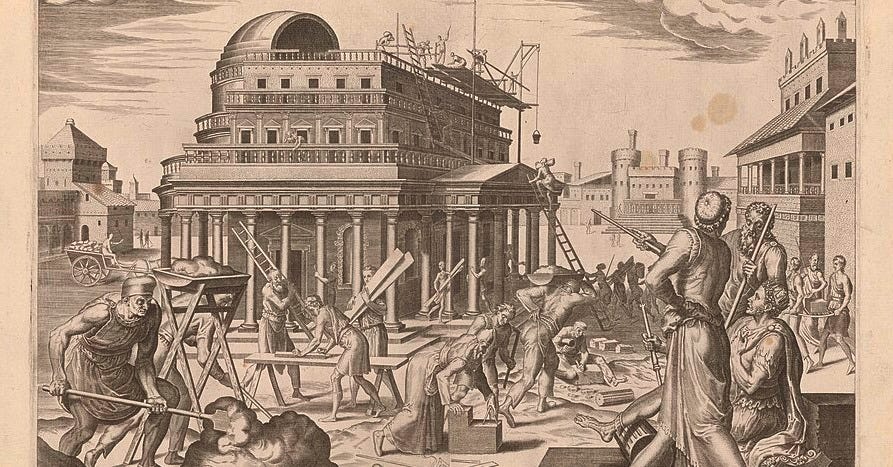
The World as a Cosmic Temple
The biblical authors draw the comparison between the Temple and creation through several subtle parallels:
Like Eden, you entered the Tabernacle from the east (Ex 27:13) and the Temple from the east (Ezek 47:1);
Like Eden, the Temple was adorned with cherubim, two large statues made of olive wood (1 Kings 6:23–28);
Like Eden, the Temple was adorned with carvings of trees and flowers made of olive wood and inlaid with gold (I Kings 6:29-32);
Like Eden, the Temple was depicted as a source of rivers—a sign of life (Ezek 47:1-12; Joel 3:18); and
Like Eden, the Temple was the dwelling place of God on earth (Lev 26:12; II Sam 7:6).
Other ancient Hebrew sources explicitly present the Garden of Eden as a Holy of Holies of the cosmic temple of God.1 To wit, God created the Garden of Eden and then, after the fall, had King Solomon build a Temple that was reminiscent of Eden—the trees, flowers, rivers, cherubim, and an entrance to the east. The biblical authors, who Christians believe are inspired by God, then captured these details in the Bible—creating strong but subtle parallels between Eden and the Temple.2
Why would God create these parallels in the Bible?
A Participant in the Cosmic Temple
The parallels between Eden and the Temple are another way to contextualize your life—you are a participant in this cosmic sanctuary called earth. The world the Bible presents is not a sterile, neutral existence, but rather a beautiful, ordered cosmos that unfolds as a story.
The world has a purpose.
You have a purpose.
The world as a Cosmic Temple rejects the idea that your existence is meaningless. It rejects that your life is a flat, random occurrence—but rather it invites you not to another reality, but to the true reality. The world is a Temple designed for the worship of God.
And He loves you.
And He invites you to a beautiful life.
Jubilees 8, 19.
See the Ignatius Catholic Study Bible: Old & New Testament, RSVCE 2nd Edition, p. 60, commenting on Gen 2:4-25.