


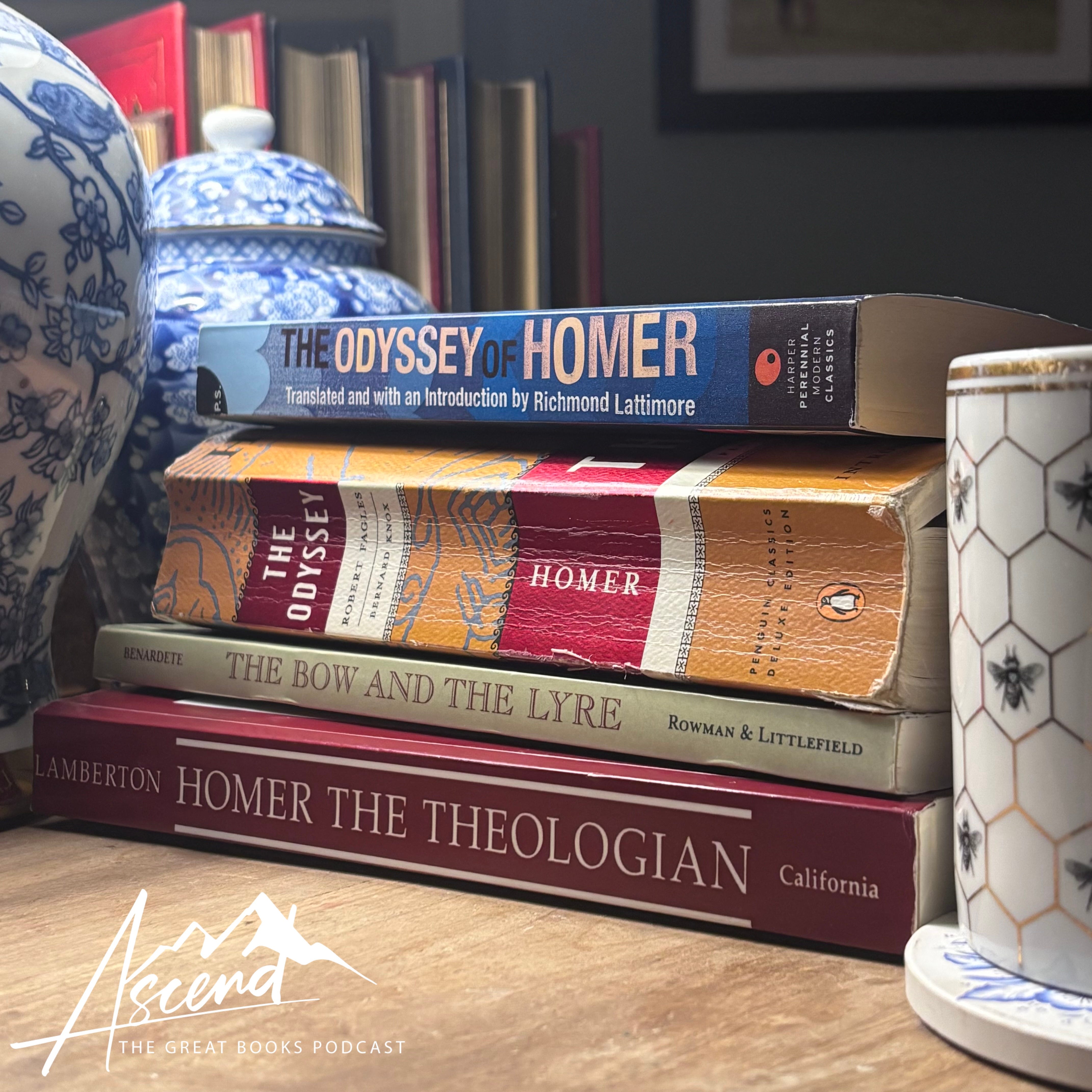
The Odyssey will change your life.
But a poor translation will hide Homer’s wisdom and waste your time.
The Odyssey stands at the beginning of Western civilization, because it comments on the perennial condition of man—providing lessons on piety, justice, fidelity, free will, providence, and more.
But what translation is best?
Here are the pros and cons of five popular translations of Homer’s Odyssey.
Reminder: you can support our mission and get all our members-only content for just a few dollars per month:
New, full-length articles every Tuesday and Friday (or Saturday!)
The entire archive of members-only essays
Access to our paid subscriber chat room
Why Should You Read Homer?
Homer is in many ways the fountainhead of Western civilization. The conversations that are so characteristic of the West, like virtue, piety, duty, religion, politics, freewill, etc., have their nascent roots in Homer’s Iliad and Odyssey. Moreover, Homer gave shape and form to a Hellenized culture that greatly impacted both the Old Testament and New Testament. In other words, there is an indelible mark of Greek thought and language on Christianity, and understanding that mark starts with understanding Homer.1
The Odyssey in particular is worth your time and attention, as it is a complicated story of temptation, homecoming, coming-of-age, mortality, and fidelity. In Odysseus, the “man of twists and turns,” Homer offers you a man of contrasts. In fact, Homer the philosopher is one that teaches you through the art of dialectic by placing contrasting poetic images within his own epic and letting you work through the tension—but at the heart of that tension, at the heart of understanding the complicated character of Odysseus, lies perennial lessons about the human condition. For more, see 10 Reasons You Should Read the Odyssey.
But… Homer’s wisdom can be easily lost or even perverted if you read a poor translation.
So, which translation should you read first?
5 Popular Translations of the Odyssey
Here are five popular translations of Homer’s Odyssey summarized with their pros and cons, especially for first time readers. Included is the opening of Book One of their respective translation of the Odyssey, so that you can have a quick taste of the tone and style.
Butler
Samuel Butler’s late-19th-century version renders Homer in straightforward, Victorian prose that prioritizes clear storytelling. It feels accessible and story-driven, appealing to readers who want to focus on the narrative without the demands of poetic verse.
“Tell me, O Muse, of that ingenious hero who travelled far and wide after he had sacked the famous town of Troy. Many cities did he visit, and many were the nations with whose manners and customs he was acquainted; moreover he suffered much by sea while trying to save his own life and bring his men safely home...”
However, it lacks the rhythmic, oral poetry of the original, often coming across as flat or dated, transforming the epic into something closer to a novel without Homer’s musical grandeur. It is a prose translation, and this gives it a distinct character and feel.
Overall, it is worth reading, but not as a first-time read. You need to have the foundation of Lattimore or Fagles first.
Fitzgerald
Robert Fitzgerald’s 1961 verse translation has long been regarded as a literary standard, prized for its elegance, lyricism, and attentive rendering of the poem’s beauty. It is a classic in its own right, and many who love Homer recommend it.
“Sing in me, Muse, and through me tell the story
of that man skilled in all ways of contending,
the wanderer, harried for years on end,
after he plundered the stronghold
on the proud height of Troy...”
It offers an experience that captures the tone and flow effectively, making it a favorite among poets and many schools. While highly readable as poetry, it can sometimes feel slower-paced or emotionally cooler compared to more dynamic renditions (like Fagles). It also does not adhere to a strict consistent meter.
Overall, it is a good translation and worth your time, but maybe not as a first read.

Wilson
Emily Wilson’s 2018 translation, the first by a woman, brings a modern, direct voice in iambic pentameter while matching the original line count. Wilson’s translation of the Odyssey is arguable the “choice” translation of many classics programs today.
“Tell me about a complicated man.
Muse, tell me how he wandered and was lost
when he had wrecked the holy town of Troy...”
Critics like Spencer Klavan, however, have argued that Wilson’s choices sap the grandeur and vigor from Homer’s language, resulting in a deflated, drab quality that diminishes the epic’s power (and this was intentional on Wilson’s part). Daniel Mendelsohn, who recently published his own translation of the Odyssey, has similarly critiqued Wilson’s translation for interpretive liberties and a tendency to impose contemporary perspectives that can distort the spirit of the original. It is important to note that Wilson has described her approach as correcting “anachronistic misogyny” added by previous male translators and “making visible the cracks in the patriarchal fantasy” rather than “honoring it.”
Overall, her translation seems to serve an ideology first and Homer second. Though very popular, it is not recommended.
Lattimore
Richmond Lattimore’s mid-20th-century verse translation stands out for its scholarly fidelity, staying structurally and linguistically close to the Greek, including its formulaic repetitions. In short, it is the more classic translation. It much more literal than say Fagles. The line numbers in Lattimore also match the Greek. Overall, Lattimore’s approach to translating the Odyssey makes it particularly valuable for academic study.
“Tell me, Muse, of the man of many ways, who was driven
far journeys, after he had sacked Troy’s citadel.
Many were they whose cities he saw, whose minds he learned of,
many the pains he suffered in his spirit on the wide sea...”
At the same time, its formal, literal style can feel less fluid or elegant in English, sacrificing some readability and poetic flow for literal closeness.
Overall, it is a good option for first-time readers, especially if you tend toward more literal translations. You cannot go wrong with reading Lattimore.
Fagles
Robert Fagles’ 1996 free-verse translation is excellent. It is poetic, dynamic, but also a clear, easy-to-follow read. It emphasizes accessibility while remaining poetic, making the story immersive and rewarding without feeling like an academic chore—these qualities have made it widely popular and enduring (especially for first time readers).
“Sing to me of the man, Muse, the man of twists and turns
driven time and again off course, once he had plundered
the hallowed heights of Troy...”
Though it may take slight poetic liberties for beauty rather than strict literalism, Fagles captures the spirit, excitement, and human drama of the Odyssey in a way that feels both timeless and contemporary. It is arguably the best translation for first time readers of the Odyssey.
Overall, if you’re looking for a fun, beautiful, engaging read, it is hard to go wrong with Fagles’ translation.
PS: Need Some Help Reading the Odyssey?
Join our sister company Ascend: The Great Books Podcast for their new 12-episode guide to Homer’s Odyssey using the Fagles’ translation. Ascend offers you podcasts, videos, and written guides to read the great books in a small group feel. Check out The Odyssey Book One with Dr. Papadopoulos and Dr. Grabowski on Apple, Spotify, or YouTube. Start today!
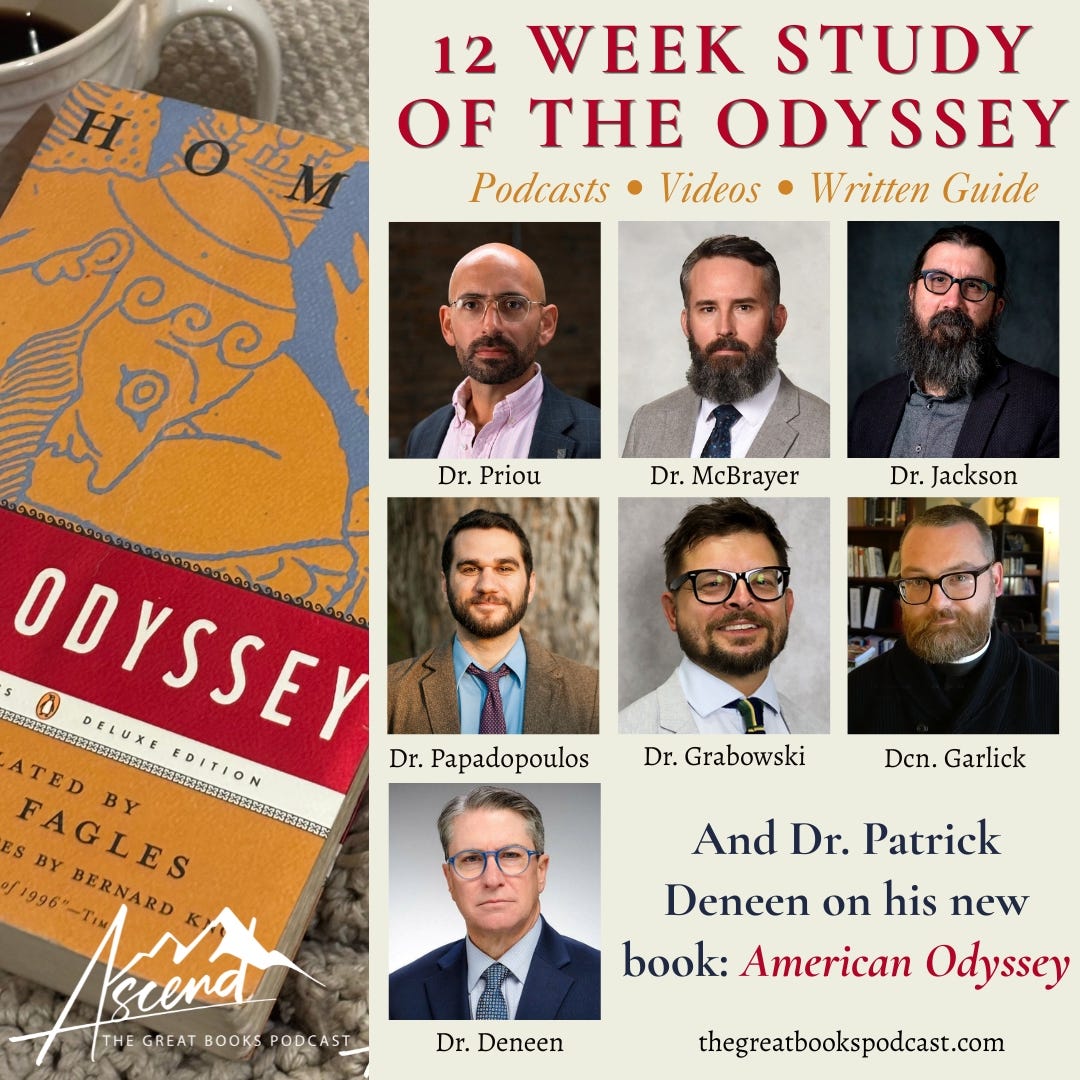
Dcn. Harrison Garlick is a deacon, husband, father, Chancellor, and attorney. He lives in rural Oklahoma with his wife and five children. He is also the host of Ascend: The Great Books Podcast. Follow him on X at Dcn. Garlick or Ascend.
For more on the Hellenization of Judaism and Christianity, see Christianity’s Debt to Homer, Homer the Philosopher, and Did Jesus Speak Greek?.
I've always considered it my dream retirement project to translate Homer into Classical Chinese. But to do that I will need to learn Homeric Greek and Classical Chinese first.
I've got E.V. Rieu.