


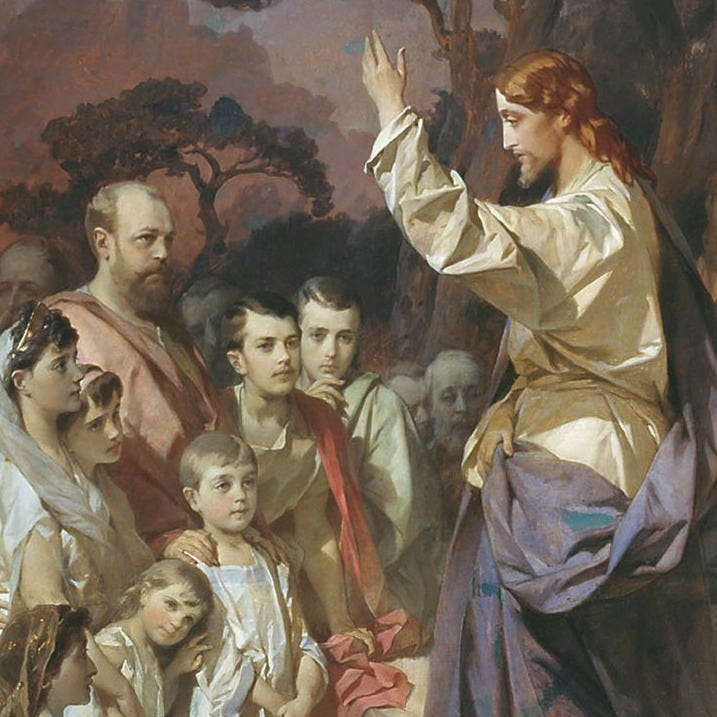
God comes to Earth to teach mankind how to live and writes nothing.
How does that make sense? He never even tells His disciples to “write this down.”
But if Jesus did not come to write a book, how did He intend for all generations to receive the fullness of His Gospel?
The Bible? It says it is not the full account of Jesus’ ministry.
How can you be sure that the Jesus you have received is the same Jesus the disciples preached?
In other words, how does Christianity remain Christian throughout the centuries?
You want to receive the fullness of Jesus, not make a Jesus according to the fads and fashions of this age. But how?
A careful look at Scripture gives us a surprising answer.
Reminder: this is a teaser of our members-only deep dives.
To support our mission and get our premium content every week, upgrade for a few dollars per month. You’ll get:
New, full-length articles every Tuesday and Friday
The entire archive of members-only essays
Access to our paid subscriber chat room
Did Jesus Come to Bring us the Bible?
It is a very odd thing that Christians believe that God came to earth to teach us how to live and never wrote a book. You would think He would have at least written an essay, an instruction manual, or something—but God himself walked amongst us and left nothing written in His own hand. Scripture tells us He wanted His teachings to be proclaimed until the end of ages, so why did He not write a book to ensure His teachings were given in a clear, confident manner?
Moreover, Jesus does not even seem interested in His disciples writing anything down. Nowhere in the New Testament does Jesus instruct His disciples to record his teachings. You would think St. Matthew, when telling of Jesus’ Sermon on the Mount, would have a line where he says he wrote all these things down the day they occurred—but the Bible never gives us those details. In fact, the Gospel of Mark is often considered the earliest Gospel account written, and it is conservatively dated in around 65-70 AD—over thirty years after Jesus’ death.
Jesus’ apparent lack of interest in writing a book or having His disciples do so presents a surprising contrast to most of modern Christianity’s focus on the Bible. A non-Christian could easily ask that if the Bible is so important to the Christian walk, why did Jesus not write it Himself or at least discuss its importance?
Furthermore, even the Bible, which Christians hold as the inspired word of God, states that it does not record everything that Jesus teaches—not even close. The last verse of the last Gospel states:
“But there are also many other things which Jesus did; were every one of them to be written, I suppose that the world itself could not contain the books that would be written” (John 21:25).
None of this is to disparage the Bible as the inspired word of God, a work of the Holy Spirit as Christians teach—but rather it should cause you to stop and challenge certain cultural presuppositions about Jesus’ mission. Jesus did not come to give us a Bible—though many act like Jesus handed the Bible to his disciples during His Ascension.
You must ask yourself: If Jesus did not intend to write a book, then how did He intend to communicate the Gospel throughout the generations to come?
Ironically, the Bible has the answer, but in several overlooked passages.
What Jesus did intend to do
If Jesus is not focused on a writing, then what is He focused on? Well, if you look at Scripture, you can see that Jesus starts the conversation about something new—a Church.
Now when Jesus came into the district of Caesarea Philippi, he asked his disciples, “Who do men say that the Son of man is?” And they said, “Some say John the Baptist, others say Elijah, and others Jeremiah or one of the prophets.” He said to them, “But who do you say that I am?” Simon Peter replied, “You are the Christ, the Son of the living God.”
And Jesus answered him, “Blessed are you, Simon Bar-Jona! For flesh and blood has not revealed this to you, but my Father who is in heaven. And I tell you, you are Peter, and on this rock I will build my church, and the powers of death shall not prevail against it. I will give you the keys of the kingdom of heaven, and whatever you bind on earth shall be bound in heaven, and whatever you loose on earth shall be loosed in heaven.” Matthew 16:13-19, RSVCE
Jesus came to found a Church. The Church is not something alien to Christ’s mission or something later foisted upon the teachings of Jesus; rather, the Church is central to the mission of Jesus Christ. Jesus may not mention the Bible or writing anything down, but He does mention His Church—a community of believers, a society of His followers.
But this Church is not reducible to a human institution. The Church is a spiritual reality. St. Paul tells us that Jesus is the Groom, and the Church is the Bride of Christ. And as husband and wife come together to form one flesh, so too do Christians become one with Jesus—He is the Head, and the Church is the Body (Eph 5:21–33). The Church is central to the saving mission of Jesus Christ. By His Cross, He invites all persons to become one with Him, to join His Body, His Church. It is by uniting yourself to Jesus Christ that one is saved and brought up into the mysterious life of the Trinity.
Yet, this has not necessarily answered the question.
The problem is how are the teachings of Jesus transmitted without error throughout the centuries, so that all persons can receive them? It would be odd if God came to earth and then gave future generations no manner of assurance that what they have heard about Jesus is what Jesus really taught.
You want to experience Jesus—not your perception of Him.
If man is in charge of deciding what Jesus taught, then Jesus takes on the form of man’s priors. The Republicans present a conservative Jesus, and the Democrats present a liberal Jesus. A church founded last week presents a Jesus with all the moral concerns of the modern age. What is the solution?
You may answer—the Bible!
But this answer is problematic. First, it is not Jesus’ focus in His ministry—and that should be taken seriously. Second, the Bible states the Bible does not give a full account of Jesus’ ministry (John 21:25). Third, the Bible is not self-interpreting. It is a complicated book and there are many differing opinions on how to read it. Non-Christians are often perplexed how Christians can all claim the Bible has the truth, and then there are 45,000+ different Christian groups with different interpretations globally.
Is this what Jesus wanted?
You have to give special attention to Jesus’ intent and how He said His teachings will be transmitted throughout the ages.
The Church is a part of the conversation—but there are many things Jesus said that people tend to forget… but they are incredibly important as to how you come to know Him centuries later.
Here are three preliminary questions to help us frame this incredibly important question.
First, how has God revealed Himself to humanity and does that change from the Old Testament to the New?
Second, how did God intend for the fullness of Jesus to be passed on to future generations? You want to experience the Jesus who entered history—not a corrupted image of Him.
Third, who was given charge of ensuring the message of Jesus was passed down from generation to generation?
These are key questions any Christian should consider.