


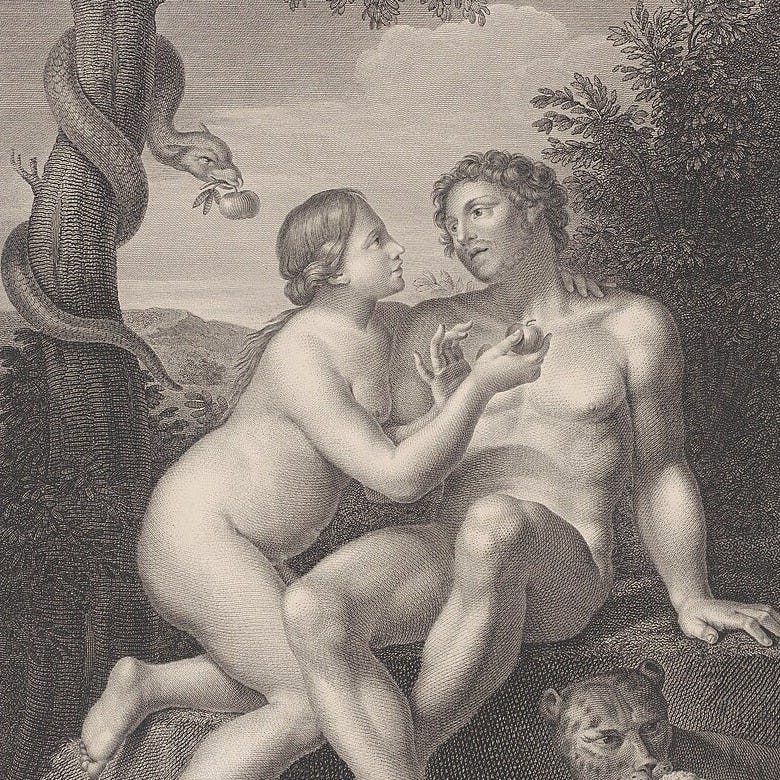
The fall of man was caused by a disobedient wife and a weak husband.
Many see the story as little more than a simple children’s tale—modern man dismisses these primordial warnings but then repeats their mistakes.
The story of the fall of mankind is a story of hierarchy—a story that reveals the hierarchy of our hearts.
Eve was faced with two interpreters of God’s will: her husband and Satan.
She chose Satan.
Why?
Reminder: this is a teaser of our members-only deep dives.
To support our mission and get our premium content every week, upgrade for a few dollars per month. You’ll get:
New, full-length articles every Tuesday and Friday (or Saturday!)
The entire archive of members-only essays
Access to our paid subscriber chat room
Eve Accepts the Fruit
Often dismissed as a mere children’s story, the images presented in the primordial story of the fall of mankind are pedagogical—they are there to teach those who are docile enough to learn. They are worth taking seriously, wrestling with, and seeing what truth can be learned and applied.
Simple images with ancient, deep meanings await.
The Serpent
First, in Genesis 3, you are introduced to the serpent, who, though not ever said to be Satan in the narrative of the fall of mankind (Gen 3-5), is later associated with Satan (Rev 12:9). The serpent is often read as an incarnation of Satan himself, but other times as Satan possessing an otherwise good animal—akin to the demonic possession of a human. In other passages, the serpent is often associated with the sea, a sea beast (Job 26:13; Is 27:1; Amos 9:3), and this makes him part of the larger poetic image in the Bible of water as chaos and death—as the Bible begins and ends with images of primordial, chaotic waters and an evil serpent.
The Hierarchy
Notice carefully how Eve responds to the serpent’s question:
He said to the woman, “Did God say, ‘You shall not eat of any tree of the garden’?”
And the woman said to the serpent, “We may eat of the fruit of the trees of the garden; but God said, ‘You shall not eat of the fruit of the tree which is in the midst of the garden, neither shall you touch it, lest you die.’” (Gen 3:1-3).
First, notice that Scripture never records that God ever told Eve to not eat of the Tree of the Knowledge of Good and Evil. That command was given prior to her creation and only to her husband, Adam (Gen 2:17).
So, how does Eve know of this command?
Because Adam has told her of the divine command; thus, we see the hierarchy established at the creation of “the woman,” as she’s not yet named Eve, functioning to express God’s will. The original hierarchy is: God → Adam → Eve.
Second, notice too that Adam has presumably given an additional command. Eve tells the serpent that “neither shall you touch it, lest you die,” which is not said when God gives the command to Adam (Gen 2:17). It cannot be said that Adam lied to Eve, as they are still without sin; thus, it seems Adam has given an additional law, a secondary hedge against the temptation, to not even touch the tree. It is an image of Adam as lawgiver and the interpreter of the divine.1
The Serpent’s Lie
It is often misunderstood how the serpent tempts the woman. Give the following a careful read:
But the serpent said to the woman, “You will not die. For God knows that when you eat of it your eyes will be opened, and you will be like God, knowing good and evil.”
So when the woman saw that the tree was good for food, and that it was a delight to the eyes, and that the tree was to be desired to make one wise, she took of its fruit and ate; and she also gave some to her husband, and he ate (Gen 3:4-6).
First, it is notable that the serpent tells the woman she will “be like God,” and the woman interprets this as becoming “wise.” In other words, through the serpent’s half-truths, Eve is tempted with something good. It is good to be like God. It is good to be wise. The original sin of the woman is more subtle than full rebellion against God or choosing the opposite of God, evil. It is choosing what is good in a not good way.
To further emphasize this point, the early church fathers speculated that God would have asked Adam and Eve to eat of the Tree of the Knowledge of Good and Evil when they were ready.
Why?
Because it would be good for Adam and Eve to be wise and know this distinction, but only after they had matured under God’s direction. To wit, the temptation of Eve is to circumvent the path God has for her—to be “like God” outside the path God has set to become like Him. It is a false theosis, a false path of sanctification and religion.
In wanting to be “like God,” Eve sets herself up as “God” of her own religion.
But we must take seriously that Eve’s sin is also against her husband, and that she elects Satan over Adam—and what this does to the divine hierarchy of creation.
And, in all this, we must also take seriously Adam’s failure to be a husband—to fulfill his role to keep the garden and be the divine interpreter of God’s will.
The Bible offers these ancient lessons to us.
The lessons of an ancient, cosmic hierarchy that reveals the hierarchy of our own hearts.
