


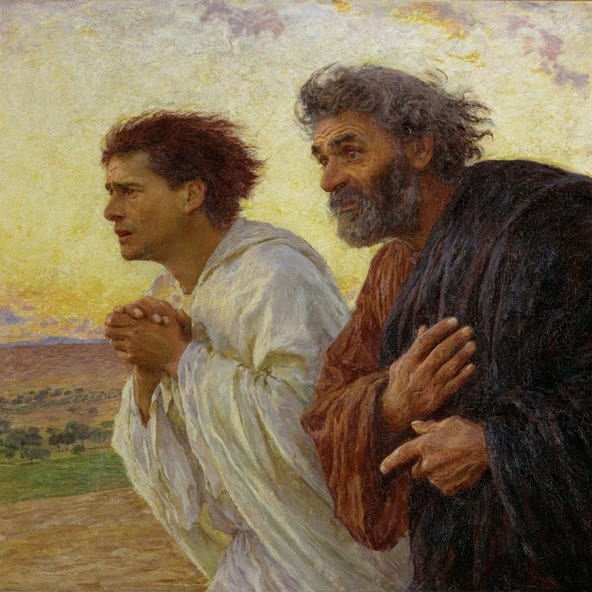
Every Easter season, you see the same jokes.
People laugh and post memes about John recording he beat Peter to the tomb.
Yet, many people couple their jokes with a comment wondering why else would John even record this detail?
Well, what if it wasn’t about humor but about John’s respect for Peter’s biblical role?
In this piece, explore the New Testament’s subtle but consistent portrait of Peter as the leader among the Twelve.
Discover why John’s “humble-brag” might be the ultimate nod to apostolic primacy.
Reminder: this publication is 100% reader-supported. We are only able to continue writing it thanks to the members who support our mission.
If you find these articles valuable, then please do consider subscribing for a few dollars per month — it helps us out enormously. You’ll get:
New, full-length articles every Tuesday and Friday
The entire archive of members-only articles and essays
Access to our paid subscriber chat room and community
John’s Story of Beating Peter to the Tomb
After the death and burial of Jesus, Mary Magdalene visits the tomb of Jesus Christ and finds it empty. She reports this to the disciples, and Peter and John run to the tomb. Here is how the Gospel of John records the scene:
Peter then came out with the other disciple, and they went toward the tomb. They both ran, but the other disciple outran Peter and reached the tomb first; and stooping to look in, he saw the linen cloths lying there, but he did not go in. Then Simon Peter came, following him, and went into the tomb; he saw the linen cloths lying, and the napkin, which had been on his head, not lying with the linen cloths but rolled up in a place by itself. Then the other disciple, who reached the tomb first, also went in, and he saw and believed; for as yet they did not know the scripture, that he must rise from the dead (John 20:3-9).
Why does St. John record, twice, that he reached the tomb before St. Peter? Every Easter season this verse tends to solicit a lot of commentary and much of it humorous.
Here are some examples:


And there are always a few good-natured, humorous memes on this verse as well.

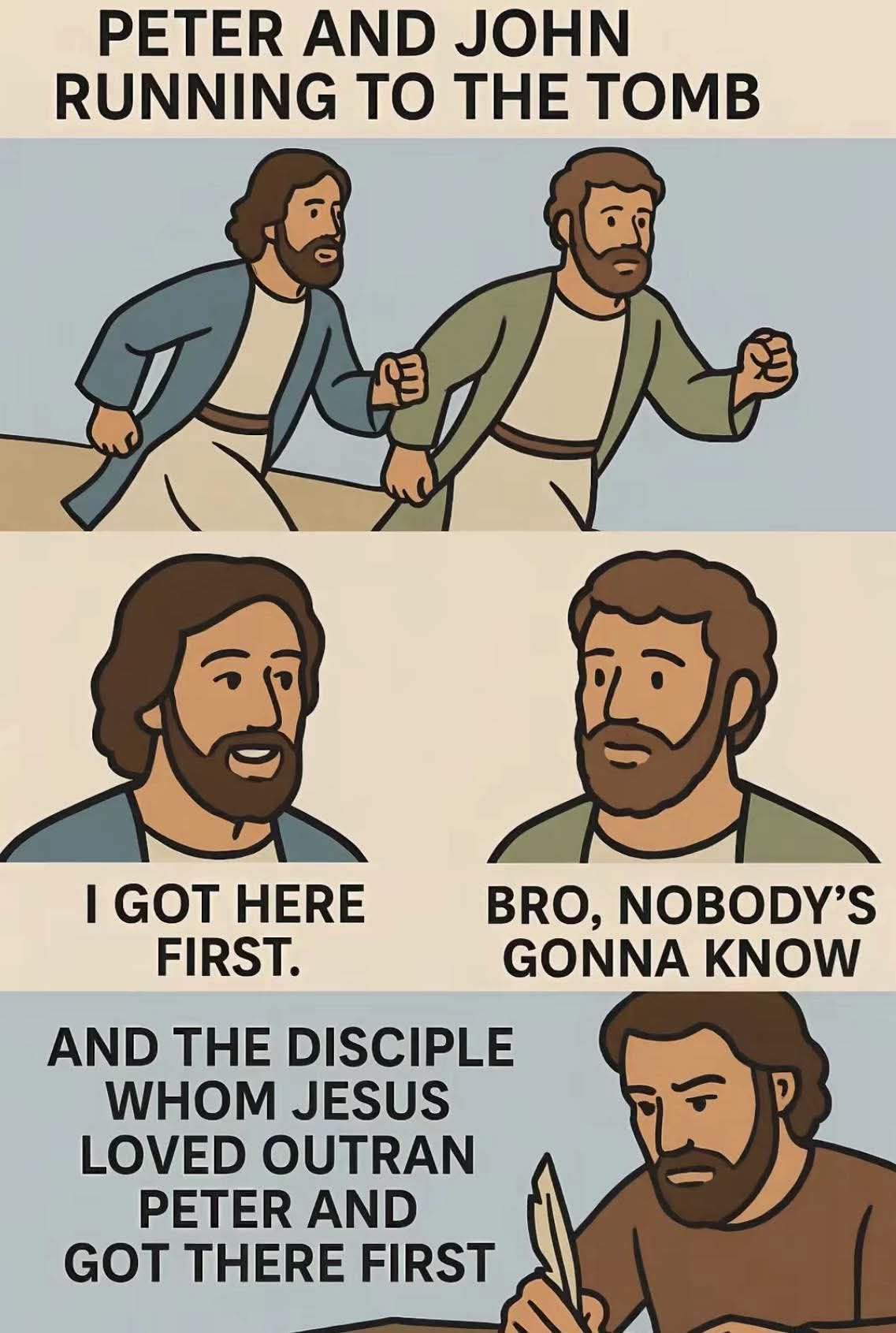
While the comedy is enjoyable, what was John’s intent in putting this detail in Holy Scripture? Many Christians defer to a “humorous” read, because they cannot discern any other reason for which John would include this detail.
But is there something more at work here?
Ancient Christianity may have an answer.
The Bible’s Subtle Lesson on Peter
Many people focused on the wrong detail. They focus on the fact that John records that he beat Peter to the tomb, but the most important detail is the John deferred to Peter to go in first.
The arriving first is in service to this important fact.
Why?
Many Christians would claim that the Bible holds a subtle lesson on Peter—one that is only received in giving attention to small details scattered throughout the New Testament.
And the lesson is this—that Peter plays a leadership role amongst the Twelve.
Here are some examples for you to consider.
1. Peter and Special Acts in the New Testament
Peter often is singled out in the stories in the New Testament. Peter is the only one to walk on the water, and he is the one to bring up the famous question about how many times we must forgive.1 You even see people being healed by Peter’s shadow.2
Peter, James, and John are a special group of disciples that are allowed to witness the Transfiguration and accompany Christ to the Mount of Olives.3 Notice, however, in this special group, Peter is singled out as the leader, the spokesman for the group. At the Mount of Olives, Christ finds all three asleep, but it is Peter he addresses. During the Transfiguration, it is Peter who speaks for the disciples.
Peter seems to always be involved in the special events of Jesus’ ministry, and he appears to play a leadership role, speaking on behalf of the followers of Christ.
2. Christ Calls Simon Peter First:
In the Gospel of Luke, Christ calls his first disciples, and the first is Simon Peter.4 The call of Peter is the call to discipleship par excellence—and once again Peter serves as the spokesman for the group speaking with Christ.
But when Simon Peter saw it, he fell down at Jesus’ knees, saying, “Depart from me, for I am a sinful man, O Lord.” For he was astonished, and all that were with him, at the catch of fish which they had taken; and so also were James and John, sons of Zeb′edee, who were partners with Simon. And Jesus said to Simon, “Do not be afraid; henceforth you will be catching men.” And when they had brought their boats to land, they left everything and followed him.
It is also notable that the call of Peter is intimately tied to being a fisherman, which ties into another subtle biblical pattern—the lesson on water as chaos and why Jesus called fishermen to be his disciples.
3. The List of Disciples According to Scripture:
Here is another subtle but important detail: every time the disciples are listed, Peter is listed first and even sometimes called “the first.”5 Even further, when referring to the disciples, sometimes only St. Peter is mentioned by name, e.g., “And Simon and those who were with him,” and “Now Peter and those who were with him”.6
The naming of Peter first amongst the Twelve or the only one to be named when the Twelve is mentioned is a small detail that merits close attention.
4. Peter’s Special Vocation in the Gospel of John
After the Resurrection, Jesus appears to the eleven disciples and, like you’ve seen before, has a unique conversation with Peter. Jesus asks Peter three times if he loves Him, and Peter responds “yes” all three times—and many Christians see this passage as a parallel to Peter’s denial of Christ three times during His Passion.
However, the affirmations of love are met by three unique vocational statements. Christ tells Peter and Peter alone: feed my lambs, tend my sheep, and feed my sheep. Peter is given the vocational duty to care for the flock of Christ.7
5. Peter’s Special Vocation in the Gospel of Luke
Similarly to John’s Gospel, Christ tells Peter that Satan has demanded to sift him like wheat. It is notable that Satan has focused on Peter, and that Peter will undergo a test—further unique characteristics of Peter. Jesus then tells Peter: “but I have prayed for you that your faith may not fail; and when you have turned again, strengthen your brethren.”8 The “strengthen your brethren” vocational statement is another mandate given only to Peter—and this is seen, at least in part, but another important and unique attribute of Peter, he is the one to preach at Pentecost.
Peter turns from his denials, embraces the reality of the risen Lord, and proclaims the Gospel to the world.
6. Peter’s Special Vocation in the Gospel of Matthew
Matthew’s Gospel has the most famous and most unique vocation given to Peter.
Now when Jesus came into the district of Caesare′a Philippi, he asked his disciples, “Who do men say that the Son of man is?”
And they said, “Some say John the Baptist, others say Eli′jah, and others Jeremiah or one of the prophets.” He said to them, “But who do you say that I am?” Simon Peter replied, “You are the Christ, the Son of the living God.”
And Jesus answered him, “Blessed are you, Simon Bar-Jona! For flesh and blood has not revealed this to you, but my Father who is in heaven. And I tell you, you are Peter, and on this rock I will build my church, and the powers of death shall not prevail against it. I will give you the keys of the kingdom of heaven, and whatever you bind on earth shall be bound in heaven, and whatever you loose on earth shall be loosed in heaven.” Then he strictly charged the disciples to tell no one that he was the Christ.
This vocation of Peter merits close attention and a careful read, but there are a few substantive points that can help you understand the special role of Peter. First, see that Peter responds on behalf of the group, as normal, but also does so as inspired by God. Peter again plays the role of spokesman but it is clear he does so by God’s grace.
Second, one of the most significant events in the New Testament is Christ giving Simon the new name of “Peter” or Kephas (or Cephas) meaning rock.
In the Old Testament, God changing someone’s name denoted a special calling, a new vocation, e.g., Abram to Abraham, Sarai to Sarah, and Jacob to Israel. As such, many Christians see Simon’s name change as part of a larger biblical pattern where a name change equals a new vocation, a special role in salvation history.
And, like the other name changes in the Bible, the meaning of the new name is providential and evidences the new vocation. As Abraham was the rock of Israel, the father of faith, so too is Peter the rock of the Church, the new Israel.
It is also important to note that Paul refered to Simon by his new name, Peter or “rock.”9 Moreover, Paul cites Peter as an sign of credibility and approval of his own apostolic ministry.10
Third, Peter is given the “keys of the kingdom of heaven,” and it is important to note that Jesus is perfecting a passage from Isaiah. In other words, this passage is a good example of a basic biblical principle: The Old Testament foreshadows the New, and the New perfects the Old. Notice the similarities with this passage from Isaiah:
And I will place on his shoulder the key of the house of David; he shall open, and none shall shut; and he shall shut, and none shall open. And I will fasten him like a peg in a sure place, and he will become a throne of honor to his father’s house. And they will hang on him the whole weight of his father’s house, the offspring and issue, every small vessel, from the cups to all the flagons.11
The passage has important parallels between the key(s), the opening/shutting with binding/loosing, and the foundations of tent peg and rock. To wit, as the Davidic king in the Old Testament has his steward that had authority when he left the kingdom, so too does Christ give Peter authority for when He leaves His kingdom.
To wit, this is not simply a unique vocation for Peter, but one that shows Peter as the leader of the Church, the steward caring for the King’s kingdom in the King’s absence.
It is an important insight into why Christ would also include Peter in unique events, and why the Gospel writers would always list Peter first.
Why John Records He Beat Peter to the Tomb
So, why does John record that he beat Peter to the tomb? Because it is part of him recording his deference to Peter, the leader of the Church. Peter is listed first amongst the Twelve, he speaks on behalf of the Twelve, and he is given several unique vocations to lead and guide the Christian Church.
John’s detail is not about comedy.
John’s detail is a subtle nod to Peter’s special, biblical role as the leader of the Church.
What do you think?
Dcn. Harrison Garlick is a deacon, husband, father, Chancellor, and attorney. He lives in rural Oklahoma with his wife and five children. He is also the host of Ascend: The Great Books Podcast. Follow him on X at Dcn. Garlick or Ascend
Mt 14:28ff; Mt 18:21.
Acts 5:15-17.
Mark 9:2-8; Mark 14:33.
Luke 5:1-11.
Matt 10:2-4; Mk 3:16-19; Lk 6:14-16; Acts 1:13. In Matt 10:2, Peter is called “the first,” the original Greek, the word is πρῶτος (prōtos), which means “first” in order, time, or importance/rank (it can carry a sense of “foremost” or “chief.”
Mk 1:36; Lk 9:32.
John 21.
Lk 22:31-34.
I Cor 15:3-5; cf. 1:12, 3:22, 9:5.
The epistle of Galatians is paramount in understanding the Pauline/Petrine relationship. In the beginning of Galatians, Paul is attempting to validate his claim to be an apostle, though he was not one of the twelve. It’s important to note that Paul invokes Cephas twice to show that his vocation and apostolic claim are both valid. After receiving his call from Christ, Paul goes out and “does not confer with flesh and blood,” but rather three years later goes “to Jerusalem to visit Cephas.” Then after fourteen years, he returns to Jerusalem and privately tells the “pillars” of the Church his gospel, “lest somehow I should be running or had run in vain.” Again, he uses Peter as vindication, saying as Peter went to the circumcised, so he, Paul, goes to the uncircumcised. Then the “pillars” (Cephas, James, and John) “perceive the grace” in Paul and send him to the Gentiles with Barnabas. (Gal 1) It is important to note the role of hierarchy within Paul’s ministry, not only in validating his own role, but later in establishing his own hierarchal churches (cf. Timothy and Titus). The question of Peter’s role is distinct from how Peter plays it, as Paul both defers to Peter and corrects him.
Is 22:22-25.
Why would recording that be a submission to his leadership?
Excellent. Thanks.