


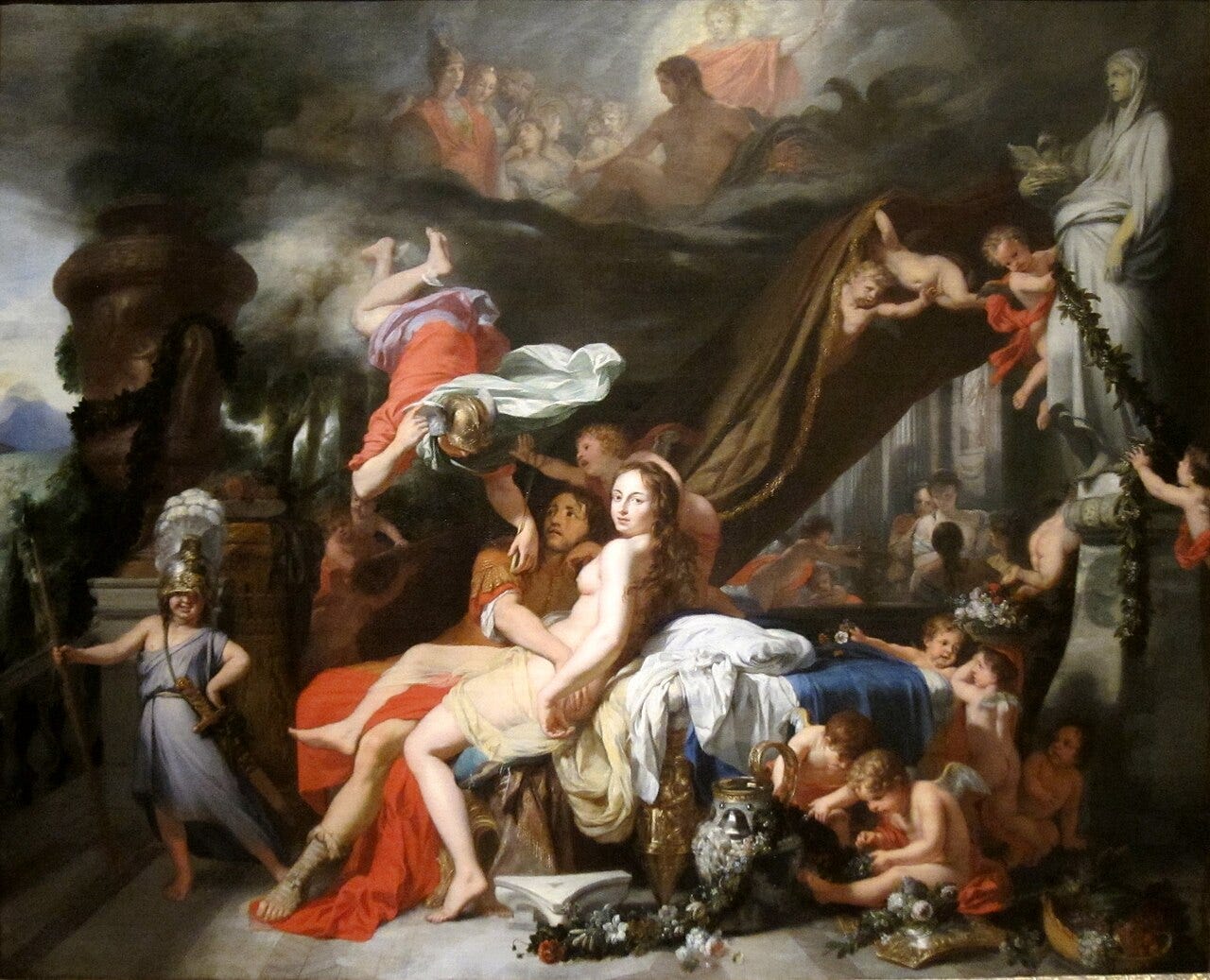
Would you refuse to become a god?
In Book V of the Odyssey, the goddess Calypso offers Odysseus immortal life as her lover on her island of pleasure.
But Odysseus says no.
How could Odysseus, a pagan, not see this life of satisfaction as the highest goal of man?
What does Homer understand that we do not?
Homer is a philosopher for those who know how to read him—and his subtle lessons in Book V of the Odyssey are amongst the most important in the Western canon.
What does it mean to be human?
Reminder: this is a teaser of our members-only deep dives.
To support our mission and get our premium content every week, upgrade for a few dollars per month. You’ll get:
New, full-length articles every Tuesday and Friday
The entire archive of members-only essays
Access to our paid subscriber chat room
What happens in Book V of the Odyssey?
It is not necessary to have read Book V of the Odyssey to benefit from this discussion, but it may help to have a quick sketch of the overall narrative—in addition to the specific textual points discussed in detail below.
A summary:
King Odysseus is trapped on Calypso’s island. Zeus, at Athena’s pleading, agrees to two proposals: first, Odysseus may leave the captivity of Calypso; and second, Athena may help Telemachus escape the trap set by the suitors (5.24). Hermes, the messenger god, goes and tells Calypso that it is Zeus’ will that Odysseus be set free upon a make-shift raft, and Calypso, though upset, acquiesces to the will of Zeus (5.125, 176). She tells Odysseus he may leave, and he has her promise she is not plotting some new harm against him (5.202). After four days of working on the raft, Odysseus sets sail on the fifth with gifts and provisions from Calypso (5.288).
Poseidon, who is returning from Ethiopia, sees Odysseus has left the island and, “it made his fury boil even more” (5.313). Poseidon sends a storm to sink Odysseus (5.321). As he’s being battered by the waves, a goddess of the sea, Ino, pities Odysseus, and tells him to strip off his clothes, tie her scarf around his waist, and swim for land (5.377). Poseidon smashes the raft to pieces (5.403), and Odysseus, with the help of Athena, makes it to the shore (5.471). The book ends with Odysseus falling asleep beneath two olive trees (5.544).1
The most important detail, however, in Book V is that Odysseus declines Calypso’s offer to become a god, her immortal lover.
And the most important question is how can Odysseus, a pagan, make this decision?
The Hidden Lesson in the First Line
Homer opens Book V with: “As Dawn rose up from bed by her lordly mate Tithonus” (5.1). The line merits attention, because the normal reference to Dawn, the goddess Eos, is about her robes—but here we receive the only reference in the Odyssey to Tithonus.
Who is he?
The citing of Tithonus is a subtle setting of the stage to understand Odysseus’ answer to Calypso. Tithonus was a mortal lover of Dawn, and Dawn asked Zeus to make him an immortal. Zeus acquiesced but stated that Dawn did not ask for immortal youth as well; thus, Tithonus falls into the horrific tragedy of being able to age but not die. He who was promised to become a god withers into a sub-human creature, an undying insect-like being that is finally placed in a basket and put away.
It is a powerful narrative for Homer to subtly invoke on the first line of a story about why a human would not want to become a god.
But even more surprising is how Odysseus, the hero of the tale, is introduced for the first time to the reader in the Odyssey.
Odysseus Crying on the Beach
It should be noted that Calypso’s pleasure cave is so enticing that even Hermes, a god, “would gaze in wonder, heart entranced with pleasure” and “stood there, spellbound” (5.81). Yet, Hermes cannot find Odysseus, and Homer tells us that the King of Ithaca is sitting on the beach, “weeping there as always, wrenching his heart with sobs and groans and anguish, gazing out over the barren sea through blinding tears” (5.92). You should note that this is the introduction to Odysseus in the Odyssey—this is the first glimpse of his character and state since the Iliad.
Why does Homer introduce him crying on the beach?
For first time readers, the scene can seem unsettling and even pusillanimous. The hero of the Trojan war, the great mastermind of the Achaeans, is crying on the beach? Yet, notice the juxtaposition Homer offers you: on one hand, a cave of pleasure where even the gods are enticed, and on the other, a place on the headlands fartherist removed from the cave, a human scene of sorrow, Odysseus yearning for home. Many parallels are presented here by Homer, e.g., divine to human, pleasure to anguish, cave to home.
Calypso’s reaction to Hermes is telling, as she states the gods are “scandalized when goddesses sleep with mortals” (5.130), and she gives a short list of how mortal lovers of the goddesses meet tragic ends (5.134). You can read this simply as the male gods being “lords of jealously,” but one wonders whether Homer is hinting here at something more—something tied into the Tithonus narrative. Is there something unnatural or disordered about a mortal becoming an immortal lover of a goddess? And, if so, in what way would it be disordered?
You could push back and recall the tale of Thetis, the sea nymph, who was pursued by both Zeus and Poseidon until Prometheus told them that her son would be greater than his father—which means that Zeus could sire his own usurper (as both Uranus and Cronos did). As such, Zeus solved the problem by giving Thetis in marriage to King Peleus, a mortal, and they had a son—Achilles. Here, however, though the arrangement saved Zeus’ rule, it did precipitate the carnage of the Trojan war, including a civil war amongst the gods. It was certainly not without consequence.
Here, Calypso reveals that she’s offered immortality to Odysseus (5.150), and Homer continues to explore in Book V how Odysseus can say refuse her offer.
In fact, it is in Odysseus’ response to Calypso that you best see how Homer is a philosopher.
And how his philosophy can teach you what it means to be human.