


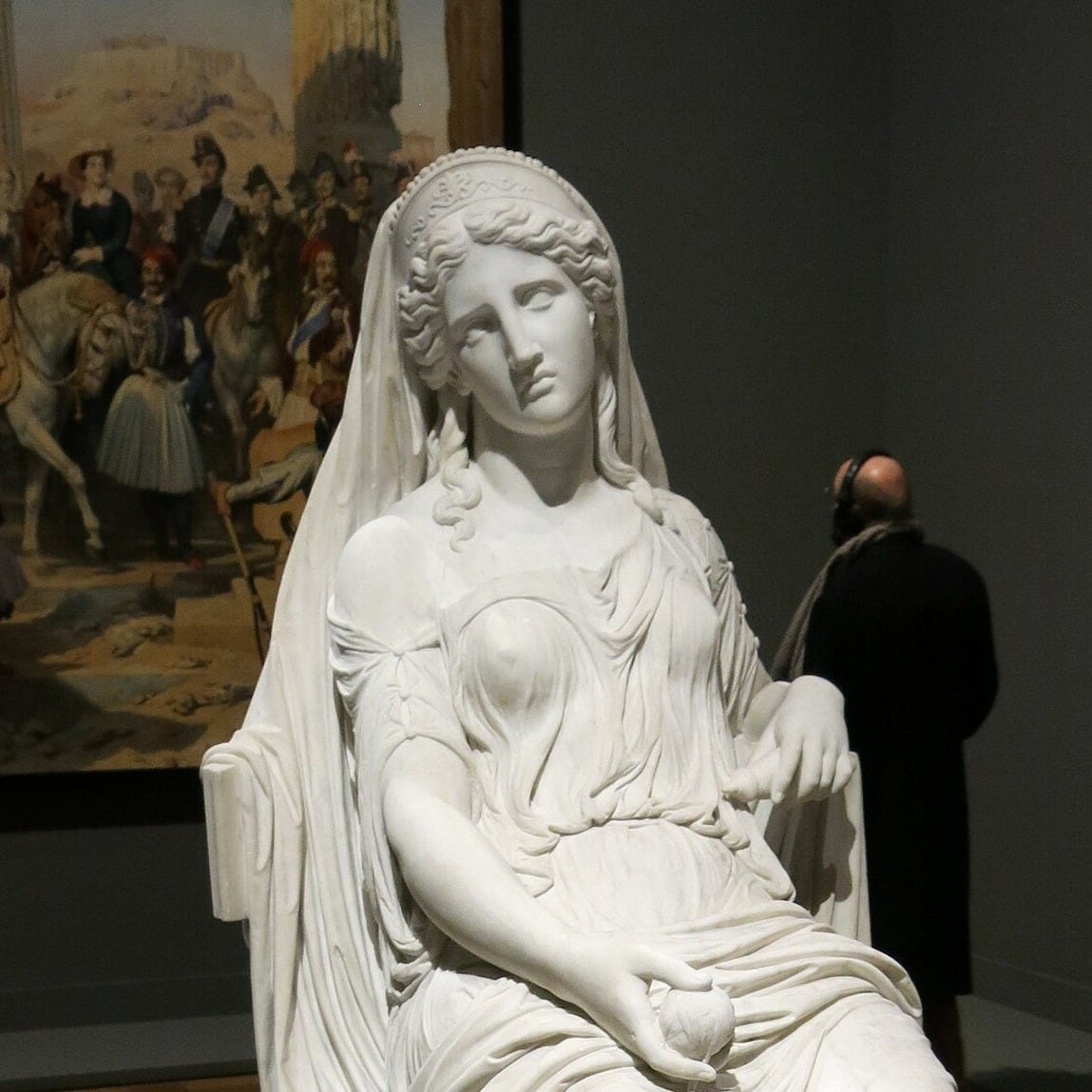
Is Penelope a hero?
Some have argued that Penelope is a hero, but Homer’s patriarchal poem does not praise her as such.
Others have argued that Penelope is anything but a hero, as Athena gives Telemachus permission to marry her to another or even to kill her.
But who is Penelope according to the terms of the poem?
Let’s look at the surprising tension that is Penelope.
Reminder: this is a teaser of our members-only deep dives.
To support our mission and get our premium content every week, upgrade for a few dollars per month. You’ll get:
New, full-length articles every Tuesday and Friday (or Saturday!)
The entire archive of members-only essays
Access to our paid subscriber chat room
Odysseus as a New Vision of the Heroic
The Odyssey is both a continuation of and a commentary on the Iliad. The Iliad opens with the divine rage of Achilles and tells of his pursuit of immortal glory in Troy. Agamemnon, Diomedes, and several other characters seek and find their aristeia upon the battlefield, the greatest act of glory they will accomplish in life. The honor won upon the battlefield is fecund, as it produces an immortal glory—an everlasting fame where your name will never die. To be an excellent man (arete), is to be great in war and win your immortal kleos, your glory.
The Odyssey, however, opens with the word “man” and offers a new way of looking at excellence. In Homer’s second epic, the Trojan war is not presented as an achievement of glory but in somber tones of regret. Nestor speaks of the war as “hell on earth” (3.120), and Menelaus would not do it all over again if he had the chance—especially considering the death of his brother, Agamemnon (4.100).1 Famously, the glory of Achilles in Troy seems not to afford him much comfort in the afterlife, as Achilles believes it would be better to return as a lowly dirt farmer than reign amongst the dead (11.488). Though, notably, Achilles struggles to envision any life different than of war and glory. Lastly, when Odysseus does slaughter the suitors, he refuses to glory over the dead (a common act in the Iliad) and prohibits his son from doing so as well (22.408).
What is Homer telling us here?
The Iliad is often referenced as the book of war, and the Odyssey is the book of peace—a reference to the two cities on Achilles’ shield (Iliad 18.478). In other words, Homer is showing us what it takes to be heroic, to have excellence, in a time of peace—in a time of the domestic. And it should be noted that the city of peace on Achilles’ shield is not without conflict—but rather it has the ability to resolve the conflict and reestablish order.
Homer shows us in Odysseus, a flawed and complicated character, an image of restoration. The disorder of the suitors must be removed in a somber, almost ritualistically sacrificial slaughter. The marriage of husband and wife, king and queen, must be restored, as seen in the great icon of fidelity, the rooted bed (23.177). And Ithaca must receive her king, one who, at least in the past, ruled like a kind father—one who seemed more like his father, Laertes, than his cunning and shrewd maternal grandfather, Autolycus (19.392).2
It can be argued that Odysseus has both the fates of Achilles. In Troy, Achilles disclosed that he was given an option: to fight and die in Troy for immortal glory or live a peaceful life at home where his name would soon be forgotten after his death. Achilles chose to fight and die in Troy. Odysseus, however, also wins immortal glory in Troy, as it was Odysseus, not Achilles, who conquered the city via the famous Trojan horse (Odyssey 8.487). In other words, cunning won over power. But Odysseus does not die in Troy. Despite his penitential journey and his fate to die somehow related to the sea, he will die in peace with his family. In other words, Odysseus seems to have achieved both fates of Achilles—though whether Odysseus, the restless desirer of knowledge, can remain with his family in Ithaca is another story.
As such, it seems clear that Homer offers a different vision of the heroic in Odysseus. He is a peace-time hero, a civilizing force, that restores Ithaca and, while still retaining his strength, uses his mind. He has both excellence (arete) and glory (kleos).
But if Odysseus is a new type of hero, what of Penelope?
Does Homer present Penelope as a hero?
At the beginning of the Odyssey, the answer seems to be not at all.
The Case Against Penelope as Hero
While the Odyssey is often portrayed as some romantic story of a husband trying to return to his wife, that is not the story Homer presents—least not in the beginning. In fact, in Book 1, many readers are shocked to see how little Athena seems to care about Penelope’s role in Odysseus’ homecoming.
Notably, Athena, disguised as Mentes, tells Telemachus that if the spirit moves his mother to remarry, he should simply send her back to her father’s house and let him marry her off to someone new (1.310). Athena is not focused on a reunion of Penelope and Odysseus, but rather Odysseus’ glory seems to be in his homecoming and slaughter of the suitors—a restoration of the marriage with Penelope is not necessary to the divine plan.
And Athena takes it even farther.
Athena tells Telemachus to be like Orestes. Who is Orestes?
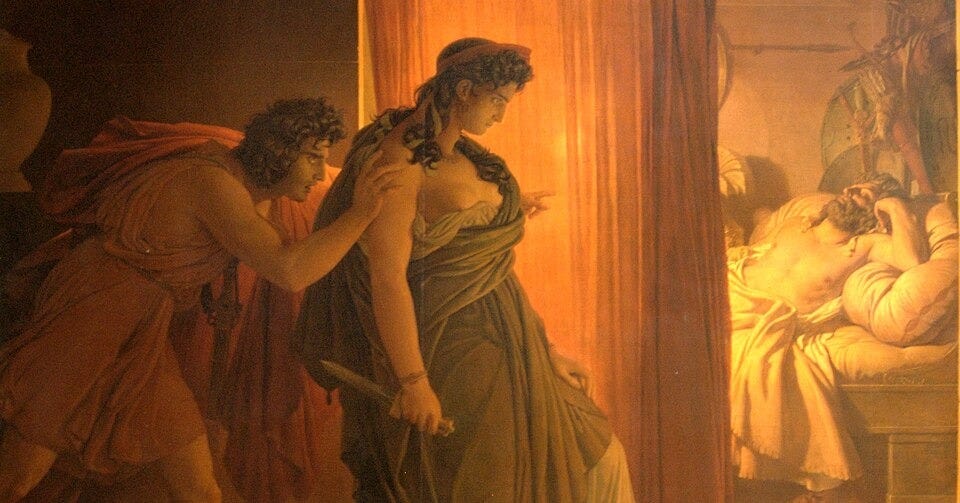
The story of Orestes provides a constant parallel to the entire Odyssey narrative. In short, when Agamemnon returned home, he was murdered by his wife, Clytemnestra, and her new lover, Aegisthus. Orestes, Agamemnon’s son, was called upon to be the blood avenger who seeks justice on behalf of his murder father. Orestes kills Aegisthus but also his own mother, Clytemnestra. As stated in Book 1 of the Odyssey, Aegisthus (and Clytemnestra) acted contrary to the gods, and Orestes killed them as the blood avenger for his father.
The parallels are clear.
Odysseus, like Agamemnon, is the hero from Troy returning to a home he has not seen in twenty years. Telemachus, like Orestes, must be faithful to his father and aid him in what is just. Penelope, like Clytemnestra, will be tested by suitors and must show her fidelity.
But many miss the other implication of the parallel—if Penelope impedes Odysseus’ homecoming, Telemachus must do what Orestes did and kill his own mother.
Again, here at the outset of the Odyssey, Penelope seems expendable. She is not a necessary part of Odysseus’ glorious homecoming. She can be married to someone else. She may even have to be killed.
But Homer is a master teacher.
He offers you images in tension, a poetic dialectic, that juxtaposes poetic descriptions. Why? Because in the tension is the answer.
And Penelope is a character in tension.
Yet within the beautiful complexity that is Penelope, there is a subtle lesson at the heart of the entire virtue tradition of Western civilization.
It is a lesson that shows Homer’s brilliance.
It is a lesson that requires you to understand the purpose of your life.