



Antigone, the character, is called the “dark signs of the gods.” If you were going to read any ancient Greek play, it would be Antigone. It is a masterwork on piety, justice, and the nature of the divine. It is one of the best dramas in Western civilization.
And if you want to know why Ascend reads Antigone before Oedipus Rex, see below.
Resources to help you read Antigone well:
Video Discussions on Antigone (below)
Antigone is often the first great book new small groups will elect to read, because the short text is packed with human drama and commentary on man’s place in the cosmos—it draws opinions out of people on how the cosmos should be ordered.
Join our reading group and study the great books with us!
To support our mission and get all our resources, become a paid book club member. In addition to the weekly podcast, you’ll get:
Live book club discussions / Q&A with Dcn. Garlick & guest scholars
In-depth reading guides and essays to lead you through the great books
Access to our incredible community of readers
The full archive of members-only content (guides, essays, and podcasts)
Introductory Letter by Dcn. Garlick
Dear Supporters of Ascend,
Antigone is my favorite Greek play. It is a compelling invitation to wrestle with perennial questions on piety, justice, and the cosmic whole. I fell in love with the character of Antigone—beauty with an adamantine will. Yet, as I’ve come to the text time and time again, I have allowed myself to see her flaws and feel the heartbreak of despair.
Set in a Thebes reeling from civil war, the play pits Antigone’s defiant act to bury her brother, Polyneices, against Creon’s decree to leave him unburied as a traitor to the polis. This guide focuses on a hierarchy of piety that reveals a set of obligations to gods, city, and family—creating an ordered, cosmic whole. Sophocles brilliantly sets these in tension with one another and shows the chaos that occurs when one part of the cosmos is not aligned with the others. Both Antigone and Creon undergo transformations—and each reveals something about the nature of justice and the divine. Which character, however, is the true hero of the work is something of a debate.
Antigone remains at the heart of Western civilization, as its drama presents a nascent pedagogy on justice, law, eros, piety, and even natural law. The lessons of Sophocles the teacher are quite antecedent to both Plato and Christ. I am indebted to Dr. Frank Grabowski and Mr. David Niles for being such good interlocutors and helping me to see the rich treasury that is Antigone.
Amongst the death and heartache, Antigone reveals an important lesson to us about wisdom and the cosmos. Like Aeschylus, Sophocles presents characters that must suffer into truth. May their suffering be pedagogical to us and take us by the hand into all that is true, good, and beautiful.
In Christ,
Dcn. Garlick

Why Read Antigone First?
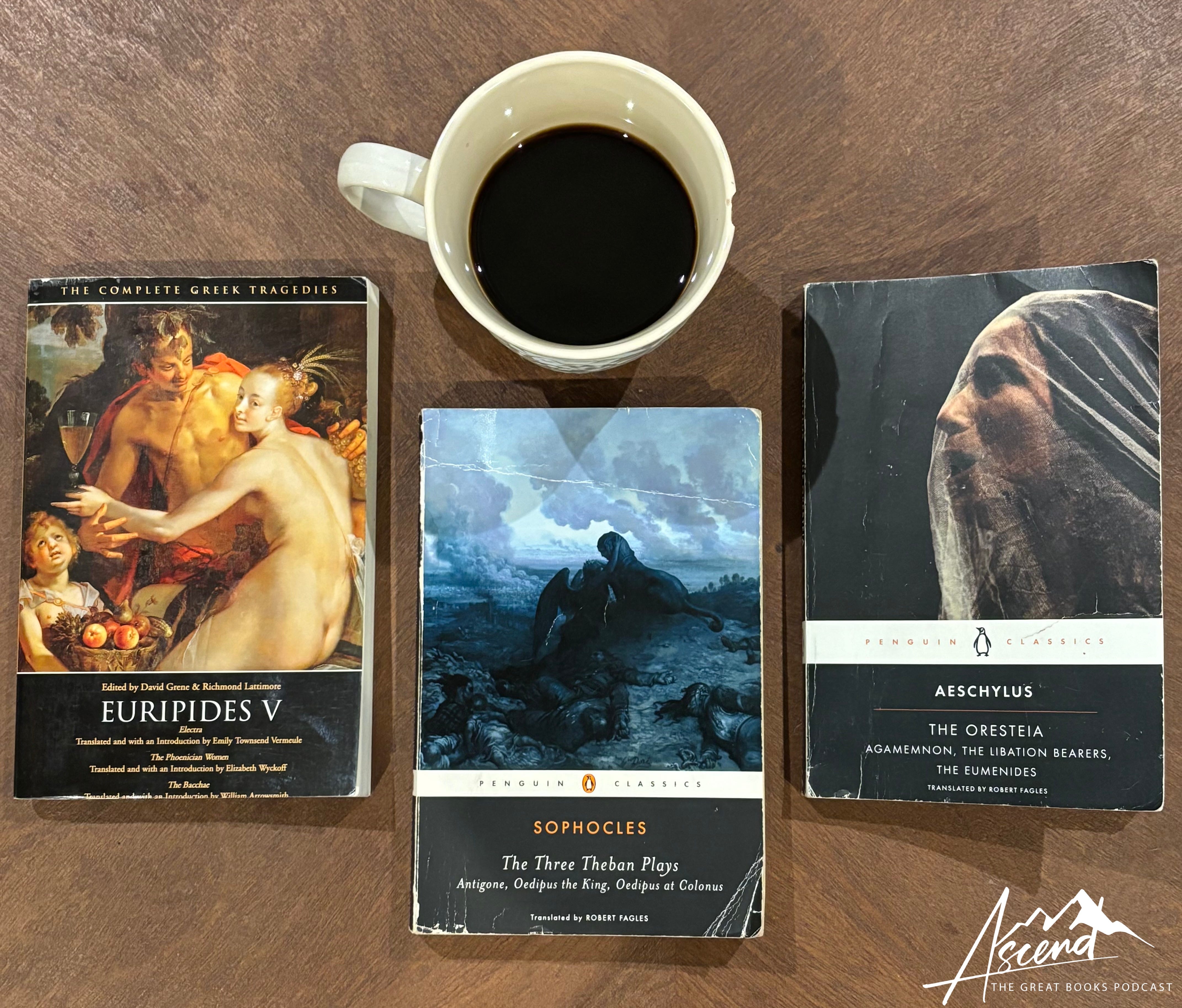
Antigone was written around 441 BC, making it the second oldest surviving play by Sophocles, likely preceded by Ajax. Although it is the final story in the chronological narrative of the Oedipus cycle (aka the Theban plays), it was the first of the three plays written by Sophocles. It should be read first, in the so-called publication order, rather than the chronological order, as Sophocles did not write the plays as a unified trilogy like Aeschylus’ Oresteia. Instead, he wrote them over his lifetime, and reading them in publication order (Antigone, Oedipus the King, Oedipus at Colonus) allows the reader to trace the development of Sophocles’ own philosophical ideas. To wit, the reader matures alongside Sophocles. To read Antigone last is a bit jarring, as though it represents the end of the narrative, it represents the most immature expression of Sophocles’ themes of suffering and justice. The ideas in Antigone appear more “raw and undefined” but become “more clarified and mature” in the latter two plays.[1]
Video Discussions
Good work! The next reading is the follow up to Antigone, Sophocles’ Oedipus Rex. It is the first part of the story chronologically speaking, as Sophocles returns to the themes of suffering and blessing. Aristotle called Oedipus Rex the best of the Greek tragedies. And remember… Sophocles did not write these as a triad, like the Oresteia, he wrote them as three individual plays over his lifetime. So, we read them as he wrote them to better track his intellectual maturation.
Keep it up.
You can read the great books with Ascend.
Dcn. Harrison Garlick lives in rural Oklahoma with his wife and five children. He serves as a deacon at Holy Family Cathedral and as Chancellor & General Counsel for the Roman Catholic Diocese of Tulsa. Follow him on X at Dcn. Garlick or Ascend.
[1] For a parallel, this same issue is present in C.S. Lewis’ The Chronicles of Narnia, as modern boxsets now number the books according to dramatic order and not publication order.