


The Euthyphro is a beautiful dialogue. It is about piety—a subject alien to our modern imaginations. It is a dialogue that stretches our own presuppositions and challenges us to take seriously the question of the gods and their nature. The most famous aspect of the dialogue is the so-called “Euthyphro dilemma,” which asks whether the gods adhere to an objective standard of piety or whether piety is whatever the gods will. The dilemma, however, is not limited to piety but presents a fundamental contrast between those who believe truth is objective versus those who believe it is subjective.
Overall, the Euthyphro appears simple (and because it is often the first dialogue many persons read) but it has layers—and the question Plato raises about the nature of the divine poses a challenge to not only ancient Greek polytheism but to Christianity as well—a challenge Christians would do well to explore and consider.
Here are the Ascend Book Club materials to help you read:
Detailed Q&A guide with introductions, outline, and more on Euthyphro
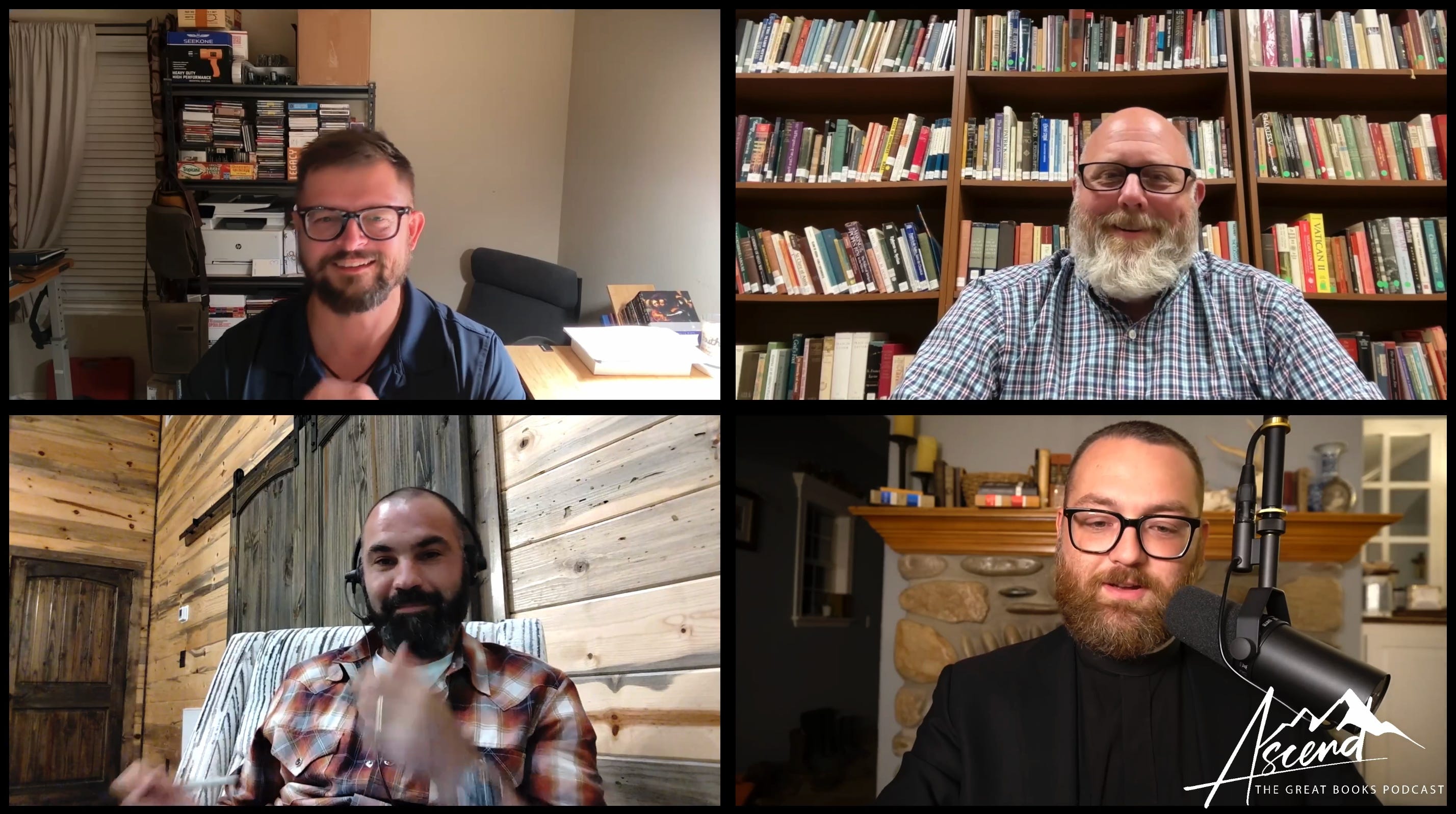
Two excellent videos with conversations exploring the Euthyphro (below)
BONUS video: Dr. Prudlo on Aquinas and the Euthyphro dilemma (below)
“Why do we call God good?” an article on the Euthyphro dilemma
The discussions and the conversation on Euthyphro and Aquinas are both available as podcasts.
Join our reading group and study the great books with us!
To support our mission and get all our resources, become a paid book club member. In addition to the weekly podcast, you’ll get:
Live book club discussions / Q&A with Dcn. Garlick & guest scholars
In-depth reading guides and essays to lead you through the great books
Access to our incredible community of readers
The full archive of members-only content (guides, essays, and podcasts)

Introduction
“One cannot settle any Platonic question of any consequence by simply quoting Plato.”
Leo Strauss[1]
Dear Ascend Book Club Members,
The Euthyphro is a beautiful dialogue. It is about piety—a subject alien to our modern imaginations. It is a dialogue that stretches our own presuppositions and challenges us to take seriously the question of the gods and their nature. The most famous aspect of the dialogue is the so-called “Euthyphro dilemma,” which asks whether the gods adhere to an objective standard of piety or whether piety is whatever the gods will. The dilemma, however, is not limited to piety but presents a fundamental contrast between a metaphysical realism and a voluntaristic view. It is a dilemma at the center of many of our cultural debates.
As always, I am indebted to those who helped me through the dialogue, like Dr. Frank Grabowski, Thomas Lackey, and Dr. Joey Spencer. I remain in debt to the men in my Sunday Great Books group and to the good men in the diaconate formation program. Reading the great books alongside kindred souls is a tremendous joy.
The character of Euthyphro merits much attention. He presents as dull and unorthodox, and many question why Plato selected him for the interlocutor—but we must always remember that an idiot in the hands of Plato can teach us a lot. He arguably has intuitions that make him open philosophy, and in this way he embodies the reader, the student of philosophy, and our challenges in accepting the truth.
Plato is philosophy. The Euthyphro is one of the most famous dialogues, and it is certainly worth your time and attention.
May we come to understand true piety.
In Christ,
Dcn. Harrison Garlick
Discussions on Plato’s Euthyphro
BONUS: Aquinas and the Euthyphro Dilemma
How would a Christian answer the Euthyphro dilemma? Today on Ascend: The Great Books Podcast, Dcn. Harrison Garlick is joined by Dr. Donald Prudlo, the Warren Professor of Catholic Studies at the University of Tulsa, to discuss Aquinas and the Euthyphro dilemma.
Great work! Reading and working through the Euthyphro is an excellent accomplishment. We continue in the narrative of Socrates’ last days by turning to one of the most famous speeches in Western history, Plato’s Apology.
Dcn. Harrison Garlick lives in rural Oklahoma with his wife and five children. He serves as a deacon at Holy Family Cathedral and as Chancellor & General Counsel for the Roman Catholic Diocese of Tulsa. Follow him on X at Dcn. Garlick or Ascend.
[1] Kerber, Hannes, and Svetozar Y. Minkov, eds. Leo Strauss on Plato’s Euthyphro: The 1948 Notebook, with Lectures and Critical Writings (University Park, PA: Pennsylvania State University Press, 2023), 81. The book is tremendous and is highly recommended.